
Wednesday’s edition of the daily word game that has consumed the morning routines of millions arrives with a set of four answers that are individually ordinary, collectively deceptive, and structurally engineered to punish overconfidence. Game #1577, playable on the official Merriam-Webster game page, asks players to solve TEDDY, MINUS, TRULY, and STARK within nine shared guesses across four simultaneous grids. The words sound simple enough in isolation. Together, they form one of the more psychologically tricky midweek puzzles of the month.
What Is Quordle and How Does It Work
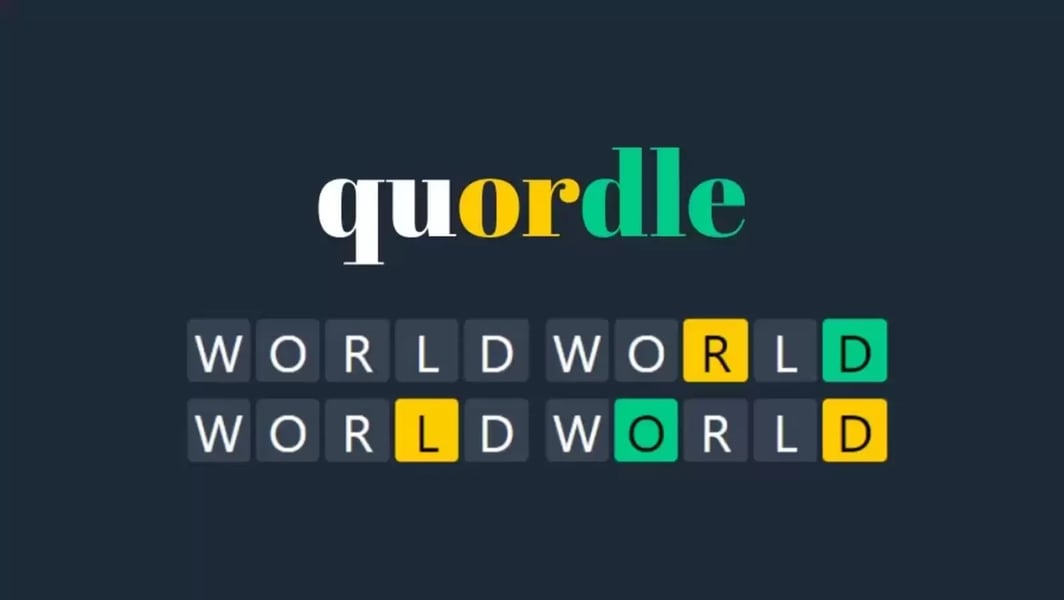
Quordle is a daily word puzzle developed by Freddie Meyer in 2022 as a more demanding evolution of the single-grid format popularized by Wordle. The premise is elegant and brutal in equal measure: players receive nine attempts to identify four separate five-letter words, with each guess applying simultaneously to all four grids. A green tile confirms a correct letter in the correct position. A yellow tile means the letter exists in the word but belongs elsewhere. A gray tile eliminates the letter entirely. The cascade of information across four boards at once is what separates skilled solvers from frustrated ones. The game was acquired by Merriam-Webster in January 2023, and its word pool has since been curated to reflect real, functional English vocabulary rather than obscure or archaic entries.
Quordle Hints for May 20, 2026 Before You Scroll
If you want to preserve your streak without surrendering the solve entirely, these calibrated hints are designed to guide without collapsing the puzzle. Two of the four answers share the same starting letter, T, which means early guesses with strong T-coverage will pay dividends across multiple grids at once. One word contains a doubled letter, a DD combination that sits in the middle of the word and is easy to miss on early passes. One answer is a common mathematical term with a distinctive vowel pairing that narrows the board quickly. One word is a single-vowel adjective, compact and clean in structure. One answer is an emphatic adverb derived from Old English, ending in Y, that shares its first letter with the doubled-letter word and will draw players into T—Y pattern confusion across boards three and four. The most consequential trap in today’s puzzle is that two words begin with T and end with Y, forcing solvers to correctly assign each pattern to the right grid before the final guesses arrive.
Full Quordle Answers for Wednesday, May 20, 2026
The four confirmed answers for today’s Quordle puzzle, Game #1577, are as follows.
TEDDY sits in the top-left grid. It is a noun functioning as a diminutive form of the names Edward and Theodore, historically attached to President Theodore Roosevelt following a 1902 hunting trip during which he declined to shoot a captive bear cub. That refusal gave rise to the stuffed toy bearing his nickname. The word carries one doubled letter, the DD in its center, which makes it a structural trap for players who have already accepted that doubled letters may not be present. The E is the sole vowel, sitting in position two.
MINUS occupies the top-right grid. It arrives from the Latin word meaning “less,” the comparative form of the adjective for small, and entered formal English usage in the fifteenth century as a mathematical indicator of subtraction or negative quantity. In contemporary usage, it also serves informally to mean “lacking” or “without.” Its vowel pairing, I in position two and U in position four, is distinctive enough that a strong opening guess will identify both quickly. MINUS is the easiest entry point in today’s puzzle and the grid where players are most likely to bank their first confirmed solve.
TRULY holds the bottom-left position. The adverb descends from Middle English and Old English roots meaning “faithfully” or “trustworthily,” built from the root word for “true” with the standard adverbial suffix attached. It is one of English’s more emphatic sincerity markers. The structural danger here is not complexity but proximity: TRULY and TEDDY share the same first letter and the same final letter. Players managing both grids simultaneously under pressure are liable to mix up T—Y assignments in later guesses, especially after committing early to one pattern.
STARK closes the set in the bottom-right grid. It is a five-letter adjective meaning severe, bare, or complete in a way that allows no qualification, commonly used to describe unadorned landscapes, harsh realities, or absolute contrasts. Its single vowel, A in position three, makes it phonetically compact and structurally minimalist. STARK is among the cleaner solves of the day once the vowel is locked, though players who have burned guesses on the T—Y confusion in the upper grids may arrive here with limited attempts remaining.
Puzzle Difficulty Analysis for Game #1577
Wednesday’s Quordle sits in a medium difficulty bracket by the standards of recent puzzles. The vocabulary is entirely accessible, with no archaic spellings, no unusual proper-noun adjacency, and no consonant clusters that resist standard opener logic. The difficulty is structural rather than lexical. The double-T opening, the shared T and Y endings across two separate grids, and the single doubled letter inside TEDDY create a three-layer trap that compounds across guesses rather than presenting itself cleanly at the start.
Compared to Monday’s Quordle puzzle, which asked players to navigate CLANK, SWINE, STEAM, and DRAPE under consonant-cluster pressure, today’s set is more manageable in terms of raw letter difficulty but more treacherous in terms of assignment logic. The experience of the May 16 puzzle, which involved repetition traps inside DEMUR, THREE, SLEEP, and CRUDE, is the closer analogue: familiar words arranged to create inter-grid confusion that punishes players who treat the four grids as independent systems.
Quordle Sequence Mode: Today’s Hints and Approach
Quordle Sequence mode changes the solving architecture by revealing words one at a time rather than requiring all four to be solved simultaneously. Players receive ten attempts in this format rather than nine, and the sequential reveal allows for more targeted letter elimination as the session advances. Today’s sequence set rewards players who use their first three guesses to maximize distinct letter coverage before committing to directional solves. High-vowel openers paired with strong consonant coverage guesses will expose the board cleanly by the midpoint of the attempt count.
Sequence mode has become an increasingly popular entry point for players new to the Quordle game format, offering the multi-grid experience with slightly reduced cognitive pressure. The pattern logic in today’s sequence board aligns with the structural approach seen in Game #1571 earlier this month, where players who prioritized consonant mapping over vowel assumptions consistently retained more flexibility in their final turns.
Streak Preservation Strategy for Today’s Grid
Experienced players approaching Game #1577 should treat MINUS as a first-target solve. Its distinctive I and U vowel pair, combined with its straightforward consonant frame, makes it the fastest grid to eliminate. Banking an early confirmed word reduces the cognitive load on the remaining three boards and frees up guesses for the more demanding T—Y disambiguation that TEDDY and TRULY require.
STARK is best approached through its A vowel position rather than through its S opening, since S is a high-frequency starting letter that may appear across multiple early guesses without providing specific placement data. Anchoring on the A in position three will lock the grid efficiently. TEDDY requires players to remain open to doubled consonants throughout the solve; the DD combination is the most common missed element in today’s session, and players who rule out doubled letters after a clean early board read will waste at least one attempt before correcting the assumption.
This structural discipline mirrors the principles that carried consistent solvers through the May 12 session, where AGLOW, AVAIL, BADLY, and STING demanded vowel-heavy opening coverage and careful consonant assignment to avoid late-stage collapse.
Recent Quordle Answer History: May 2026
The puzzle calendar for May 2026 has delivered a consistent pattern of structurally demanding grids built around common vocabulary. The May 13 puzzle pushed players into vowel traps across SKUNK, CHAFE, INTER, and SOOTH, rewarding those who prioritized consonant mapping from the start. Game #1567 on May 10 delivered one of the month’s most discussed sessions, a board that looked manageable through five guesses and then collapsed streaks worldwide through dense consonant clusters and psychologically misleading letter patterns. The trajectory across the month confirms a deliberate design philosophy: difficulty engineered through structure rather than vocabulary rarity.
About Quordle on Merriam-Webster
Since its arrival on the Merriam-Webster platform, the Quordle daily word game has operated with a curated word list drawn directly from dictionary data, ensuring that each solution is a real, commonly used English word with a traceable definition and usage history. The integration allows players to access the full Merriam-Webster definition for each answer after the session ends, turning a competitive puzzle into a minor vocabulary event. The game resets at midnight every day, and new puzzles are shared simultaneously by players across the United States, the United Kingdom, Australia, Canada, and India, generating a daily global conversation around four words that most solvers will not have anticipated when they woke up. Wednesday’s four, TEDDY, MINUS, TRULY, and STARK, will be gone by midnight. Tomorrow brings a fresh grid, and with it, four new words to chase.