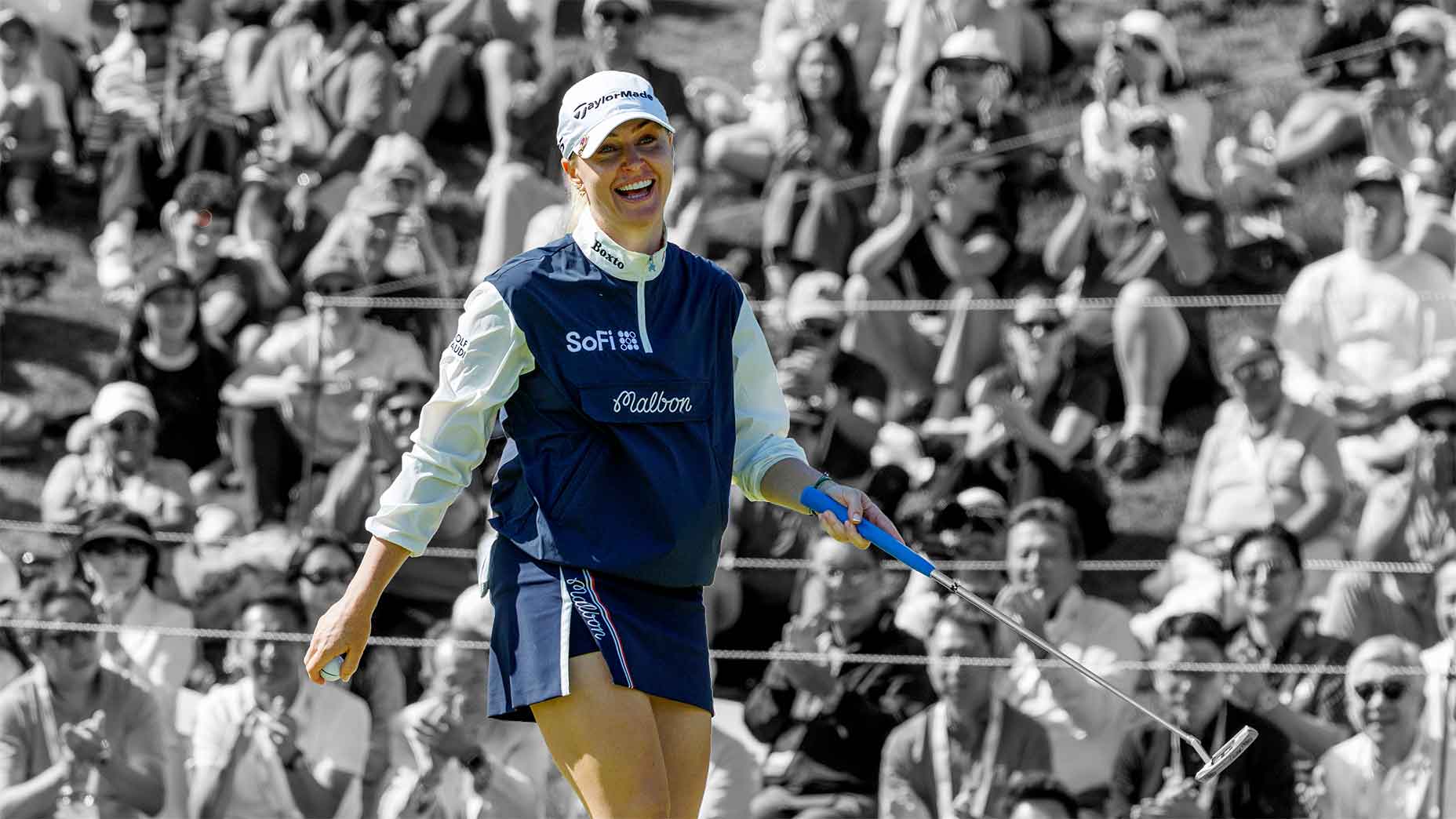

PACIFIC PALISADES, Calif. — She had just seized the solo lead at a U.S. Open when she stopped to sign a few flags.
Not after the round. Not on the way to the scoring tent. Mid-round, steps off the 11th green, while eight under par and with more golf left to play. Charley Hull saw the people who wanted her signature and decided, in the middle of a major championship, that they were going to get it. Then she looked up at the leaderboard and decided eight under was not quite enough.
That is Charley Hull in full. You cannot prepare for her. You can only watch.
What unfolded over the final 36 holes at Riviera Country Club on Saturday and Sunday was the kind of weekend that the LPGA Tour should be bottling. Hull came into the tournament outside the top 40, having shot rounds of 73 and 72 to sit seven strokes off the lead at the halfway mark. The field had largely written her off. Hull had not written off herself. On Saturday, she posted a 6-under 65 — the lowest score of her major career, the lowest of the week — and arrived at Sunday’s final round three shots behind co-leaders Nelly Korda and Sei Young Kim with a specific operating philosophy. Two words: “F—k it.”
“Today was ‘F—k it,’ pretty much,” Hull told reporters Sunday evening. “Just go for it, you know what I mean?”
She eagled the first hole of the final round. She birdied the third. By the time she reached the back nine, she was briefly leading a U.S. Women’s Open. In front of a packed Sunday gallery, Hull’s play was a live argument against caution, against managed expectations, against the quiet corporate professionalism that sometimes makes elite golf feel like a Q3 earnings call. She plays golf the way most people wish they could — with the audacity of someone who genuinely believes the next shot is going in.

The result, in the end, was a tie for second with Mexico’s Gaby Lopez — seven under par, one shot behind Nelly Korda, who birdied the par-five 17th to pull away from a four-way tie at the top. Hull described the outcome as frustrating and “pretty annoying.” That is an accurate accounting of where the week landed. But frustration at the result and regret about the approach are not the same thing. Hull made that distinction explicit. She said she has no intention of playing differently. If anything, she said she intends to engage the attack mindset earlier next time.
“If you always aim super, super high and you just come short, you’re still going to do really well,” she said. “Like big expectations. If I’d have thought, ‘Oh, seven [under] is going to win,’ I’d probably finish five [under].”
The logic is genuine and it is also revealing. Hull’s self-awareness about how she functions as a competitor is unusually clear. She knows she needs the ceiling to be high in order to produce. She knows she is motivated by closing speed rather than front-running. She has spent her career proving both. Her third round on Saturday climbed from a position where most players would have been playing for the cut cheque. By Sunday afternoon she was signing autographs while holding the lead.
The contrast with Korda is part of what made this weekend so watchable. Where Hull is all surface — every thought landing immediately on her face or out of her mouth — Korda is contained. When Korda drops an expletive it comes quietly, after a bad shot, mostly absorbed by the gallery. Hull says the same word gleefully into a microphone after being asked about her game plan. Korda was raised by two professional athletes and spent her teenage years at the IMG Academy in Bradenton. Hull quit school at 13 and turned professional at 16. Korda’s preparation for a major is methodical and documented; her sister Jessica cadded for her at Riviera, part of a deliberate plan to win a championship she had dreamt about since childhood. Hull’s preparation included taking her cousin Jodie to Malibu, braving the traffic on Sunset Boulevard for Mexican food at a hill restaurant with a view of Los Angeles, and arriving Sunday morning with the same instructions she had given herself the day before.
These are not competing philosophies in the sense that one is obviously superior. Korda won. But the sport needs both. The women’s game has a presenting challenge that is separate from the quality of play: the difficulty of making casual sports fans care about tournaments they might not seek out. Hull removes that difficulty. You watch because you want to know what she is going to do. She went from tied 45th to tied second in two days. She was signing autographs while holding the solo lead. She nearly aced the par-three sixth in the final round. She told reporters her two-day strategy was four letters long. You watch.
This was her fifth runner-up finish in a major, the fifth time she has come within reach of a first title and not held on. That sequence — the 2016 ANA Inspiration, the 2023 AIG Women’s Open at Walton Heath, Pebble Beach that same year, the 2025 AIG Women’s Open at Royal Porthcawl, and now Riviera — is the part of Hull’s record that gets treated as a problem. It may eventually become one. There is no guarantee that aggressiveness alone converts into a major. There are players who have attacked relentlessly and spent decades without the right result to show for it. The KPMG Women’s PGA Championship at Hazeltine comes in three weeks and after that, the Evian Championship and the AIG Women’s Open. Hull will be the favourite in all three rooms when Sunday afternoon rolls around, with 36 holes left to play and a lead to chase.
That night at Riviera, Hull and her cousin watched Korda’s winning putt finish on a television in a back room of the clubhouse — the ball circling the cup before dropping in. “It’s just,” Jodie said, “you feel sick.”
Hull’s record at the majors is 12 top-ten finishes and five runner-ups without a win. The five second-place finishes tie her for the most runner-up finishes at majors by any player since 2015, a group that includes Rory McIlroy and Brooks Koepka. The company is not a consolation. It is a measure of how consistently Hull produces when the stakes are highest. “It’s not over until the fat lady sings,” she told reporters who had written her off after two rounds of over-par golf. By Monday morning she had proven that, again, emphatically. Whether the chapter ends differently the next time is the question the sport is asking. Hull’s answer, as always, is to swing harder.
The next women’s major, the KPMG Women’s PGA Championship, is scheduled for June 25–28 at Hazeltine National Golf Club in Minnesota. Hull will be there, aiming at the flag, telling anyone who asks that the ceiling is as high as she wants it to be. And the cameras will follow.