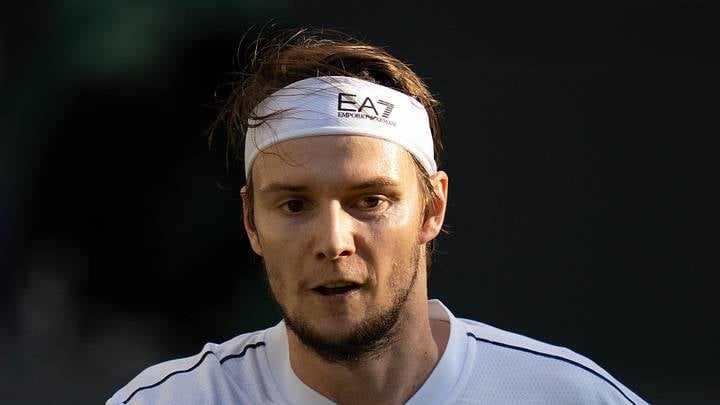

KITZBUHEL – The drop shot landed a foot inside the service line, spinning away from Facundo Diaz Acosta before the Argentine could close on it, and Alexander Bublik pumped his fist toward the thin mountain air. The moment, arriving at 6-5 in the second set, sealed a 6-3, 7-5 victory for the top seed at the Generali Open on Thursday and gave the Kazakh breathing room in a draw that has been shedding favorites since opening day.
Bublik needed 90 minutes to dispatch Diaz Acosta on the red clay courts in the Austrian Alps, his serve dominant enough to suppress a game opponent who found no traction on the Kazakh’s second delivery. Diaz Acosta converted just 18 percent of second-serve points, a figure that amounts to a slow death for any returner trying to build a baseline rally.
The first set told two different stories at once. Bublik struck eight outright winners and committed precisely eight unforced errors, a zero-sum production line that nonetheless translated into a single break advantage and a 6-3 finish. The errors were the kind a player of his caliber files away as excess voltage. The winners were not accidents.
Diaz Acosta, ranked outside the top 80 this week, arrived in Kitzbuhel having made the quarterfinals in Hamburg earlier in July, carrying the form of a clay courter in full summer rhythm. That context made the second-serve return numbers more striking, not less. His footwork on approach was sound, but Bublik denied him the medium-paced rally ball that suits his grinding baseline style. Every time the Argentine settled into position for a backhand exchange, the drop shot cut through the point before it could develop.
The second set tightened as expected. Both players held serve with unusual efficiency through the first ten games, creating the kind of locked stalemate that requires a single error or a single precise strike to break open. Bublik generated that moment at 6-5, breaking Diaz Acosta for only the second time in the match and then serving out the victory.
The result sends Bublik into the quarterfinals of an event where the draw has opened considerably. The second seed, Henri Vacherot of France, and third seed Arthur Rinderknech, also French, both fell in the first round, clearing two of the most credible challengers before the tournament reached its fourth day. The early exits have left Bublik as the dominant presence in a bracket that now lacks its expected resistance.
His quarterfinal opponent comes from the match between Alexander Molcan of Slovakia and Germany’s Dominik Altmaier. Molcan, a clay specialist with a grinding retrieval game, represents the harder test on these courts. Altmaier’s left-handed serve creates problems for right-handed players reading ball flight off the baseline, but Molcan’s capacity to extend rallies past the point where Bublik’s patience, historically thin, begins to fray is the more consequential factor.
Bublik’s serve-first approach functions efficiently on a surface where red clay traditionally rewards baseliners over bigger servers. His first-serve percentage through Thursday’s match held above 65 percent for most of the contest, a figure that neutralizes clay’s inherent advantage for returners. Diaz Acosta found no margin to apply pressure on second-ball opportunities.
The drop shot, which Bublik deploys with greater frequency than almost any other player on tour, functioned as a second weapon. It pulled the Argentine out of position at the back of the court and into no-man’s land between the service line and the baseline. When Diaz Acosta anticipated the short ball and rushed forward, Bublik redirected the next shot into the open court. The pattern repeated often enough in the second set that Diaz Acosta appeared to lose certainty about whether to hold position or commit early to the net.
The ATP summer clay swing has produced unpredictable results across draws this season. Ben Shelton and Taylor Fritz reached an all-American Stuttgart final before the clay stretch began, with American players performing strongly in the weeks before Kitzbuhel. The Generali Open sits near the end of the clay calendar before the hard-court transition to Montreal, Cincinnati, and the US Open.
Clay performances in July generate form data but rarely predict New York outcomes, given how sharply the surfaces diverge. The grass season earlier this summer brought its own surprises, including the Wimbledon quarterfinal stage where Djokovic’s record wins became the central narrative, while the clay swing immediately following rewarded different physical profiles. Bublik reached the fourth round at the US Open in 2023, and his clay game this summer suggests he can threaten as the hard-court season begins.
Earlier in the grass season, Kamil Majchrzak reached the Den Bosch final against Daniil Medvedev, signaling that midtier players have been generating upsets at a higher rate than the top seeds would prefer. The Generali Open reinforces that pattern: when the second and third seeds exit the bracket before the round of sixteen, the title belongs to whoever holds steadiest under pressure in the quarterfinals.
For now, Bublik is through in Kitzbuhel, that drop shot still spinning away from the Argentine’s reach, the small crowd in the Austrian stadium watching a performance that was convincing when it needed to be and loose enough in between to suggest the quarterfinal carries more uncertainty than the scoreline shows.