
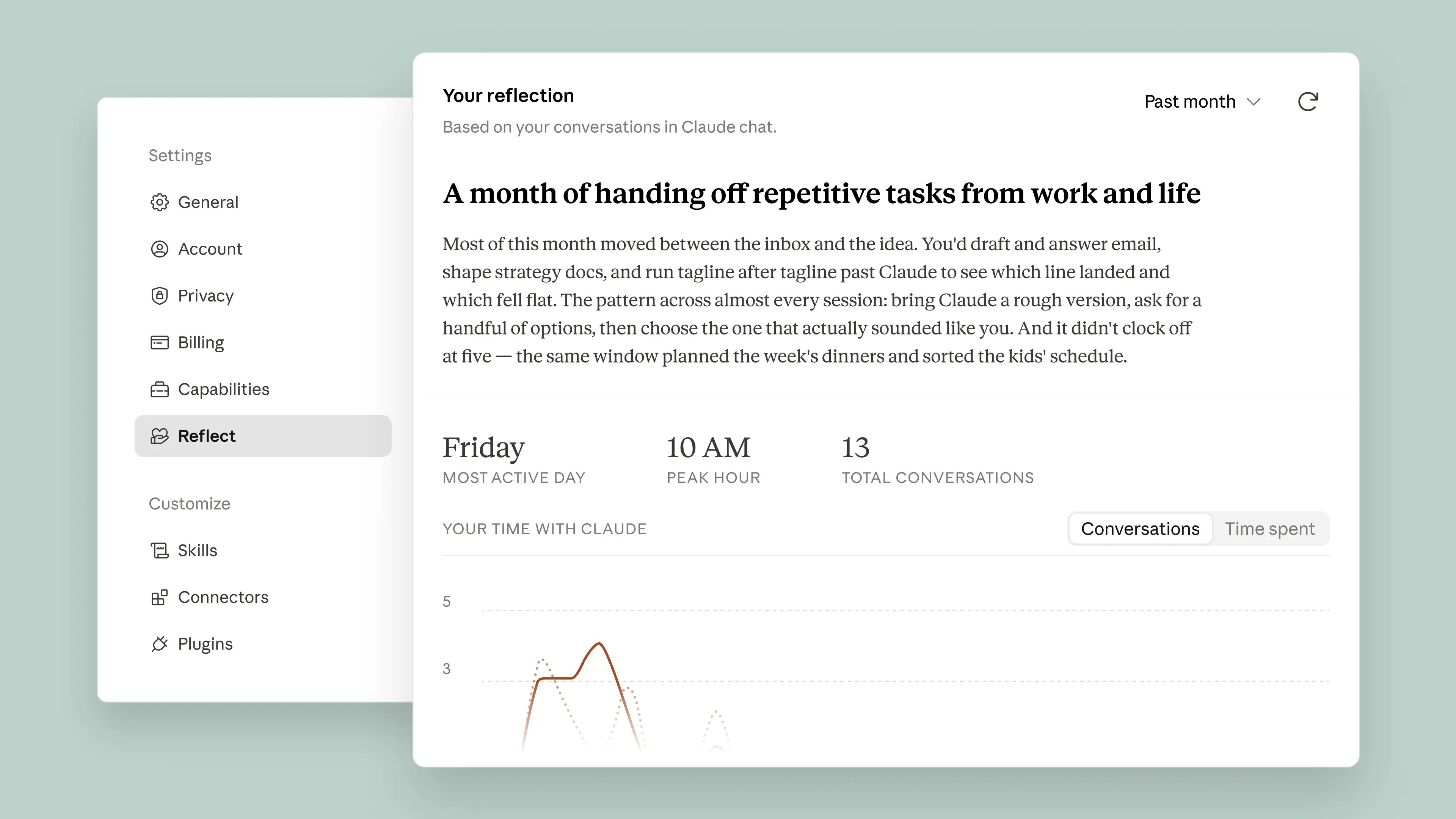
SAN FRANCISCO – A card appeared this week in some Claude users’ apps, uninvited and quietly placed. It offered a month’s worth of personal data: the topics they had raised most in conversations, the hours when they most often opened Claude, the categories their questions fell into. At the bottom sat a recommendation. Anthropic wanted them to try Projects.
The feature is called Reflect. It launched on July 9 in beta, available to Free, Pro, and Max subscribers who have Claude’s memory function turned on. TechCrunch reported the rollout, noting that the dashboard’s suggestion engine does not recommend competing AI tools. The company framed the launch as a step toward mindful technology use.
The closest parallel Anthropic offers is Gmail Meter, a third-party plugin from 2012 that gave users a report on their email behavior. The comparison is instructive in ways the company probably does not intend. Gmail Meter was a curiosity built by someone outside Google. Reflect was built by Anthropic, inside the product, and it comes with an agenda.
What Reflect surfaces: a breakdown of conversation themes organized into categories such as research, writing, personal queries, and technical questions, alongside the frequency and timing of usage. A “quiet hours” setting lets users schedule periods away from Claude. A break recommendation feature surfaces at regular intervals. Health-related conversations are excluded from the data, and the company says usage statistics are not fed into other product functions or shared externally.
That exclusion of health data is not incidental. Behavioral health data sits at the center of an active legal and regulatory debate about AI companies and what they can collect. Anthropic’s decision to carve it out suggests the company anticipated the question. Whether it represents a genuine privacy commitment or a preemptive legal posture is not answered by how the feature launched.
The recommendation engine is where Reflect’s commercial purpose becomes explicit. A user whose conversations cluster around long research projects gets steered toward Projects, Anthropic’s workspace tool for managing multi-session tasks with persistent context. There is no suggestion to try a competitor’s approach. The quiet hours feature sends its notification inside Claude. The break recommendation appears inside Claude. The exits are designed into the platform.
None of this makes Reflect malicious in intent. The data Anthropic is surfacing is genuinely useful to people who want to understand their relationship with AI. Knowing that you engage most heavily between midnight and 2 a.m., or that your questions trend toward professional anxiety more than technical problems, is actionable self-knowledge. The issue is who that knowledge serves more.
Anthropic has built its public identity around AI safety and responsible development. That positioning has always carried an internal tension: safety research is expensive, and the money comes from a product that needs users who return. Meta’s recent Muse Spark push and OpenAI’s continued expansion of ChatGPT into daily tasks have made this competitive pressure sharper in 2026. Reflect is the first Anthropic feature that addresses retention directly, rather than capability.
The platform lock-in argument is not subtle. If a user learns from Reflect that Claude is where they process difficult decisions, draft important communications, and research the things that matter most to them, switching to a competitor’s product carries a psychological cost that goes beyond technical preference. Usage data, framed as personal insight, becomes one more reason to stay.
The beta rolls out now. Users who prefer not to see their AI usage turned into a report can turn the feature off. Memory must be enabled, and memory is the feature that lets Claude retain context across sessions, accumulating exactly the kind of longitudinal data that makes Reflect possible. The two features are not separable by accident. Claude’s recent integrations with external platforms have deepened this pattern further.
Anthropic has not confirmed when Reflect will exit beta or whether it will become standard for all Claude users regardless of memory settings. The feature is quiet, small, and easy to dismiss. What it says about how AI companies are thinking about engagement is not.