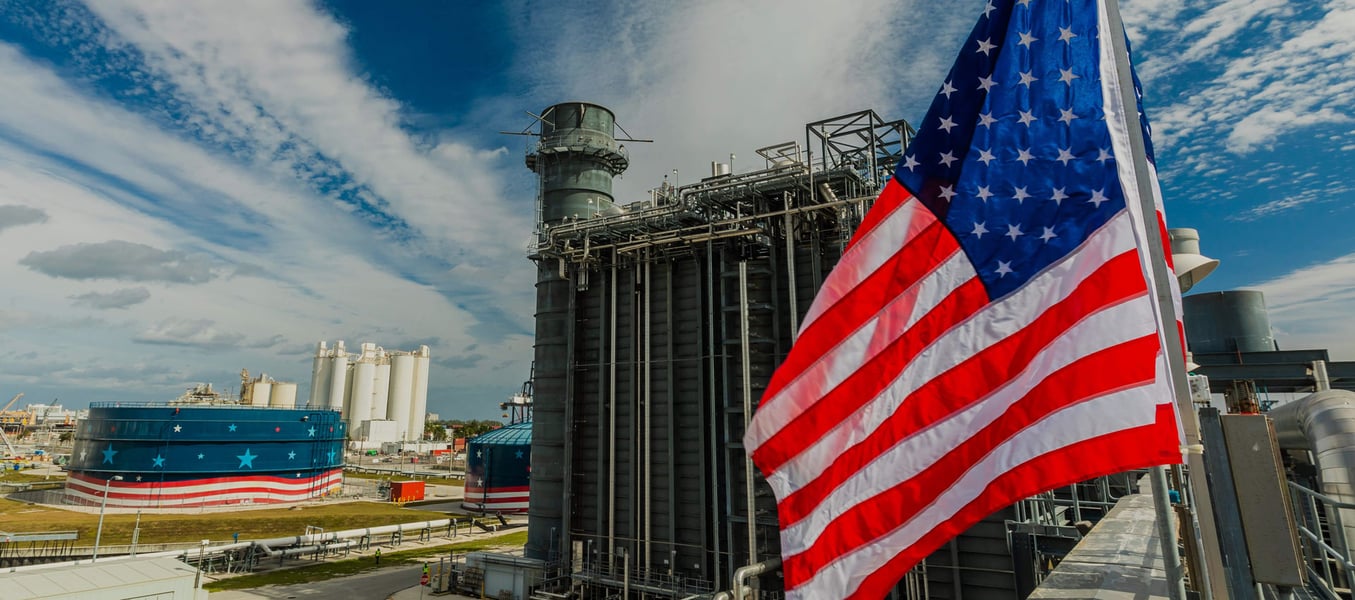

NEW YORK – The companies building artificial intelligence have not been building its power supply. That is about to change, and not through the hyperscalers.
NextEra Energy Inc. and Brookfield Asset Management Ltd. announced Wednesday a commitment to develop a data center campus with a total capital value of $100 billion, a figure that would make it the largest single AI infrastructure pledge announced by any entity outside the technology sector. For an industry whose hardware ambitions have long outpaced its ability to secure reliable electricity, the announcement marks the moment the energy infrastructure layer of the AI economy was formally claimed by a Florida utility and a Canadian asset manager rather than by the companies whose models are supposed to run on it.
The investment would unfold over multiple years. NextEra, which operates the largest renewable energy portfolio in the world and one of the largest nuclear fleets in the United States, would manage the power infrastructure. Brookfield, which oversees approximately $1 trillion in assets across infrastructure, renewable energy, and real estate, would contribute capital and development expertise. A confirmed location for the campus was not publicly disclosed Wednesday, nor was a precise timeline for the full build-out.
The partnership is structured around a straightforward premise: NextEra can build and operate power-generating and delivery infrastructure at a scale most utilities cannot match, and Brookfield can finance long-duration real assets with the kind of stable cash flows that institutional investors have sought for decades. Together they are offering something Microsoft Corp., Alphabet Inc., Amazon.com Inc., and Meta Platforms Inc. have each spent tens of billions trying to secure on their own: guaranteed power capacity for the workloads underpinning large language models, inference engines, and the processing systems that run every time a user queries an AI product. The Trump administration’s approval of NextEra’s development of up to 10 gigawatts of natural gas generation in Texas and Pennsylvania, announced earlier this year, suggests the company had been positioning for exactly this scale of demand well before Wednesday’s announcement.
A campus designed to serve multiple hyperscaler tenants runs not in megawatts but in gigawatts, a demand profile that rivals the peak consumption of mid-sized American cities. Governor Kathy Hochul, when imposing New York’s first-in-the-nation moratorium on large-scale AI data center construction, put the number plainly: a single large facility “consumes as much power as 50,000 homes,” as Fox Business reported. The political consequence of that demand is already concrete. Oregon passed the POWER Act, which took effect July 9, requiring data centers to absorb a 29 percent electricity rate increase so they pay their own way rather than shifting grid-infrastructure costs to residential customers, according to Fox Business. In that environment, a utility with NextEra’s regulatory relationships and generation capacity is a fundamentally different counterparty for a data center tenant than a developer starting from scratch.
The partnership has not named its anchor tenants. People close to the discussions described conversations as ongoing with several major technology companies, though no binding commercial agreements were disclosed Wednesday. The broader pattern is legible even without a named customer list. The largest AI companies have collectively pledged more than $300 billion in data center investment across the coming years, yet their ability to translate those pledges into operating capacity has repeatedly been constrained by the same variable. Earlier this month, AI infrastructure stocks fell sharply as markets questioned whether returns on data-center capital spending were materializing fast enough, with semiconductor stocks falling for a fourth consecutive session on the same doubts. The NextEra-Brookfield structure is, in part, a response to that capital allocation problem: let the infrastructure be owned by entities that value stable long-term yields, not technology growth multiples.

The structural argument behind the deal borrows from a template the wireless industry established in the early 2000s, when cellular carriers concluded that owning their own tower assets was an inefficient use of balance-sheet capital. American Tower Corp. and Crown Castle International became the infrastructure layer; AT&T Inc. and Verizon Communications Inc. became the tenants. Brookfield is betting the same disaggregation now applies to AI. Infrastructure assets carrying long-term contracted cash flows trade at yields that pension and endowment capital finds attractive. Technology company shares do not. Brookfield’s institutional investors hold capital with multi-decade time horizons; they are structurally better suited to own a multi-gigawatt campus generating contracted revenue over fifteen years than a technology company whose shareholders value quarterly growth in model capability and software revenue. What is being concentrated here is not just the physical capacity of AI but the ownership of it: control of the electrical layer of artificial intelligence is moving into private infrastructure capital, largely beyond public scrutiny.
The regulatory path from announcement to operating campus is neither short nor guaranteed. Grid interconnection queues at regional transmission operators in the United States routinely extend five to seven years. Environmental permitting in states with active utility commissions requires public hearings, needs-determination filings, and in some cases legislative approval for new large-load interconnections. NextEra’s pending combination with Dominion Energy, which would create the world’s largest regulated electric utility, provides regulatory relationships across multiple jurisdictions that a technology company filing its first interconnection application in an unfamiliar state simply does not have. Those relationships represent a real advantage in what Energy Secretary Chris Wright has cast as a national competitiveness question, arguing that restricting data center construction costs the United States ground in its AI race with China. The debate between that position and the consumer protection logic behind Oregon’s POWER Act and New York’s moratorium is not resolved, and the NextEra-Brookfield campus will navigate it directly.
What the announcement does not establish is the single fact that matters most to any company assessing whether to commit capacity as a tenant: whether NextEra and Brookfield hold signed power purchase agreements with investment-grade technology companies, or whether they hold a set of conversations still being evaluated as the construction timeline comes into focus. A $100 billion project carrying binding commitments from creditworthy counterparties is fundable at a cost consistent with Brookfield’s infrastructure portfolio. A $100 billion project still assembling its tenant base is a capital allocation decision of a different order entirely. That distinction was not publicly clarified Wednesday.
One way to read the $100 billion figure is as a measure of how quickly the energy gap beneath AI has widened. Three years ago, the binding constraint on AI deployment was compute: not enough chips, not enough GPUs. That problem drew more than $100 billion in investment from Nvidia Corp., TSMC, and the hyperscalers themselves, and it has not so much been resolved as it has been overtaken by the constraint behind it. NextEra and Brookfield are not forecasting that AI demand will grow. They are building as though the forecasts are already too conservative, and betting that when the power is ready, the tenants will not be hard to find.