
LISBON – Bonnie Tyler spent the better part of June in an intensive care unit in Portugal, fighting for her life after emergency surgery for a perforated intestine. She was placed in a medically-induced coma when she arrived. She never fully recovered. Tyler died on July 9 in a Portuguese hospital at age 75, NBC News reported.
She was the voice on “Total Eclipse of the Heart.” She was also the voice on “Holding Out for a Hero,” on “It’s a Heartache,” and on a discography spanning five decades that placed her in a cohort of dramatic pop vocalists not easily categorized and not easily forgotten.
“Total Eclipse” arrived in 1983 and made no attempt to fit conventional radio architecture. Written and produced by Jim Steinman, who had built Meat Loaf’s “Bat Out of Hell” on the same operatic principles five years earlier, the song ran close to six minutes and built to a choral climax that belonged in an arena rather than a three-minute slot. It topped the charts in the United States and the United Kingdom regardless. The song eventually accumulated over a billion streams, a figure that would have seemed incomprehensible in the London studio where Tyler recorded it.
She was not the only artist who recorded it. She was the one who made it irreplaceable. Her voice had a particular quality: a hoarse, almost serrated delivery that came partly from natural timbre and partly from a throat infection she sustained in 1976. That infection left her with nodules on her vocal cords and, eventually, one of the most recognizable sounds in popular music. Doctors initially recommended surgery to remove the nodules. Tyler declined. She sang through them instead and built a career on what the injury left behind.
The song’s cultural afterlife extended well past the charts. It appeared in television montages, wedding receptions, and a worldwide karaoke culture that treated it as communal property. Tyler did not find that reductive. She said she never tired of performing it: “I love it because everyone can’t wait to sing it.” That instinct for music that pulls an audience into the sound rather than simply playing at them was central to what made the song outlast its decade.
Her career extended far beyond that one song. She earned three Grammy nominations, released fourteen studio albums, and worked with producers across styles that never resolved cleanly into a single genre category. She was pop and rock simultaneously, built for commercial radio but constitutionally unable to fit neatly inside it. “It’s a Heartache,” her 1977 single, reached the top ten in both the United Kingdom and the United States before “Total Eclipse” arrived, evidence that the transatlantic appeal of her voice predated the Steinman collaboration.
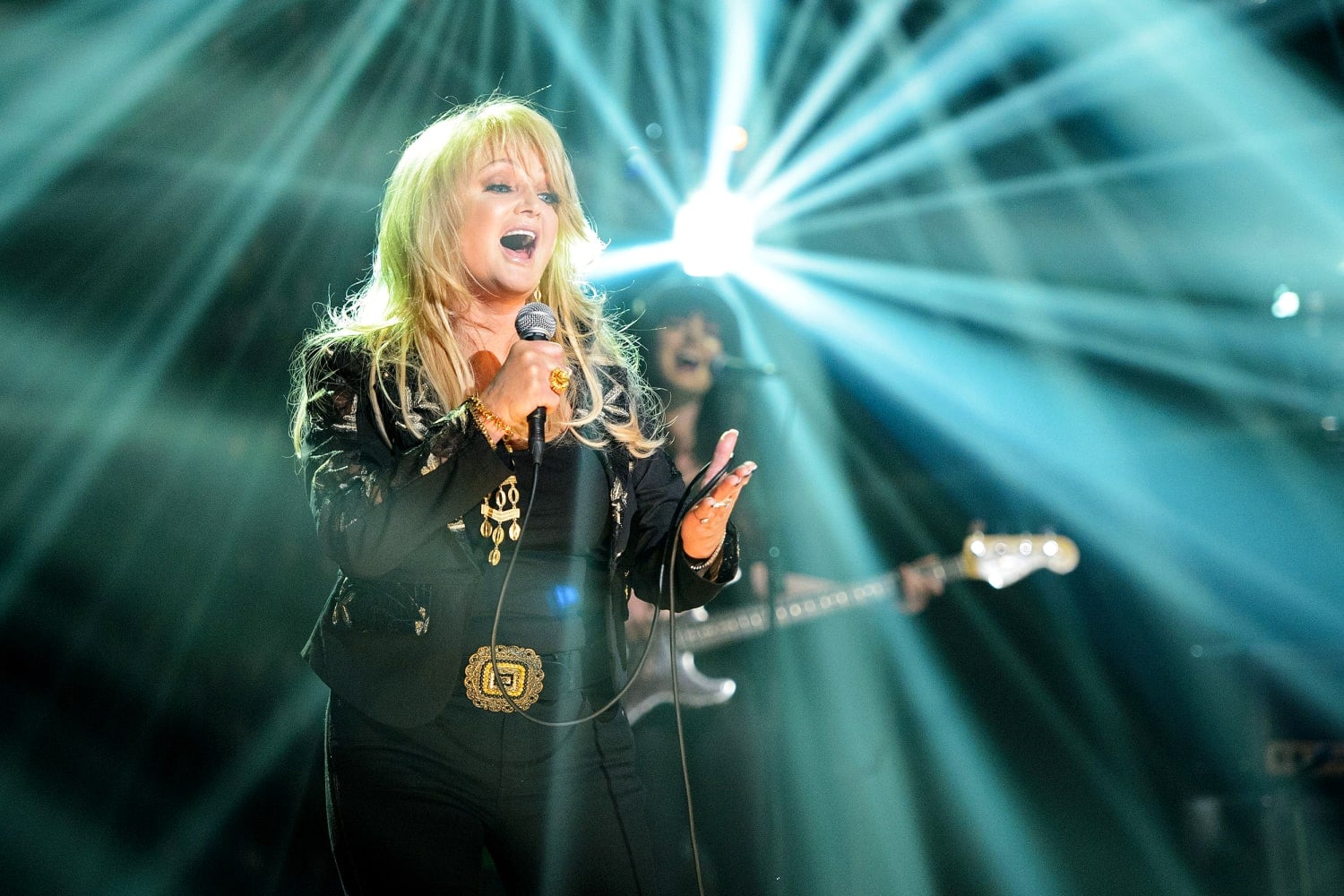
She represented Britain at the Eurovision Song Contest in 2013, performing “Believe in Me.” The appearance served as reintroduction to a generation that had discovered her through streaming catalogs rather than original airplay, and it reminded the industry of what it tends to forget about artists from that era: the voice was still there.
She received a medal of honor from Queen Elizabeth II in 2023, recognition that placed her among a generation of British and Welsh artists credited with shaping popular music rather than merely selling within it. Tyler was born Gaynor Hopkins in Skewen, a village in South Wales, in 1951. She spent much of her later life in Portugal, where she had a permanent home. It was there, far from South Wales, that she was hospitalized and where she died.
There was no indication, in the hours after her death was announced, of how her estate would be managed or whether a public memorial had been planned. The announcement came without the usual context of farewell tours or publicized illness: Tyler had gone into surgery in June, into a coma shortly after, and did not come back out.
Her contemporaries, who made the 1980s one of the strangest decades in the history of commercial music, a decade of excess and emotional volume where anthems apologized for nothing, will note her passing in the way that generation notes these things. The original cast is thinning.
Wales has continued to contribute to the music world in unexpected ways. Anthony Hopkins, born in Port Talbot, signed a classical music deal with Decca Classics at 88, with a debut album due in August. The country’s tradition of producing artists who exceed the categories assigned to them has not slowed.
Tyler was one of those. She never stopped touring. She never stopped performing “Total Eclipse of the Heart” with the ferocity of someone still trying to prove something. Whatever the nodules took, they gave back in full.