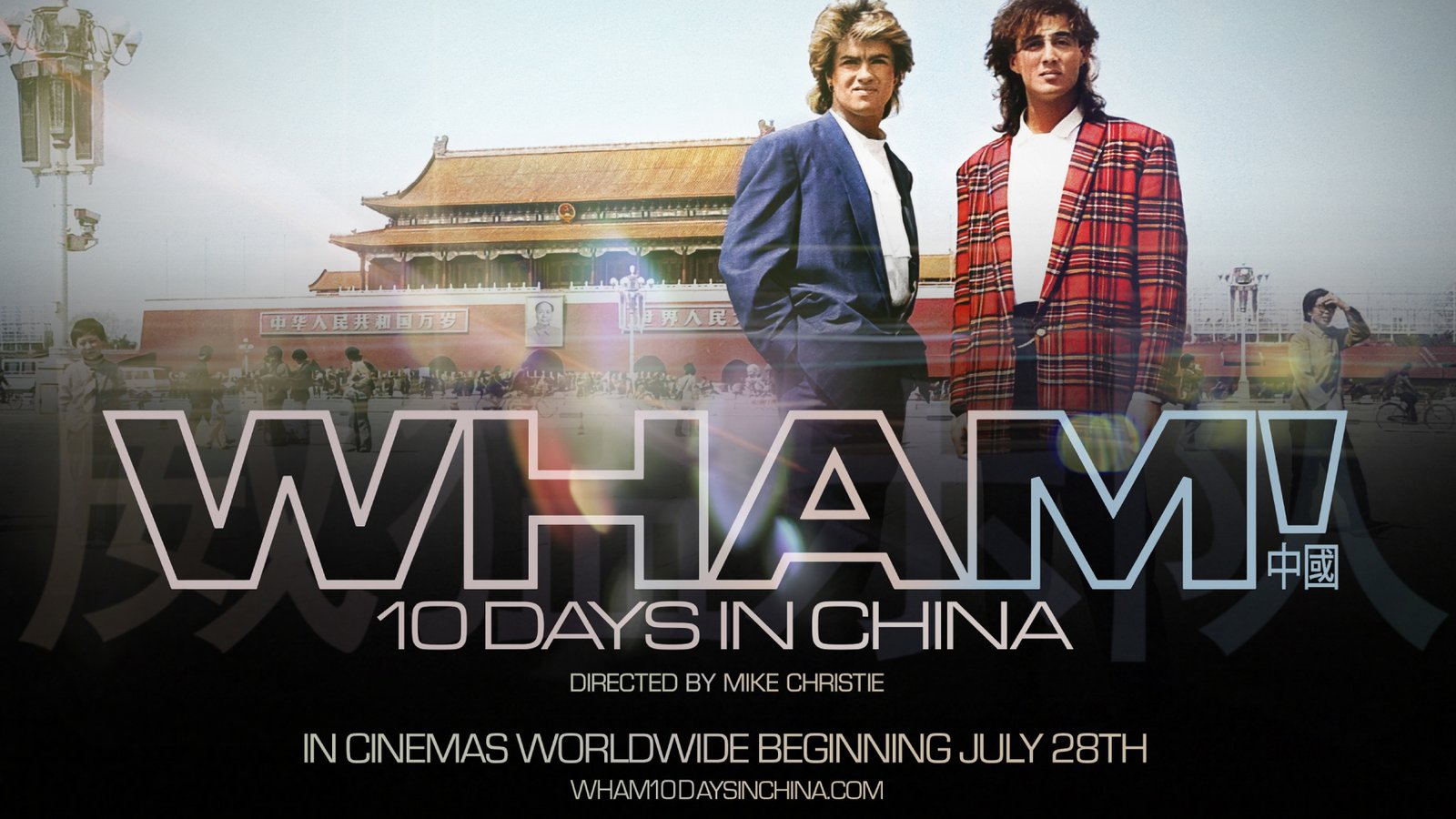

LONDON — George Michael told his manager in 1985 that Wham! would be the world’s number one group within a year. He delivered the line, manager Simon Napier-Bell later recalled, as though he were reading from a schedule that had already been agreed. The footage that would document his most audacious attempt to make good on it — ten days in China, Wham! performing in Beijing and Guangzhou as the first Western pop group ever to play in communist China — was shelved within months of being shot, and the world has not seen it publicly since.
Until Monday. Wham! 10 Days in China, directed by Mike Christie and produced by Sony Music Vision, played across 1,000 cinema screens in the United States, Britain, and Australia on July 28 in a one-day global theatrical event that gave a locked-away piece of cultural history its first real audience, forty-one years after the cameras stopped rolling. The film runs ninety minutes. It is distributed by Trafalgar Releasing, the company that has made one-day cinema events a workable model for archival and concert films.
The trip happened in April 1985. Wham! performed in Beijing on the 7th, then moved south to Guangzhou for a second show on the 10th. Napier-Bell has been candid about how the undertaking was sold. “No one there had ever heard of Wham!” he said in interviews surrounding the documentary’s release, acknowledging that the premise of a market to conquer was, as he put it, a complete fiction. What existed in its place was a theory: that the sheer improbability of two British pop stars turning up in the People’s Republic might generate the kind of international press attention that could break Wham! in America. Michael, specifically, needed that break.
The footage was commissioned as a fly-on-the-wall documentary by the band’s management, with Lindsay Anderson — the British director of If… and O Lucky Man!, and a recipient of the Academy Award — brought in to shape the material. Anderson and Wham! did not get along. His first cut emphasised Chinese daily life rather than the band’s performances and was rejected. A version re-edited by the band’s regular collaborator Andy Morahan, titled Wham! In China: Foreign Skies, was screened at the band’s farewell concert at Wembley Stadium in 1986 and then, effectively, retired. The original footage went nowhere in particular.
What Christie has assembled from newly restored material is something more layered than either of those earlier cuts suggested was possible. Working from archival footage that appears not to have been seriously examined in decades, he has produced a documentary that critics are treating as a genuine discovery rather than a nostalgia exercise. From five reviews, Metacritic assigns a score of 76 — generally favourable — while the Rotten Tomatoes aggregate sits at 100 percent, a result placing Wham! 10 Days in China among the stronger-reviewed music documentaries to receive a theatrical run this summer, alongside A24’s Anthony Bourdain biopic, which also opened to perfect notices. The Timeout London critic found that the film reveals “a much richer, stranger and more complicated reality” than the official narrative had allowed, with its real value lying in “the unexpected legacy of this legendary tour.” The Guardian called it “a strange and riveting moment in pop and political history.”
Andrew Ridgeley, as the documentary’s primary interview subject, is more forthcoming than a conventional fan-service production would require. “It was essential for us that Wham! was a success — and a success for George, personally,” he told journalists ahead of the theatrical release. He does not sidestep what he understood even at the time: “I knew, and he knew, that his future lay outside of Wham!” Michael in the archival footage — barely in his twenties, working at the construction of a public persona he would spend the rest of his career trying to inhabit — appears, as Timeout noted, to be struggling to maintain his composure in the company of formal Chinese dignitaries, still working out what version of himself he needed to be. Ridgeley, by contrast, comes across as more circumspect. He was already watching from a slight remove.
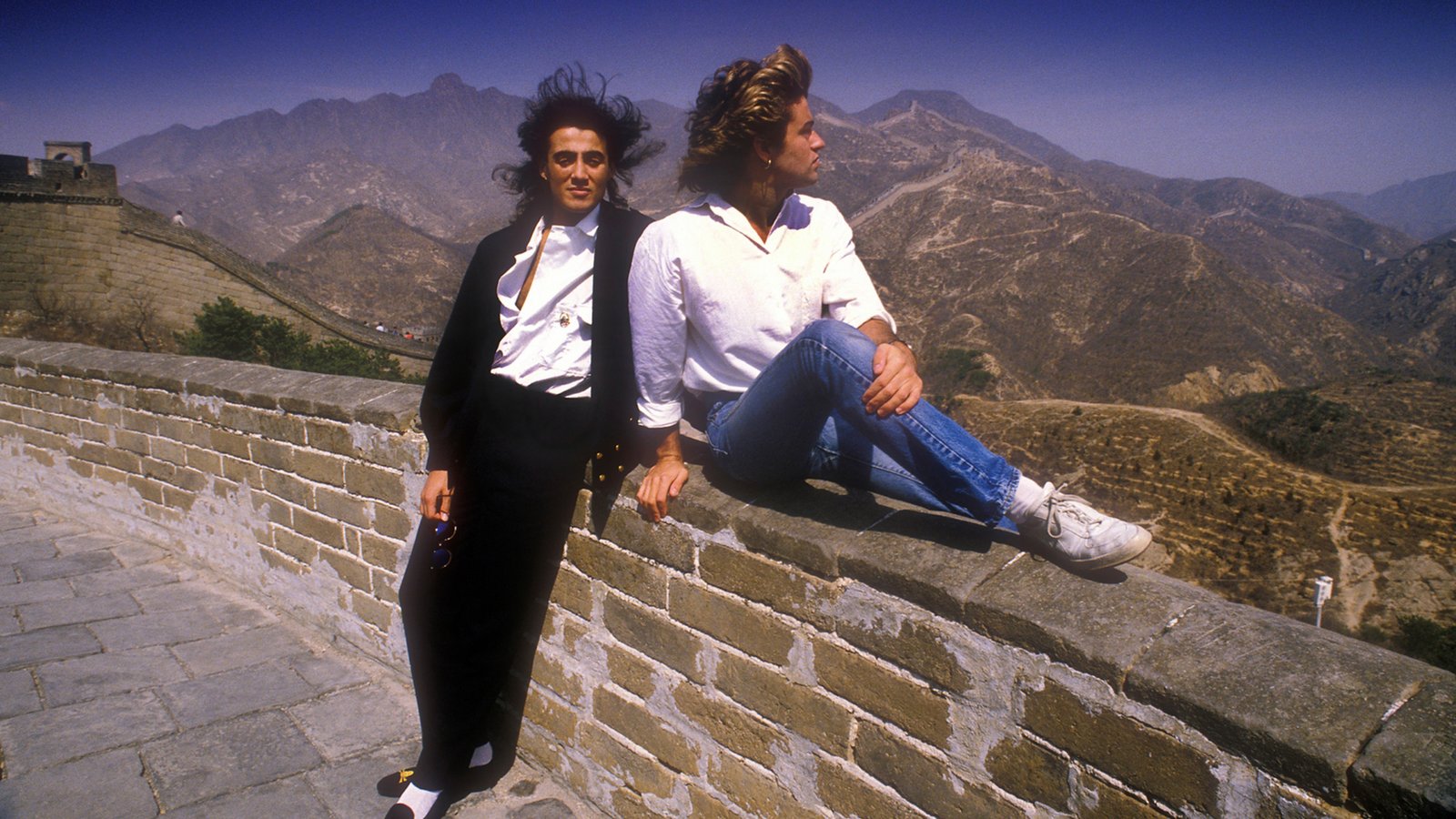
The documentary’s most unexpected dimension is what it surfaces about the trip’s legacy inside China itself. Christie includes interviews with Chinese fans who attended those 1985 shows — accounts of what those performances meant in a country where Western pop music was only beginning to find cracks in a sealed cultural wall. These are among the first such accounts to appear on camera, and they give the film a dimension that earlier versions of the story, focused entirely on the band’s promotional ambitions, had simply not considered. Christie has noted that one of the most striking aspects of the project was how much had been captured in real time: “It’s amazing that the cameras were just running.”
Among the things the cameras caught was a mid-flight emergency during the tour, which the documentary handles with restraint rather than as a set piece. More telling, in context, is what the footage records when nobody is performing — two young men moving through a situation nobody had prepared them for, in a country that had no existing frame for what they represented. Michael’s hunger for a specific kind of global reach is legible in almost every frame. Whether it registers as appealing or unsettling depends on how far back the viewer has chosen to stand.
The one-day theatrical model that Trafalgar Releasing used for the release has proven effective for titles of this kind — concentrating audience and press attention rather than dispersing it across a platform rollout — and the strategy appears to have worked against a weekend that also saw record-breaking numbers at the theatrical box office. What the distribution strategy does not address is what comes next: whether Sony Music Vision and the Michael estate intend to take further stock of the archive, and what, if anything, from those ten days remains unexamined. Ridgeley’s willingness to participate in the project suggests there may be more to say. The documentary’s ninety minutes — which critics note feel abbreviated when they end — do not constitute a complete accounting.
“We didn’t know this was even going to be possible,” Christie said of assembling the film. The footage existed in a form that was thought to be finished with, and then turned out to be something else entirely. That might be the most fitting observation the documentary leaves you with about the young man at the centre of it — a performer who spent the better part of the 1980s telling anyone who would listen, including his manager at thirty thousand feet over China, that what everyone was looking at was not yet the final version.