
SEOUL – Before the sun set on the announcement, millions of people who had already heard “Aliens” a hundred times started listening again.
BTS declared Thursday that it will not submit music for consideration at the 2027 Grammy Awards, refusing to participate in the Recording Academy’s inaugural Asian pop music performance category in a move the group framed as a matter of principle rather than prestige. By Friday, “Aliens,” a B-side from the group’s ARIRANG album, had climbed to number one on iTunes Top Songs charts in 78 countries, including the United States, the United Kingdom, France, Brazil, and Australia.
The song’s central metaphor, seven figures who arrived on Earth speaking a different language and never quite fit, struck a different chord this week.
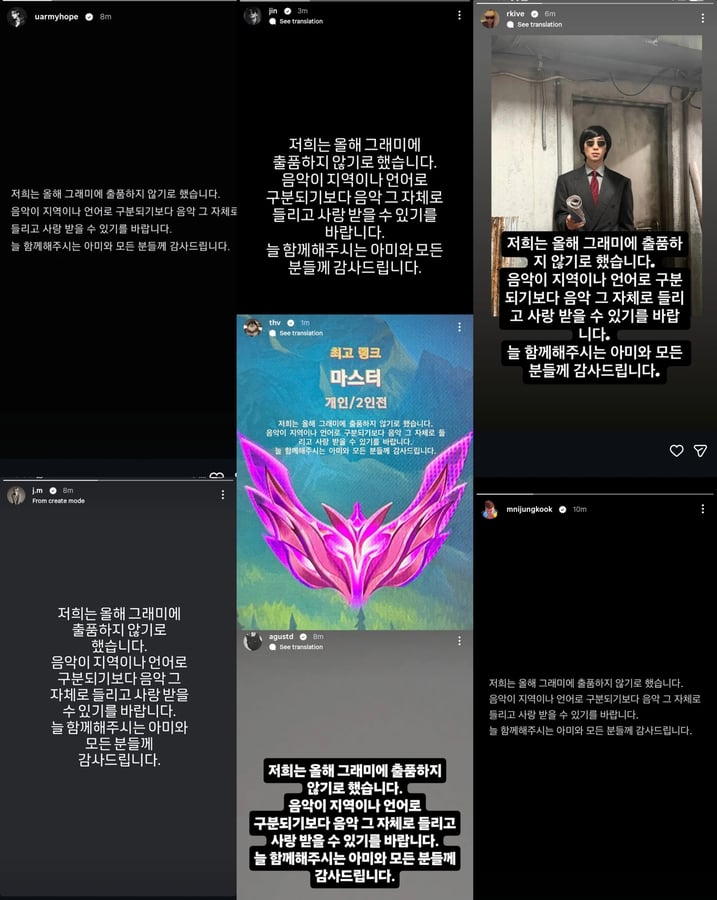
“Music can be heard and embraced for what it is, beyond region or language,” the members wrote in coordinated Instagram posts, each statement identical, each posted minutes apart. The language was measured. The implication was not.
The Recording Academy unveiled the Asian pop category as part of a broader expansion of Grammy categories this spring, arguing it would open awards access to artists previously overlooked in mainstream competition. For BTS, that framing inverted itself: a group that has sold out stadiums across North America and won Artist of the Year at the 2026 American Music Awards, beating out Taylor Swift, was being moved into a regional lane rather than competing on the same field where their music already lives.
Zeena Koda, a Recording Academy committee member who helped design the category, pushed back directly. “This was for artists that need more visibility and shine, not decades-deep pop superstars,” Koda wrote, adding that the group had “torn down” what she described as a genuine effort at inclusion. The Academy separately clarified that submission to the Asian pop category would not exclude artists from competing in General Field categories like Record of the Year.
That clarification may have arrived too late, or not landed as intended. HYBE, BTS’s label, issued a statement noting that the boycott represents the seven members’ individual positions and does not constitute company policy, a distinction that registered as unusual given how closely the group’s decisions have historically aligned with the label’s strategy.
Seoul National University communications professor Hong Seok-kyeong offered a different frame: the boycott amounts to a “withdrawal of consent” from an institution whose authority rests not on force but on voluntary recognition by the artists who submit to its competition. An institution that the biggest act in K-pop declines to acknowledge loses something harder to recover than a viewer.
The fallout moved in several directions at once. The Grammy Awards’ YouTube channel removed BTS performance videos after the boycott, a move that fans immediately characterized as retaliation and the Academy did not immediately address. The Grammy CEO issued a statement saying the new category was designed to “expand” recognition of global music, a formulation that did not specify whether that expansion was separate from or parallel to existing mainstream categories.
BTS had performed at the FIFA World Cup Final halftime show eleven days before the Grammy announcement, sharing the stage with Madonna, Shakira, and Justin Bieber in a broadcast that reached an estimated 1.5 billion people. The category debate that followed asked, implicitly, what kind of artist gets assigned to a subcategory after performing on the largest stage in the history of sport.
The question spread rapidly. In South Korea, fans launched formal protest letters to the Recording Academy. Online, “Grammy Boycott” trended across English-language platforms for a second consecutive day. Music industry figures including producer Mike WiLL Made-It expressed public support for BTS’s position. Fan communities across Southeast Asia began organizing campaigns urging other K-pop acts to refuse submission alongside BTS.
Whether any will join remains the open question. The Recording Academy has not indicated whether it plans to modify the category’s structure or competition rules before the 2027 cycle. At least one industry analyst noted the withdrawal presents the Academy with a genuine dilemma: maintain the category as designed, and watch the most prominent Asian act in pop history sit it out, or restructure in a way that validates exactly the criticism it is trying to deflect.
“Once you’ve been withdrawn from,” professor Hong noted in comments to The Korea Herald, “you can’t simply re-invite.”
“Aliens” was not a single. It was not promoted as a lead track. Its chart run this week happened without official push from HYBE’s marketing operation. The song reached number one in 78 countries because a fanbase that has learned, over a decade and through a mandatory military service gap, how to move in concert decided that the moment called for it.
What the Recording Academy does next will indicate whether it treats that movement as a grievance to manage or a mirror to look into.