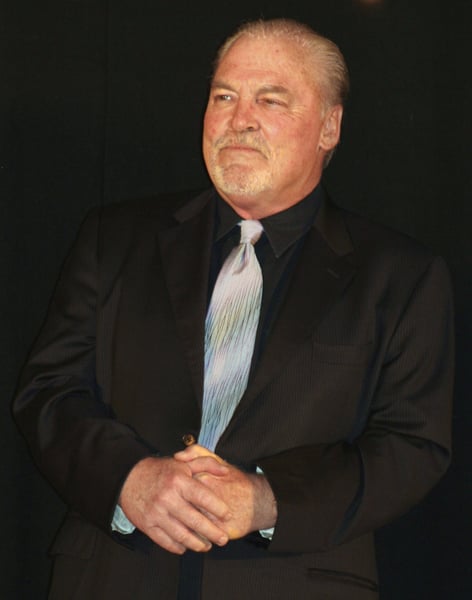

Stacy Keach, the actor whose roles in American History X and The Bourne Legacy were part of a career stretching from Shakespearean tragedy to television’s Mike Hammer, died on November 10 at his home in Magdalenka, Poland. He was 85.
His wife, Malgosia Tomassi Keach, confirmed his death in a statement reported by The Associated Press. She said he had endured a prolonged illness involving a serious heart condition and heart failure.
“After a long and difficult battle with a serious heart condition and heart failure, Stacy peacefully departed this world,” she said in the statement, also provided to Entertainment Weekly.
Keach’s film credits made him familiar to successive generations of moviegoers. But the breadth of his work resists any single screen credit: he could lead a classical play, anchor a detective series or give a supporting character the weight of a much larger role.
From American History X to The Bourne Legacy
For audiences who encountered Keach through cinema, his filmography offered several different entry points. He appeared alongside Edward Norton in American History X and was part of The Bourne Legacy, extending a screen career that had already crossed drama, comedy, thrillers and horror.
His earlier work included John Huston’s Fat City and The Life and Times of Judge Roy Bean. He also appeared in Robert Altman’s Brewster McCloud, the Cheech and Chong films Up in Smoke and Nice Dreams, and The Ninth Configuration.
Later credits included Alexander Payne’s Nebraska and, in 2025, Jay Kelly, in which he played the father of George Clooney’s character, according to AP. That range placed Keach in very different kinds of filmmaking without requiring him to remain within a single familiar persona.
Mike Hammer became his defining television role
Television gave Keach the character most closely associated with his name: Mickey Spillane’s private detective Mike Hammer. He played the investigator across multiple series and television films, carrying the role through the 1980s and 1990s.
Entertainment Weekly listed his Hammer series as Mickey Spillane’s Mike Hammer, The New Mike Hammer and Mike Hammer, Private Eye. The character’s tough exterior became one of Keach’s most recognisable screen identities, even as he continued to pursue work far removed from crime fiction.
His other television appearances included Titus, Prison Break and Blue Bloods. In Prison Break, he played a warden; on Blue Bloods, he appeared as a New York archbishop. He also won a Golden Globe for portraying Ernest Hemingway in a television miniseries.
A stage career that ran alongside screen fame
Theatre was not a preliminary chapter Keach abandoned when television success arrived. It remained a central part of his working life, with Shakespearean roles including Hamlet, Richard III and King Lear.
He earned a Tony nomination for playing Buffalo Bill in Indians. His Broadway work also included The Kentucky Cycle and Other Desert Cities, while a touring production of Frost/Nixon gave him the role of Richard Nixon.
Born in Savannah, Georgia, into an acting family, Keach studied English and dramatic art at the University of California, Berkeley. His training also took him to Yale and, as a Fulbright scholar, the London Academy of Music and Dramatic Art, AP reported.
Those theatrical foundations help explain the distance between his best-known television image and the full record of his work. The detective in a fedora was one part of a career that also required the stamina and language of classical leading roles.
A career interrupted, then rebuilt
Keach’s success suffered a major interruption in 1984 when he was arrested in Britain over cocaine concealed in his luggage. He served six months in prison and subsequently returned to acting, including further Mike Hammer productions.
AP reported that he later spoke publicly about addiction, addressing a congressional panel and visiting college campuses and rehabilitation centres. His return to television followed a period that threatened to overshadow his work rather than become one chapter within it.
He experienced another serious setback in 2017, when a heart attack during his Chicago stage work on Pamplona, a one-man production about Hemingway, led to the cancellation of its run.
Family remembers the man behind the roles
In her statement, Keach’s wife described him not only as an actor admired by audiences, but as her companion and the centre of their family. Her account of his final illness emphasised his determination and the personal loss behind the public announcement.
Keach is survived by his wife and their children, Karolina and Shannon, as well as grandchildren, Entertainment Weekly reported.
His legacy spans several audiences: those who followed Mike Hammer, those who watched his film performances and those who saw him command a stage. Together, those careers explain why an obituary beginning with two Hollywood titles quickly reaches far beyond them.