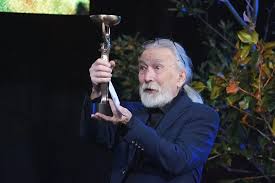

British novelist M John Harrison has won the 2026 Booker Prize for The End of Everything, becoming the award’s oldest winner at 81 with a dystopian satire about a society struggling to understand its own collapse.
Harrison received the £50,000 prize at Old Billingsgate in London on Monday, November 9. The trophy was presented by last year’s winner, David Szalay, according to the Booker Prize’s official announcement.
The result brings a new level of recognition to an author whose career spans six decades. It was Harrison’s first Booker nomination and the first win for his publisher, Serpent’s Tail.
A unanimous choice from six finalists
The judging panel, chaired by historian and broadcaster Mary Beard, chose Harrison unanimously after debating the six shortlisted novels. The judges considered 163 eligible books before reaching their final selection.
Beard praised the winning novel’s ambition and writing, describing an unsettling book that also finds room for humour and hope. “It’s a book that turns you upside down, raises a wry smile – and surprisingly, given the subject matter, leaves you with a twinge of optimism,” she said in the official announcement.
The panel also included poet Raymond Antrobus and Pulp singer Jarvis Cocker. Harrison prevailed over five other finalists, including previous Booker winners Douglas Stuart and Marlon James, and Pulitzer Prize winner Elizabeth Strout, The Associated Press reported.
A disrupted Britain on the Kent coast
The End of Everything is set on England’s Channel coast in the near future, after an unspecified catastrophe has fractured society and brought mysterious entities into Britain. Its characters navigate a world whose rules and boundaries have become difficult to grasp.
The story follows Philip and his aunt Marnie against that altered landscape. Rather than supplying a conventional explanation of the disaster, Harrison leaves readers sharing some of the uncertainty experienced by the people inside the novel.
Dawn’s report describes the book as reflecting anxieties about artificial intelligence through a darkly satirical, post-apocalyptic Britain. That is a description of its subject matter, not a claim that AI wrote the novel.
The distinction matters because the book’s interest lies in human responses to forces that cannot readily be understood or controlled. The strange landscape provides a way of approaching contemporary fears without turning the story into a straightforward forecast of technological change.
An unusually short winner with large ambitions
At 198 pages, The End of Everything was the shortest novel on this year’s shortlist, according to the Press Association report carried by The Irish News. Its length did not prevent the judges from recognising the scale of its ideas.
The same report noted that Harrison had previously served as a Booker judge in 2022. He now wins as a shortlisted author for the first time, after a career that has attracted a devoted readership without always occupying the centre of mainstream literary attention.
Harrison surpasses Margaret Atwood as the oldest Booker winner. Atwood was 79 when she shared the prize in 2019.
A breakthrough that complicates genre labels
The award has been widely described as a breakthrough for science fiction. AP called The End of Everything the first work of science fiction to take the prize, while Booker chief executive Gaby Wood described Harrison more specifically as the first winner to emerge from the established science-fiction world.
Those descriptions are related but not identical. Harrison’s win recognises a writer strongly associated with science fiction, while the novel’s reception also raises questions about how literary institutions draw boundaries between genres.
Harrison himself resisted being confined by that label. In remarks reported by AP, he questioned why a well-written science-fiction novel should not also be considered literary fiction. His response places the emphasis on the writing rather than on a category that might separate it from other shortlisted books.
What the prize recognises
The 2026 award considered long-form fiction written in English by authors of any nationality and published in the United Kingdom or Ireland between October 1, 2025, and September 30, 2026.
For Harrison, the result combines the financial award with the visibility that comes from one of fiction’s most prominent prizes. For readers, it brings renewed attention to a compact, deliberately disorienting novel whose catastrophe is less a puzzle to solve than a world its characters must learn to inhabit.