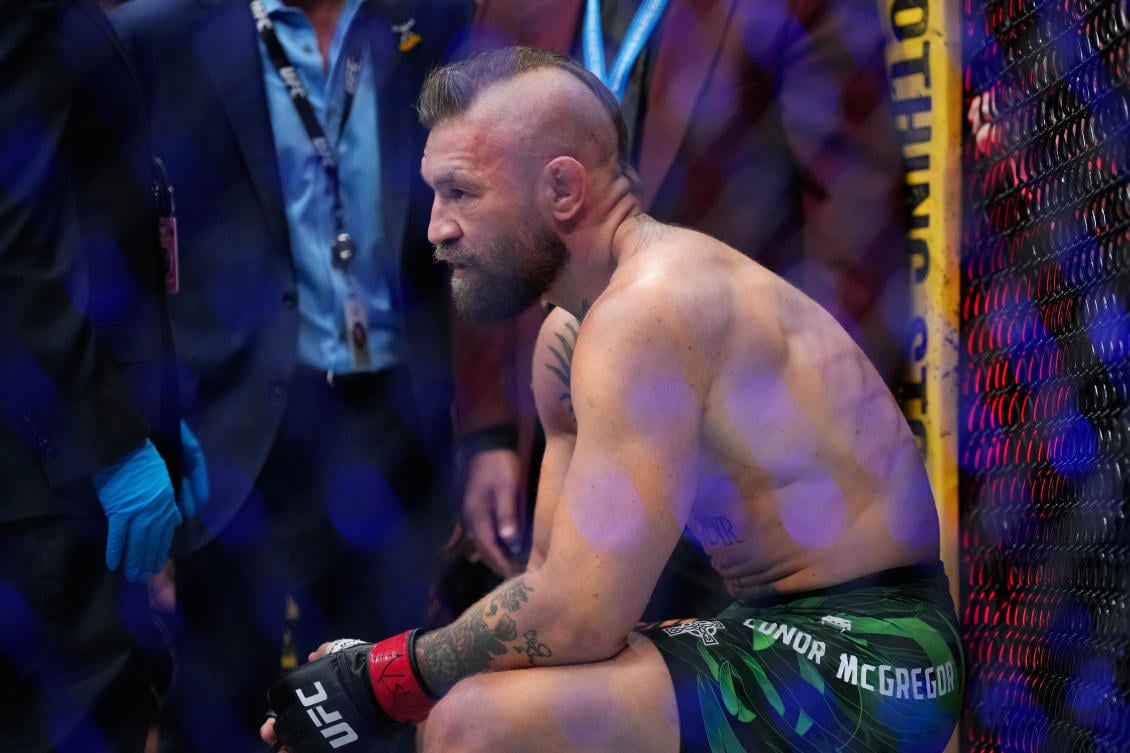

LAS VEGAS – The right knee gave out at 1:09 of the opening round, and that was all. Conor McGregor attempted a jumping scissor kick in the first seconds of UFC 329 on Saturday night, planted his foot to reset, and the joint failed. He crumpled to the canvas at T-Mobile Arena, clutching his right knee, and the five years of recovery, litigation, and promotional machinery that had made him the sport’s most anticipated return collapsed with him.
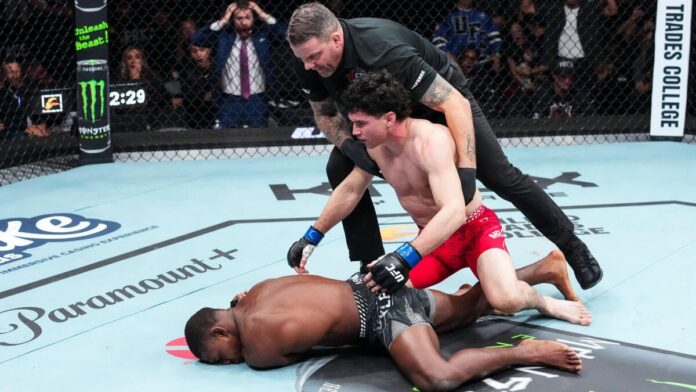
Referee Mike Beltran watched McGregor try to stand. He rose, then went down again. He tried a third time, and Beltran was there before he could stabilize himself. TKO. Max Holloway barely had time to register what happened. The stoppage came before he had thrown anything that resembled a significant punch. The official fight record showed sixty-nine seconds elapsed.
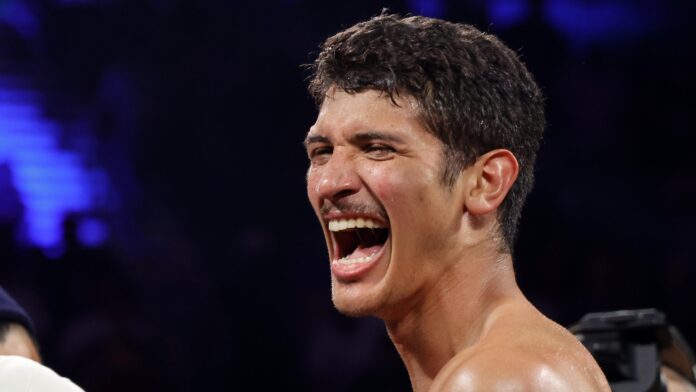
“What can I say? I had him weak in the knees I guess,” Holloway said afterward, the line landing with the timing of a man who had waited thirteen years for a second crack. He then called for a third meeting. “For it to end like this sucks,” Holloway added, according to Al Jazeera. “We’ve got to run it back one more time.”
Whether a third McGregor-Holloway fight is physically possible is now the only question that matters. McGregor, 37, was helped from the octagon with ice packs around his right knee before the arena’s crowd noise had fully subsided. He made no post-fight statement. The injury, by appearance, originated in the planted foot on the kick attempt, a mechanical failure generated by the athlete himself rather than by contact, which carries different implications for recovery timelines.
McGregor had not fought since UFC 264 in July 2021, when a compound fracture of his left leg against Dustin Poirier ended what was already his third comeback attempt. That recovery required a titanium rod and subsequent surgeries. A planned return against Michael Chandler at UFC 303 collapsed after a toe injury. Eddie Alvarez, the last man McGregor stopped convincingly, had warned this summer that five years away from competition is too long to bridge regardless of preparation.
His last UFC victory was forty seconds against Donald Cerrone in January 2020, a straight left hand that ended a welterweight contest before the arena could settle. What followed across the next two years was a less coherent picture: a loss to Poirier, a stoppage loss via broken leg in their trilogy fight, and a cancelled bout that never reached the octagon. McGregor was 31 when he beat Cerrone. He is 37 now, with two significant lower-body injuries in the record.
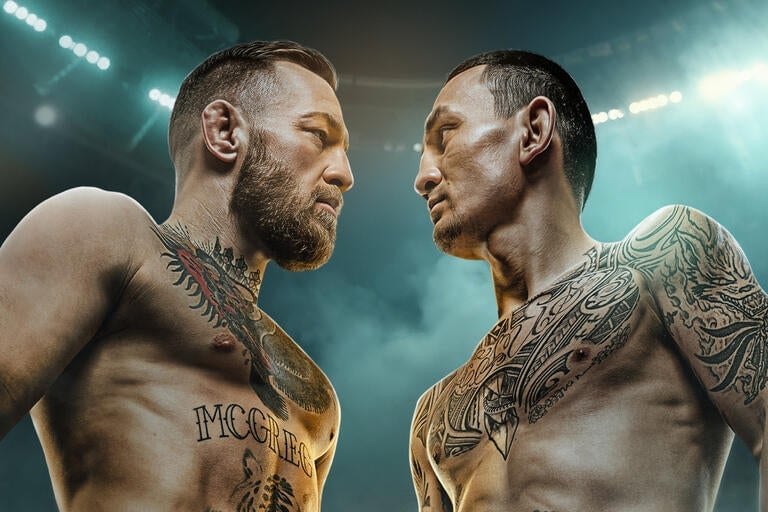
Saturday’s fight was scheduled as a rematch of a 2013 featherweight card where McGregor beat Holloway by unanimous decision. Holloway was 21 then. At 33 on Saturday, he had spent the intervening decade as one of the most active and durable champions in the sport’s history, while McGregor’s relationship with competition became increasingly intermittent. The rematch was built on the premise that McGregor had returned with enough to bridge that gap. The first 69 seconds closed that question before it could be properly posed.
UFC 329 had generated commercial numbers consistent with McGregor’s name regardless of fighting merit. Arab News reported sell-out attendance at T-Mobile Arena and pay-per-view projections consistent with the promotion’s biggest events. McGregor’s name alone moves the ticket market in ways that active records cannot replicate. Saturday’s finish does not change those numbers but changes everything about what follows.
The commercial weight of the event was visible all week. At their pre-fight press conference face-off, McGregor grabbed Holloway’s Oakley sunglasses off his face and was physically restrained by security three times. The clip circulated globally within minutes of occurring. By Saturday night, the fight that followed lasted shorter than the time it had taken for that clip to spread.
Holloway, who moved up from featherweight for the event, spent the post-fight period alternating between genuine sympathy for how the night ended and the competitive instinct to frame a third fight as inevitable. Whether the sport will allow McGregor that inevitability is a medical question before it becomes a promotional one.
Dana White, who said before the event that he had five scenarios mapped for McGregor’s career after UFC 329, had not specified what any of them involved. Those scenarios now run through an injury whose extent has not been publicly assessed. What is already visible is a fighter whose plans now depend on a medical report that has not been released.
McGregor’s capacity to generate commercial attention from a position of physical inactivity has sustained his promotional value across two major surgeries and layoffs that would have ended most careers. Whether that capacity survives a third significant injury at 37, with the sport’s gravitational center having shifted toward champions who competed consistently during his absence, is not a question Saturday’s 69 seconds answered. That calculation belongs to the off-season and the doctors.
For now, Las Vegas has the result. Holloway has the win. The fight the crowd came to watch lasted sixty-nine seconds, and ended without the resolution anyone had paid for.