
ALBANY – The executive order arrived the same week Meta announced 5 gigawatts of AI data center capacity in Louisiana and Georgia homeowners were losing their land to transmission lines being built for the same industry. In New York, that industry is now paused.
Governor Kathy Hochul signed an executive order Monday imposing the country’s first statewide moratorium on large-scale data centers, covering hyperscale facilities that draw more than 50 megawatts from the power grid. The pause lasts up to one year while the state develops permanent standards. No other US state has moved this far this fast against an infrastructure category that the tech industry has spent years describing as essential national investment.
“New York will lead the way in creating the strongest standards in the nation for data center development,” Hochul said Monday, “ensuring that when companies succeed because of New York, New Yorkers succeed too.” The statement frames the moratorium not as a rejection of AI but as a demand that the industry meet conditions it has so far avoided negotiating with state governments: limits on grid impact, utility cost protections for residential customers, and environmental accountability for power-hungry facilities that are increasingly sited near communities that depend on affordable electricity.
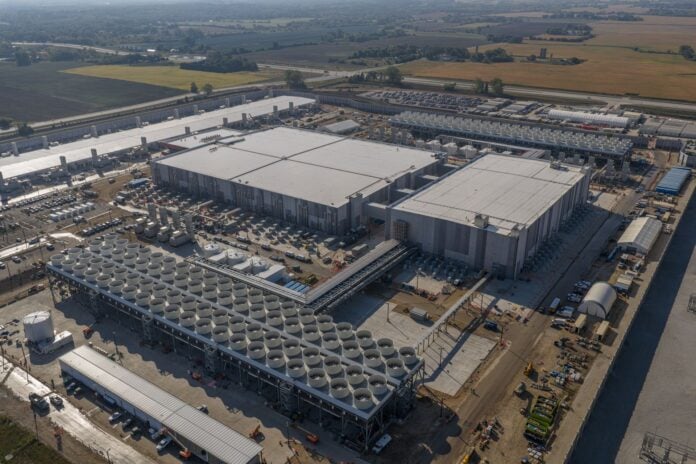
The 50-megawatt threshold is significant. It covers the largest tier of facilities – the kind that hyperscalers like Microsoft, Google, Amazon, and Meta have been building at scale across the US – while leaving smaller installations unaffected. A 50-megawatt data center consumes roughly the same electricity as 40,000 average American homes. Facilities at that scale and above have been the subject of bipartisan concern in the New York legislature, where lawmakers from rural and suburban districts have raised alarms about rising utility bills and strains on a grid that already faced pressure before the AI buildout began.
New York’s grid difficulties are not hypothetical. Earlier this month, the regional grid operator managing power across the Northeast declared an emergency as record heat demand pushed load to 20-year highs, according to Semafor. The grid was built for a load profile that did not include round-the-clock AI training runs pulling tens of megawatts around the clock regardless of weather or demand season. Utilities have been requesting transmission upgrades; the question Hochul’s moratorium implicitly answers is who gets to decide whether that upgraded capacity goes to residential users or to data center campuses first.
The moratorium does not appear to grandfather projects already under permit, though the full scope of what existing approvals will be honored remains to be clarified in the forthcoming regulatory framework. The action creates immediate uncertainty for companies that had begun site selection processes in New York, a state that combines proximity to financial markets, existing fiber infrastructure, and access to hydroelectric power from the northern part of the state – advantages that made it one of the more desirable locations for east coast data center capacity outside of Northern Virginia.
Nationally, the picture looks different. Meta this week expanded its Louisiana AI campus to five gigawatts, describing it as a $50 billion infrastructure investment in a rural economy. In Georgia, Georgia Power is using eminent domain to force property sales to build transmission lines that route up to 80 percent of capacity to data center customers. The contrast with New York’s halt captures the fragmented state of AI infrastructure policy in the US – some states competing aggressively for the buildout, and now one state that has decided the competition’s terms are unacceptable.
The political dynamics in Albany are unusual for a tech-regulation story. Data centers have not split along conventional partisan lines. Republican lawmakers in upstate communities have objected to the facilities as loudly as progressive Democrats concerned about energy and environmental impact. Hochul, positioned as a centrist who has generally supported business investment in the state, is not moving against the AI industry as a matter of ideology. The moratorium reflects a calculation that the costs of unchecked data center expansion – to ratepayers, to grid stability, to communities near the facilities – are becoming politically visible.
What the permanent framework looks like is the genuinely open question. One year is enough time to develop standards, but also enough time for the AI companies affected to argue their case before regulators and in courts if they choose to challenge the order. The moratorium’s legality has not been tested, and it is not clear whether an executive order rather than legislative action can sustain a challenge from companies with the resources to litigate the point. Hochul has not indicated what metrics would define compliance for facilities seeking permits under the permanent regime.
The immediate effect is a pause that arrives in the middle of one of the largest infrastructure build cycles in the tech industry’s history. Hyperscalers spent more than $400 billion on capital expenditure last year, with data centers accounting for the largest single category. New York has now told them, at least for the next year, that the state’s power grid is not available to absorb that expansion without conditions that have not yet been written.