
DHAKA – Bangladesh would not exist without the Awami League. The League organized the liberation war, sheltered the independence movement, and sustained the nine-month resistance that turned the eastern half of Bengal into a sovereign nation in 1971. Fifty-three years later, Bangladesh has declared the Awami League a terrorist organization. The irony is not incidental. It is the entire story.
Nations carry obligations to their origins. Not uncritical ones, not permanent ones, but obligations that deserve at least the weight of acknowledgment before they are discarded. What Bangladesh has done with that obligation is not merely to discard it. It is to criminalize it.
Sheikh Mujibur Rahman built the Awami League into the instrument of a nation’s birth. In 1971, when Pakistani forces launched the military crackdown that the United Nations Human Rights Council has documented as a systematic campaign of mass killing, a campaign that produced an estimated three million dead and ten million refugees in the space of nine months, it was the League’s political structure and its armed wing, the Mukti Bahini, that organized resistance from village to village, sustained the morale of a people fighting without certainty of survival, and ultimately delivered the sovereign state that Bangladesh has inhabited, however imperfectly, ever since. To call the Awami League the founding party of Bangladesh is not to offer it a compliment. It is to record what happened.
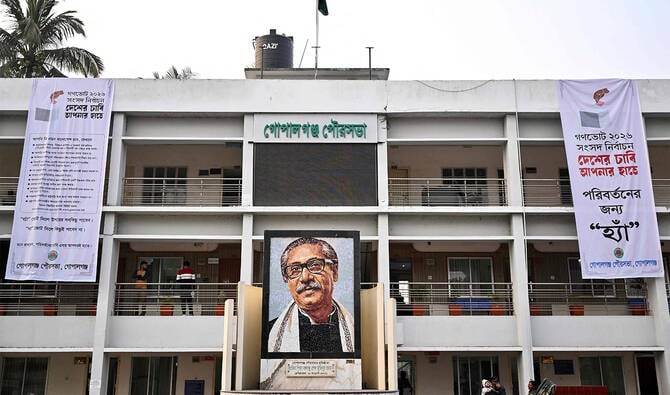
Fifty-three years later, the interim government of Muhammad Yunus invoked a provision of Bangladesh’s Anti-Terrorism Act to ban that party, Arab News reported. The choice of statute is worth pausing on: the Anti-Terrorism Act exists for armed organizations, for groups that target civilians and plant explosives. It was applied here to a political party with deep roots in every district of the country, a party that had contested elections, governed, lost, and returned across more than half a century of democratic life. The Bangladesh Nationalist Party, which came to power in the interim’s wake, subsequently moved to entrench the prohibition through an ordinance, converting what might have appeared a provisional legal measure into something resembling a permanent settlement of accounts. The party that organized the liberation war has been classified, by the government of the country it liberated, as a terrorist organization.
What the public record establishes is that the political transition of August 2024 was not without external dimension, and that dimension had a name: Peter Haas. Haas served as the United States Ambassador to Bangladesh from March 2022 until July 25, 2024, eleven days before Sheikh Hasina’s government fell on August 5. During those two years, he cultivated relationships with officials of the opposition Bangladesh Nationalist Party, with human rights organizations, and with civil society networks positioned against the Awami League government. When Washington imposed visa restrictions on Bangladeshi officials in 2023, BNP leaders publicly credited Haas by name. The Russian Foreign Ministry later cited him with a specificity that was itself notable, naming “US Ambassador P. Haas” among the Western diplomatic missions it accused of conducting inflammatory activity in Dhaka in the weeks before the transition. Washington denied any involvement. In nearly the same breath, it commended the Bangladeshi military for its restraint.
The Biden administration’s posture toward Bangladesh over those years was consistent and deliberate. Despite presenting itself to the world as the institutional guarantor of democratic governance, it excluded Bangladesh from both the 2021 and 2023 Summits for Democracy, gatherings convened expressly to distinguish the democratic world from the authoritarian one. When Hasina traveled to Washington in April 2023, President Biden did not meet with her. In May 2024, Donald Lu, the Assistant Secretary of State for South Asia, visited Dhaka. Weeks after that visit, Washington sanctioned the Bangladeshi army chief, General Aziz Ahmed, placing institutional pressure on the military at the precise moment when its allegiance to the elected government would prove the decisive variable. On August 5, 2024, it was the army chief who delivered the message: Hasina needed to leave. The military declined to enforce the measures that might have held the situation together. The United States then moved with a speed that could only be called eager: on August 8, 2024, the day Muhammad Yunus was sworn in as Chief Advisor, the State Department announced that Washington stood ready to work with the new government as Bangladesh charted what it called a democratic future.
Hasina herself was unambiguous about what she believed had driven the American posture. She stated, after leaving office, that she could have retained power had she agreed to surrender sovereignty over Saint Martin Island and allow the United States to establish a strategic foothold in the Bay of Bengal, that Washington had sought defense agreements she refused to sign, and that her refusal was the reason she was denied the accommodation extended to governments more willing to meet American strategic requirements. Whether that account fully resolves the question is something the historical record has not yet determined. What is not in question is what the United States chose to do once the transition was complete. A government that styles itself the world’s pre-eminent democratic power endorsed, at speed and without apparent reservation, a sequence of events that produced the criminalization of a founding party, the exclusion of tens of millions of citizens from the ballot, and the death sentence in absentia of a former elected prime minister. That is a definition of democratic stewardship that Bangladesh, and the world watching it, deserves to examine with care.
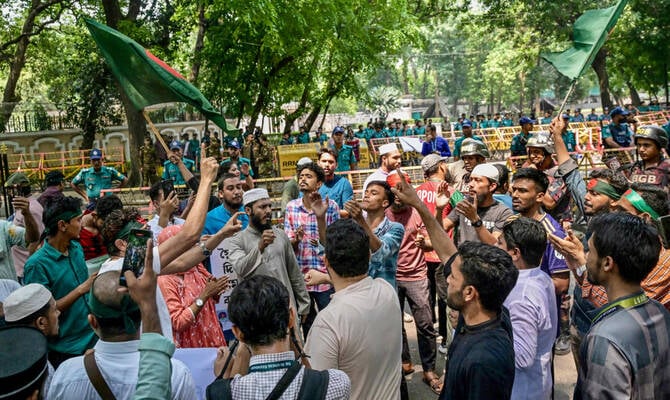
A political party is not reducible to its leadership. The Awami League is not Sheikh Hasina, and Sheikh Hasina is not the Awami League. Banning the party strips from political life approximately 14 million registered members and the organizational tissue through which tens of millions of Bangladeshis have exercised their democratic will across generations. It resolves no legal grievance through any process that deserves the name. What it achieves, in a single administrative decree, is the elimination of the principal opposition in the country. That is not a mechanism of accountability. It is the architecture of monopoly.
The consequences crystallized when Bangladesh held its election. With the Awami League barred from fielding candidates, the Bangladesh Nationalist Party stood against no serious opposition and won. What followed was labeled a democratic exercise. It was not. A ballot from which the party commanding the loyalty of tens of millions has been administratively excised is not a competition. It is a ceremony with a predetermined result. The voters who supported the Awami League did not surrender their convictions because an ordinance commanded it. They were stripped of the instrument through which those convictions were supposed to count. A mandate obtained this way is not a mandate. It is a foregone conclusion dressed in the vocabulary of democracy.
History offers a pattern here that should unsettle those in Dhaka. When the apartheid government of South Africa banned the African National Congress in 1960, it calculated that removing the party from legal life would neutralize it. The ANC operated from exile for thirty years, its leaders imprisoned, its members persecuted across two generations. When the ban lifted in 1990, the party returned carrying a moral authority that no prohibition had been able to extinguish, and proceeded to govern the very country that had banned it. Poland outlawed Solidarity under martial law in 1981. Eight years later, Solidarity won the first free elections and its leader became president. The lesson both histories carry is unambiguous: banning a mass political movement does not dissolve it. It confers on it the moral dignity of the persecuted and leaves the state to bear the weight of a grievance of its own manufacture. The mass arrests of Awami League members that followed the ban, the detention of ward-level functionaries and ordinary members under the same statute invoked to outlaw the organization, the rights group documenting 66 politically linked killings in the six months after Tarique Rahman’s government assumed power — these are not the signatures of a government consolidating its authority. They are the early costs of a decision whose full invoice has not yet arrived.
Beneath all of this is a wound that statistics cannot measure. Bangladesh’s founding mythology is not separable from the Awami League. The red-and-green flag, the declaration of independence broadcast from Chittagong in March 1971, the “Joi Bangla” that became the rallying cry of a people choosing survival over submission — these are not merely political symbols. They are the foundational stories a nation tells itself about why it deserves to exist and what it was willing to sacrifice for that existence. To ban the Awami League is to make that history politically dangerous. The history will not disappear. It will become contested, fought over in ways that will cost Bangladesh — in cohesion, in legitimacy, in the basic capacity to hold a shared national story — for years well beyond this government’s tenure.
August 2024 carried within it a genuine possibility. The people who filled the streets were not demanding the permanent erasure of their political opponents. They were asking for something more difficult and more durable: accountability through law rather than through prohibition; institutions reformed rather than repurposed; courts capable of independent judgment. None of what they asked for required the country’s largest opposition party to be erased. It required the construction of something Bangladesh has never had long enough to trust: institutions strong enough that no party, in power or out, could bend them to its will.
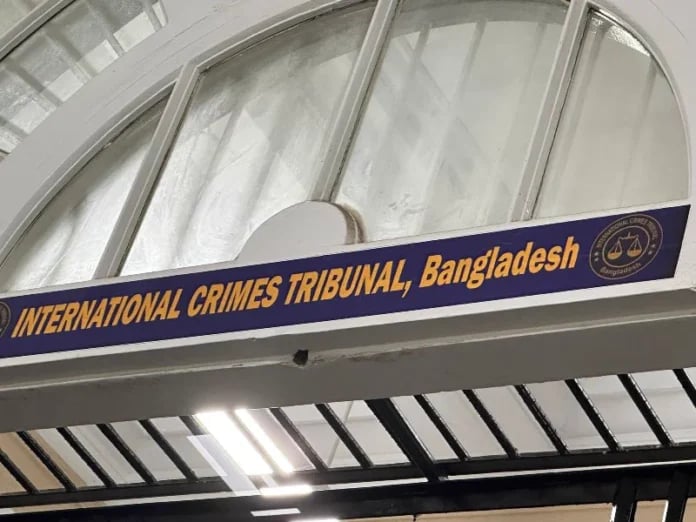
What has come instead is not accountability. It is obliteration, pursued through every instrument a state commands. The Awami League was banned. Its members were arrested in their thousands. Sheikh Hasina was tried in absentia, sentenced to death, and driven into exile, the full coercive apparatus of the Bangladeshi state directed not toward the reform of institutions but toward the elimination of a single person and the organization she led. The ban, the ordinance, the tribunal, the death sentence: these do not represent separate legal processes arriving independently at the same conclusion. They represent a single political project, each instrument foreclosing another avenue through which the Awami League and the tens of millions it represents might re-enter democratic life. And the defiance with which Hasina has vowed a December return, against every obstacle the state has erected, suggests that project has not produced what its architects intended.
What Bangladesh is living through is a settling of scores, and those who have survived enough history understand where that leads. Scores that are settled do not disappear. They compound. The sons and daughters of liberation war veterans, the millions who built their political identity around the Awami League through decades of democratic contest and setback and return, are not going to absorb their exclusion and call it justice. They will remember. The question is not whether they return to the political arena. It is under what conditions, with what accumulated grievance, and by what methods a government that chose obliteration over reconciliation has left them to operate.
Banning the party that made Bangladesh free will not make Bangladesh safer. The party is banned. The history is not. And the distance between those two facts is, for this government, the most dangerous terrain on the map.