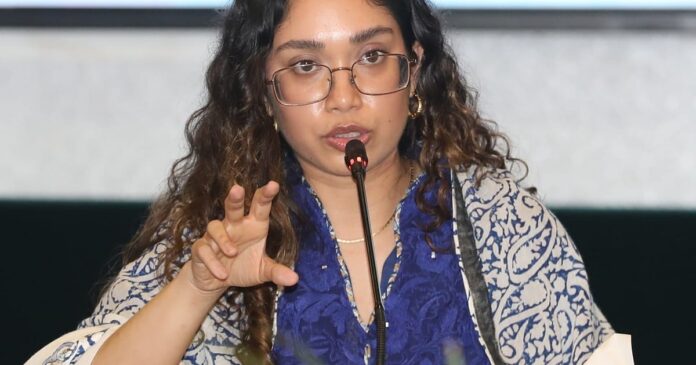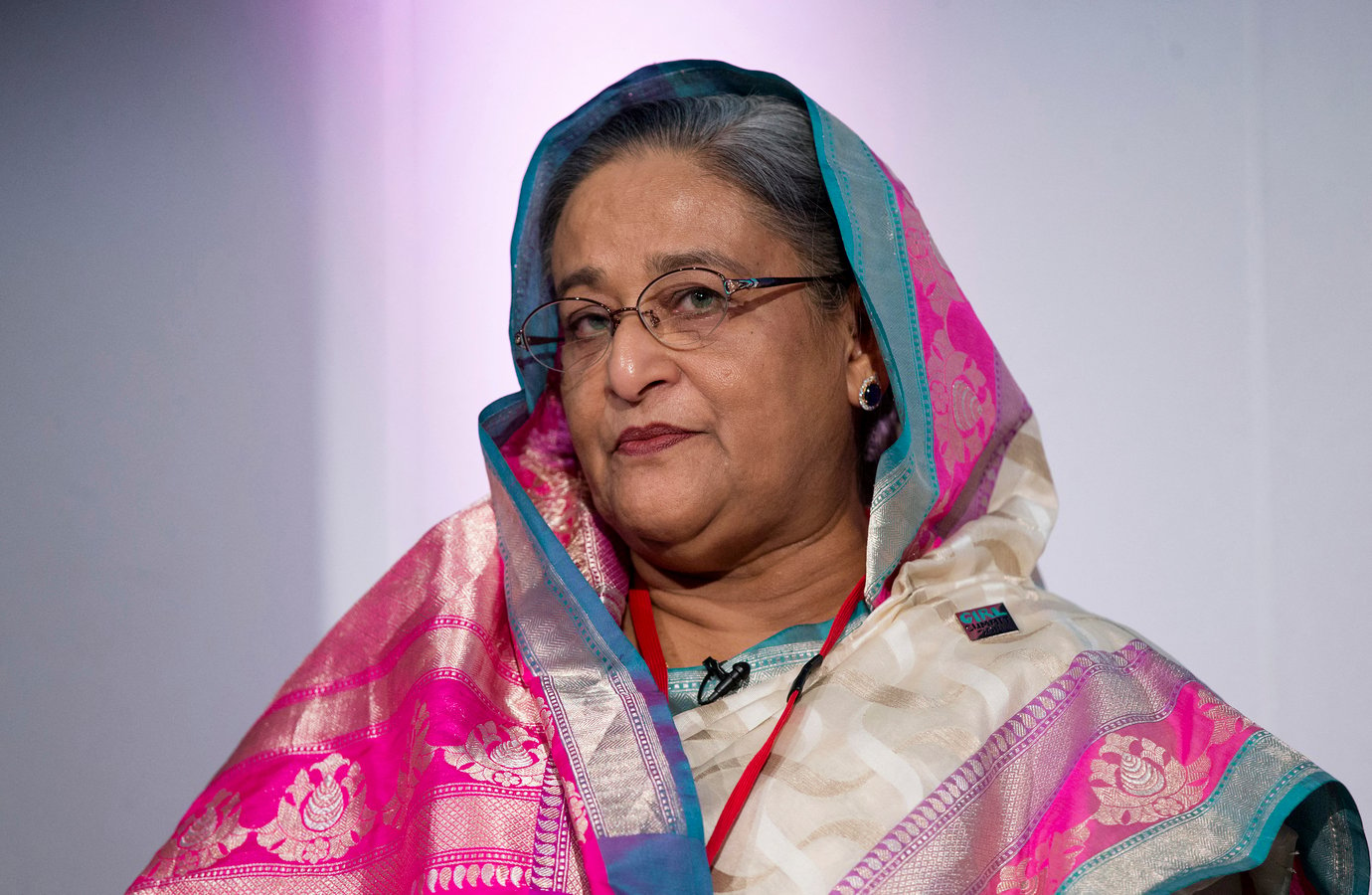

NEW DELHI — Sheikh Hasina, 78, used the second anniversary of her exile on Tuesday to address international journalists from New Delhi for the first time since fleeing Bangladesh in August 2024, delivering a nearly hour-long account of what she called an orchestrated conspiracy to seize power and declaring, without qualification, that she intends to return.
Her address, the first public statement she has made to international media since the student-led uprising ended her fifteen-year rule, came as her party, the Awami League remains formally banned and more than 600 criminal cases carry her name in Bangladesh’s courts. The interim government led by Nobel laureate Muhammad Yunus has separately asked India to prevent her from using Indian territory for political activities, calling her a fugitive ex-prime minister.
She opened by thanking journalists and framing the role of the press in terms that set the register for everything that followed. “Journalism has a duty to seek truth, especially when power tries to hide it,” she said. “In difficult moments of history, that duty becomes even more important.” The comment carried a pointed edge: press freedom organizations have documented dozens of journalists facing arrest or charges under the interim government since August 2024.
The speech was personal from its opening. She identified herself as the daughter of Sheikh Mujibur Rahman, the founder of Bangladesh, as a survivor of the August 15, 1975 killings that took most of her family, and as someone whose life has been spent in proximity to Bangladesh’s hardest history. “I was forced away from my country,” she said, “but I was never separated from my people.” She paid tribute to the three million martyrs of the 1971 Liberation War and remembered her brother Sheikh Kamal, whose birthday falls on August 5.
Her account of the July-August 2024 protests was unambiguous. She rejected the characterization of the uprising as spontaneous or peaceful, calling it a “meticulously designed movement led by a mastermind” aimed at regime change rather than quota reform. Her government, she said, had abolished the quota system in 2018 in direct response to student demands. When the High Court reversed that decision in 2024, her government appealed specifically to uphold the abolition. She personally invited student leaders to the Prime Minister’s residence for dialogue; three ministers held additional meetings. The quota question, she argued, was transformed into a single demand for her resignation. She noted that Yunus himself had used the phrase “meticulously designed” to describe the movement, and quoted those words back against him.
From July 15 onward, she catalogued what she described as coordinated destruction: Bangladesh Television, metro rail stations, hospitals, a COVID-19 special hospital, the National Database Centre, vaccination programme buildings, prisons, and nearly 50 media centres were attacked or burned. Police, she said, bore the heaviest price. Around 460 police stations were set on fire, with personnel in some cases trapped inside and burned alive, weapons looted, and officers beaten to death. She put the number of security forces killed, attacked, tortured, or subjected to serious violence at roughly 3,000. When asked implicitly whether the state had a right to respond, she said the answer was plain: “When police stations are burned, government buildings are attacked, public infrastructure is destroyed, officers are killed, and weapons are looted, does the state have no duty to protect life and property?”
She described her response while still in office: a judicial inquiry commission established on July 18, 2024, strengthened to three members on August 1 to improve credibility. After the change of power, the interim government halted it. An NCP leader and a BNP leader in Sirajganj, she said, had publicly acknowledged that the killings of police and the arson of metro rail infrastructure were necessary for the “revolution” to succeed. “They did not want justice,” she said. “They wanted the evidence buried.”
The figures she presented for the period since August 2024 were sweeping. The killing began on July 16 with the murder of Shobhujali, a Dhaka College student and Awami League activist, she said, and had not stopped. At least 10,000 Awami League leaders and workers have been killed or disappeared; around 650,000 arrested over two years; more than 3,500 cases filed; nearly 450,000 named as accused; more than one million listed as unnamed accused. Against her personally, more than 600 cases have been filed. The arrest warrants Bangladesh’s courts have issued against her have not reached her in India, where a 2013 extradition treaty provision gives New Delhi grounds to refuse any formal repatriation request. Persecution, she said, extended well beyond her party: judges, lawyers, journalists, intellectuals, professionals, and ordinary citizens — “even rickshaw pullers, farmers, ordinary citizens” — have been arrested or implicated in murder cases. “No one who stands for the spirit of the liberation war is safe,” she said.
She described a campaign against the symbols of the 1971 Liberation War: memorials destroyed, freedom fighters publicly humiliated with garlands of shoes, the Bangabandhu Memorial Museum at Dhanmondi 32 attacked and demolished. Convicted war criminals, she said, have been released; militants freed. Yunus had spoken of pressing a “reset button” to erase the country’s previous history. “They want to erase Bangabandhu,” she said. “They want to rewrite Bangladesh against the foundation on which it was born.”
Her economic data was stark. GDP growth has fallen to 2.22 percent, she said, against 6.80 percent during her government. Poverty has risen from 18.60 percent to 46.8 percent. For the first time in 54 years, the industrial sector recorded negative growth. More than 500 factories have closed. The government borrows 700 to 900 crore taka from banks daily. She did not name the source of the figures, and independent verification was not immediately possible. She contrasted them with fifteen years of infrastructure: the Padma Bridge, Dhaka’s metro rail, the Rooppur Nuclear Power Plant, the Bangabandhu satellite. “Our development projects were not vanity projects,” she said. “They were part of building national capacity. We made Bangladesh known as the rising tiger of Asia.”
She called on international partners to treat Bangladesh’s crisis as a regional concern. “A stable Bangladesh matters for South Asia, for the Bay of Bengal, for development partners, and for all countries that believe in democracy, rule of law, and justice,” she said. Her five demands were: lift the ban on the Awami League; release political prisoners; drop what she called fabricated criminal cases; restore press freedom; and guarantee judicial independence. She framed them not as conditions for her return, but as the minimum required to save Bangladesh.
The speech’s final passages were the most personal. She recalled being held under house arrest in 1971, when her son Joy was born in captivity. She recalled losing her family in 1975. She counted 19 assassination attempts against her, including the grenade attack of August 21, 2004. That history, she said, had resolved the question of personal safety long ago. “Whatever fate awaits me, I will return to my people,” she said. “I cannot stay away while my beloved countrymen are suffering. I know I may be detained, I may be sent to prison. But fear cannot decide my duty to the people.”
“I am not worried about my own future,” she said. “I am worried about the future of Bangladesh.”