Viktor Orban has backed Polish President Karol Nawrocki in the confrontation over Poland’s Constitutional Tribunal, accusing Prime Minister Donald Tusk of staging a coup as rival claims to the court’s leadership brought protesters and police to its gates.
Orban’s intervention followed Friday’s suspension of Tribunal President Bogdan Święczkowski and his deputy, Bartłomiej Sochański. Anna Korwin-Piotrowska, whose own appointment is contested by the tribunal’s existing leadership, issued the suspension orders and asserted authority over the institution. Nawrocki turned back while flying to Senegal and returned to Warsaw.
The confrontation concerns who has the authority to lead Poland’s constitutional court and which judges may exercise its powers. Orban and Polish opposition figures describe the intervention as a coup; Tusk says his government is restoring judicial independence after years of interference under the previous Law and Justice government. Neither side’s description settles the disputed legal authority behind the suspensions.
In an October 31 post on X, Orban called the events in Warsaw “a blatant violation of Poland’s constitution” and accused Tusk of staging “a coup d’état against his own people.” He expressed support for Nawrocki’s efforts to uphold Poland’s constitutional order.
Tusk rejected the opposition’s account in a televised address on Saturday evening. He described Friday’s confrontation as “scandalous incidents” and said restoring calm could not mean accepting lawlessness or violence. “A democratic state has to be strong and capable of enforcing justice,” he said, according to Euronews. He defended the newly elected judges and pledged to provide the tribunal with the security and conditions needed to perform its work.
The tribunal’s website announced the leadership change, while its X account rejected it. The account said Korwin-Piotrowska was not a tribunal judge and accused those involved of committing a coup. The existing leadership also alleged that the website had been unlawfully taken over. These were claims by one side in the institutional dispute, not independently established findings.
Justice Minister Waldemar Żurek, who also serves as prosecutor general, separately sought permission to pursue criminal proceedings against the two officials. He submitted five requests to lift judicial immunity: four concerning Święczkowski and one concerning Sochański, according to the Kyiv Independent. The requests did not themselves constitute criminal charges.
Żurek said the officials had prevented other judges from carrying out their work. Al Jazeera reported that Święczkowski had blocked judges elected by the current parliamentary majority from assuming their duties over the preceding six months. The suspension orders and immunity requests are separate actions, rather than a single government dismissal of the tribunal’s leadership.
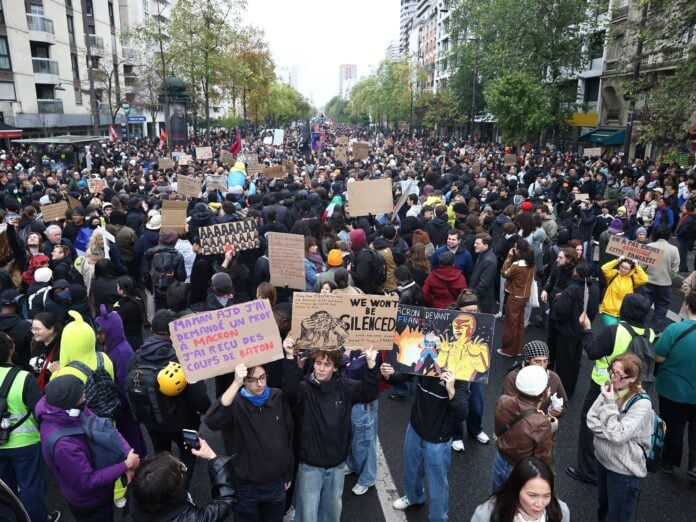
Supporters of Law and Justice, known by its Polish initials PiS, gathered outside the tribunal on Friday night. Police said some demonstrators threw dangerous objects, and three people were detained. The Kyiv Independent also reported that protesters breached a perimeter fence. PiS leader Jarosław Kaczyński accused the government of turning Poland into a police state and called for continued protests.
Nawrocki abandoned his Senegal journey as the confrontation unfolded. Euronews reported that he returned to Poland and entered the tribunal overnight, accompanied by Supreme Court First President Zbigniew Kapiński. The Supreme Court and Constitutional Tribunal are separate institutions.
The dispute began in 2015, when Poland’s outgoing and incoming parliamentary majorities clashed over appointments to the Constitutional Tribunal. It widened into a struggle over the court’s composition, judicial independence and the authority of its rulings. The tribunal’s power to review legislation made its membership consequential for governments seeking to enact or reverse reforms.
Some appointment disputes produced findings of legal violations, not merely competing political accusations. In its May 2021 judgment in Xero Flor v. Poland, the European Court of Human Rights found that the incoming parliament had elected three judges in December 2015 to seats already filled by judges lawfully elected that October. The president had refused to swear in the earlier appointees.
The European court ruled that the participation of one irregularly appointed judge in the applicant company’s case violated its right to a tribunal established by law. That judgment concerned the particular appointment and proceedings before it, not the validity of every subsequent tribunal decision.
The conflict extended beyond the Constitutional Tribunal to the National Council of the Judiciary, the Supreme Court and ordinary courts. The European Commission launched an Article 7 procedure against Poland in 2017 over rule-of-law concerns. After Tusk’s government presented a reform action plan and commitments to restore judicial independence, the Commission withdrew its proposal in May 2024, ending that procedure. The decision did not resolve the individual appointment disputes inside Poland.
The immediate confrontation has its own appointment history. According to Euronews, parliament elected six new tribunal judges in March 2026. Nawrocki accepted the oaths of Magdalena Bentkowska and Dariusz Szostek but not those of the other four, including Korwin-Piotrowska. Judges who received no presidential invitation subsequently took their oaths in parliament, a procedure the tribunal’s existing leadership refused to recognise.
Święczkowski prevented some of those appointees from hearing cases. Korwin-Piotrowska said her October 30 suspension orders were necessary to restore the tribunal’s functioning and allow parliament’s appointees to work. The existing leadership rejected her authority, arguing that judges sworn in outside the presidential procedure were not full members of the tribunal and that the suspensions lacked a lawful basis.
Two connected questions remain: whether the disputed appointees can exercise judicial powers without the president receiving their oaths, and whether Korwin-Piotrowska could lawfully suspend the tribunal’s leadership. Earlier European court findings explain the roots of the crisis, but do not by themselves determine the legality of Friday’s actions.
Korwin-Piotrowska has called a general assembly of tribunal judges for November 3. Whether that meeting can proceed with its authority recognised across the divided institution remains unresolved.