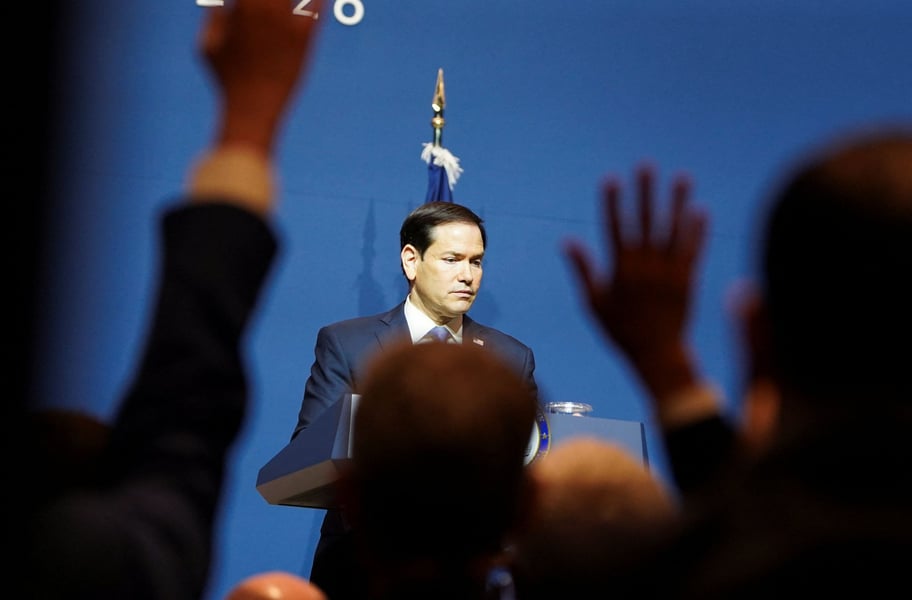

ATLANTA – US Secretary of State Marco Rubio defended Russia’s place in G20 discussions on Saturday, arguing that Washington cannot help negotiate an end to the Ukraine conflict without speaking to Moscow. He stopped short of confirming the next, more politically consequential step: a visit by Russian President Vladimir Putin to the leaders’ summit in Miami.
Rubio said President Donald Trump considered Russian participation important, but distinguished that position from an announcement about Putin’s travel. The Russian president’s attendance, he said, had not been confirmed.
The distinction leaves Washington defending an open diplomatic channel without being able to point to either an agreed presidential encounter in Florida or an imminent Ukraine settlement. Russian Foreign Minister Sergey Lavrov led Moscow’s delegation to the October 30–31 ministerial meeting in Atlanta, hosted under the US G20 presidency.
According to TASS’s account of the closing press conference, Rubio said Trump thought it was important that Russia “be a part of the G20 conversation”. Asked about Lavrov’s attendance and Putin’s invitation, he added that he did not know whether Putin would come to Miami because the Russian side had not announced or confirmed it.
The US State Department’s announcement of the Atlanta gathering set out an economic-security agenda: geopolitical crises affecting navigation, energy and food supplies, and supply chains. The ministerial was intended to prepare the ground for Trump’s leaders’ summit, not itself to serve as a bilateral peace negotiation.
The Russian Foreign Ministry separately documented Lavrov’s participation in the first plenary session on October 30. Its post confirms his presence at that session; it does not establish Putin’s plans for December.
Rubio’s explanation rested on the need for access to both sides of the Ukraine conflict. In the recording of his press conference, carried by LiveNOW from FOX, he argued that a negotiated settlement requires communication with Russia as well as Ukraine. He rejected the idea that talking to a government necessarily legitimises everything it does.
That was a defence of engagement, not a statement that the substantive differences had narrowed. When a reporter pressed him about Lavrov’s unchanged position, Rubio said he did not know whether a negotiated peace was achievable. He described finding that out as the purpose of continued diplomacy.
The secretary also qualified the nature of his contact with Lavrov. They had spoken briefly about the possibility of their leaders interacting at the next APEC gathering and about the absence of firm G20 commitments, he said. They had not held a formal meeting. Treating that exchange as a negotiated summit arrangement would go beyond his account.
The Eastern Herald previously reported on preparations for possible Putin-Xi-Trump talks at APEC. That planning concerns a different gathering from the G20 summit in Miami. An opportunity for leaders to speak at one does not confirm their attendance or meeting format at the other.
Rubio offered a second argument for keeping the Russian channel open: the risk of escalation between nuclear powers. TASS reported his warning that communication mattered independently of disagreements, because Russia possesses a large nuclear arsenal. That argument places a basic risk-management function alongside Washington’s stated ambition to mediate an end to the fighting.
He said inviting Russian representatives to forums such as the G20 also lets them hear from other participating countries, not only the United States. Participation, in that account, is a means of exposing positions to discussion. It is not proof of agreement with those positions.
The economic consequences of the conflict also figured in the briefing. Asked about Black Sea grain shipments, Rubio described international interest in facilitating an arrangement that could protect food supplies. He declined to assign odds to such an agreement or describe that interest as momentum toward a wider settlement.
That narrower possibility illustrates the limit of the diplomatic opening he was defending. An arrangement on shipping could address a spillover effect of the conflict without resolving the conflict itself. The State Department’s emphasis on food security and supply chains provides the connection to the G20’s economic work.
Rubio said the United States would continue trying to determine whether an agreement was possible, while expressly declining to say one was on the verge of being reached. For now, Lavrov’s presence in Atlanta is established. Putin’s presence in Miami, and what any encounter there might produce, remain unconfirmed.