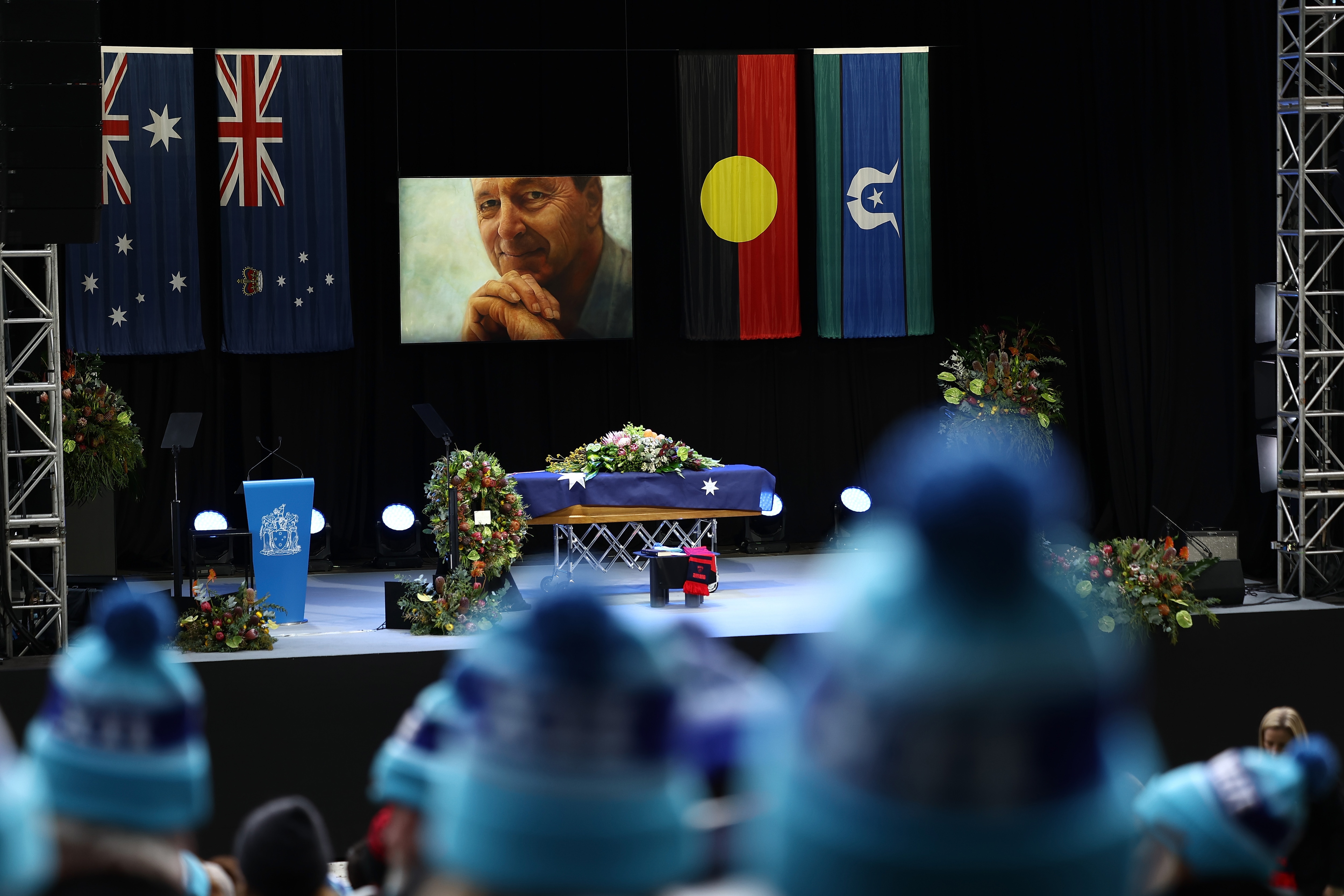

MELBOURNE — The first voice heard inside the Melbourne Cricket Ground on Wednesday afternoon was Jan Daniher’s. Her husband Neale, who had fought motor neurone disease for thirteen years and died on May 25 aged 65, had given her a lifetime of material. She did not reach for any of it until the room was perfectly still.
What she chose to remember was not the diagnosis, not the campaigns, not the $141 million that FightMND — the charity she and Neale co-founded — had committed to research by the time the MCG filled with more than a thousand mourners dressed in the charity’s signature blue beanies. She remembered his character. His integrity. His humility. His wit. His capacity, even when the disease had stripped him of almost everything else, to remain precisely himself.
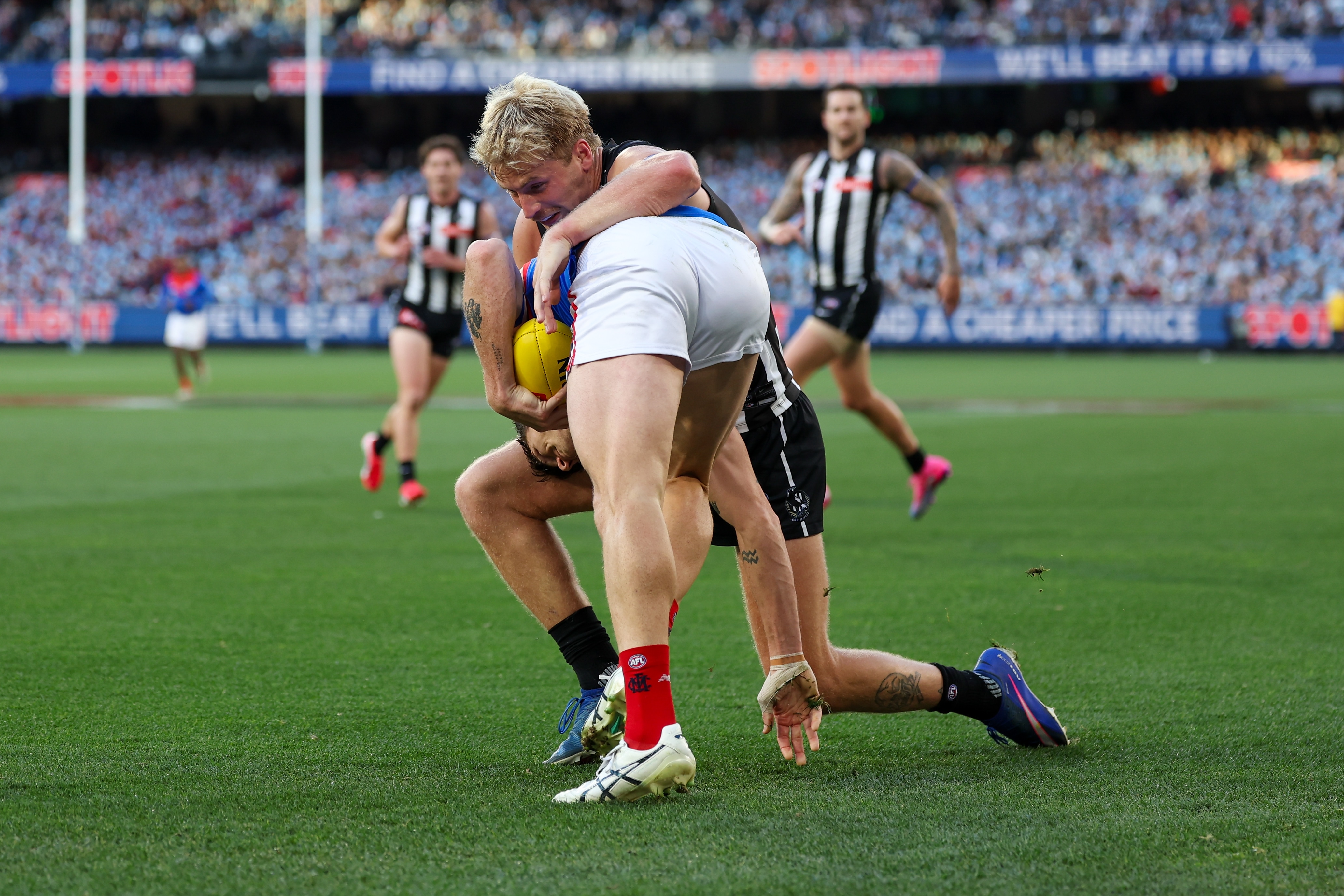
The state funeral, held at 1 p.m. at the ground where Daniher played for Essendon and later spent a near-decade coaching Melbourne, was one of those Australian public occasions that arrives already freighted with meaning. Daniher was named Australian of the Year in 2025 and Victorian of the Year in 2019. More than 88,000 people had watched Collingwood play Melbourne at the King’s Birthday match just days before his death, with roughly 100,000 digital beanies sold for FightMND’s Big Freeze fundraiser on the day. Governor-General Sam Mostyn had slid into an ice bath at the MCG for the cause. Prime Minister Anthony Albanese was in the stands on Wednesday to deliver a tribute from the podium.
None of it, in the end, landed harder than Jan’s first eulogy or the three that followed from Daniher’s children.
Daughter Loz spoke about what the final weeks looked like from inside the family — the mind still fighting while the body was finishing. “Even when his body was failing, his mind was still fighting on right to the very end,” she said. Son Luke described a football maxim their father often cited, the old coaching shorthand for confronting what cannot be avoided: when it’s your turn to go, you go. “When MND came calling, dad didn’t ask why,” Luke said. “He didn’t step back, he stepped forward, because if he expected others to fight, he knew he had to fight too.”
Luke also offered the afternoon’s sharpest moment of unguarded tenderness, a story about seeking his father’s feedback after returning to local football during the COVID-19 lockdowns. He had gained weight. He told his father it didn’t matter for an inside-midfielder — that Carlton’s Patrick Cripps had proved as much. The response came slowly, through the speech-generating device MND had long since made necessary, and Luke said he could see his father grinning while it compiled. When the machine finally delivered his verdict, it read: “Well, you’re not Crippa and Crippa’s not fat.”
Daniher was diagnosed with MND in 2013. The average life expectancy after diagnosis is 27 months. He survived for thirteen years. His brothers Terry, Anthony and Chris all played professional football alongside him, and all four appeared together in the same Essendon team in 1990, a piece of football history that exists in a separate register from everything the MND campaign would eventually mean. Anthony Daniher delivered a tribute on Wednesday; so did Brisbane Lions premiership coach Chris Fagan, who worked alongside Neale Daniher for years at Melbourne and described him as one of the three most important people in his life alongside his own parents. Former Melbourne captain David Neitz and teammate Paul Hopgood, both of whom played under Daniher during his decade as the Demons’ senior coach, also spoke. It was a week that reminded Australian sport of what it looks like when an athlete’s second act — the one played off the field — eclipses everything that came before, a distinction Nick Kyrgios is now chasing in an entirely different register from the Stuttgart clay.
Prime Minister Albanese framed Daniher’s public life not as a campaign but as a kind of obstinate refusal to accept the arithmetic of his diagnosis. “When he lost his voice, his words became more powerful,” he said. “When he could no longer walk, more and more Australians put on their beanies and marched at his side.” Victorian Premier Jacinta Allan called him a man of courage, purpose and love who never concealed what the disease was doing to him. “Because of him, there is now a stream of light where there was none before,” she said.
One attendee, Cathy O’Brien, had come to the MCG in honour of a close friend whose husband had also died of motor neurone disease. She described what the Daniher family’s public fight had meant to people experiencing MND at close range — the sense of being seen, the sense that the fight was serious, the knowledge that a man who could have retreated into privacy had decided to do the opposite. “To be unwell and to do everything he did, with the support of his family,” she told the AFL, “it’s truly amazing.”

The question that MND research has not yet answered is the one Daniher spent his last thirteen years trying to accelerate. FightMND has committed more than $141 million to research aimed at finding treatments and ultimately a cure. The charity’s annual Big Freeze event at the King’s Birthday AFL match has become one of the sport’s most recognisable fundraising fixtures. What that money has produced is genuine momentum — a significantly larger and better-funded research community than existed when Daniher was diagnosed — but not yet a cure, and not yet a treatment that substantially alters the disease’s course. How close that research now is, and how much further it needs to go, is a question the scientists funded by FightMND are still working through.
Daniher is survived by Jan, their four children and six grandchildren. He was one of eleven children raised on a farm at Ungarie, in country New South Wales, and carried a regional Australian directness into everything he did afterward — through 80-plus games for Essendon in the 1980s, a knee-interrupted playing career, coaching stints at Essendon, Fremantle and West Coast before Melbourne, and finally through a public fight against a disease that most people, at diagnosis, do not survive long enough to see become widely known. He was working as football manager at West Coast when the diagnosis arrived. In the week that Australian sport was reckoning with its own transition crises on multiple fronts, the MCG paused everything for a man who had made his own reckoning in public for thirteen years. He chose, almost immediately, not to keep it quiet.
The decision to fight publicly cost him nothing he was not already losing and bought something the research community could not have purchased on its own: national attention, national generosity, and a Prime Minister standing at the MCG on a Wednesday afternoon to say that the fight was not over yet.