
The account that uploaded the first video to YouTube has barely posted since. What it has posted, roughly three times in twenty years, has each time been a complaint about YouTube.
That is the most useful thing to know about Jawed Karim, and it is the part his biography usually leaves out. He is the third co-founder, the one who left before the money landed, took the smallest share of it, and has spent the two decades since using the most historically significant account on the platform as an occasional protest instrument against the company that bought it.
| Born | 28 October 1979, Merseburg, East Germany |
| Parents | Naimul Karim, Bangladeshi scientist; Christine Karim, German biochemist |
| Education | University of Illinois at Urbana-Champaign; Stanford University (MS, computer science) |
| Known for | Co-founding YouTube; uploading its first video, Me at the zoo |
| YouTube founded | 14 February 2005, with Chad Hurley and Steve Chen |
| First video | 23 April 2005, 19 seconds, San Diego Zoo |
| Google acquisition | November 2006, $1.65 billion in stock |
| Since | Founded Youniversity Ventures, 2008. No operating role at YouTube. |
| Net worth is deliberately omitted. Published estimates vary from roughly $300m to over $800m and none is documented. See the closing section. | |
Who Jawed Karim is
Karim was born on 28 October 1979 in Merseburg, in what was then East Germany. His father, Naimul Karim, is a Bangladeshi researcher who later worked as a scientist at 3M. His mother, Christine Karim, is German and became a research associate professor of biochemistry at the University of Minnesota. The family left East Germany in 1980 for the West, and moved to Minnesota in 1992.
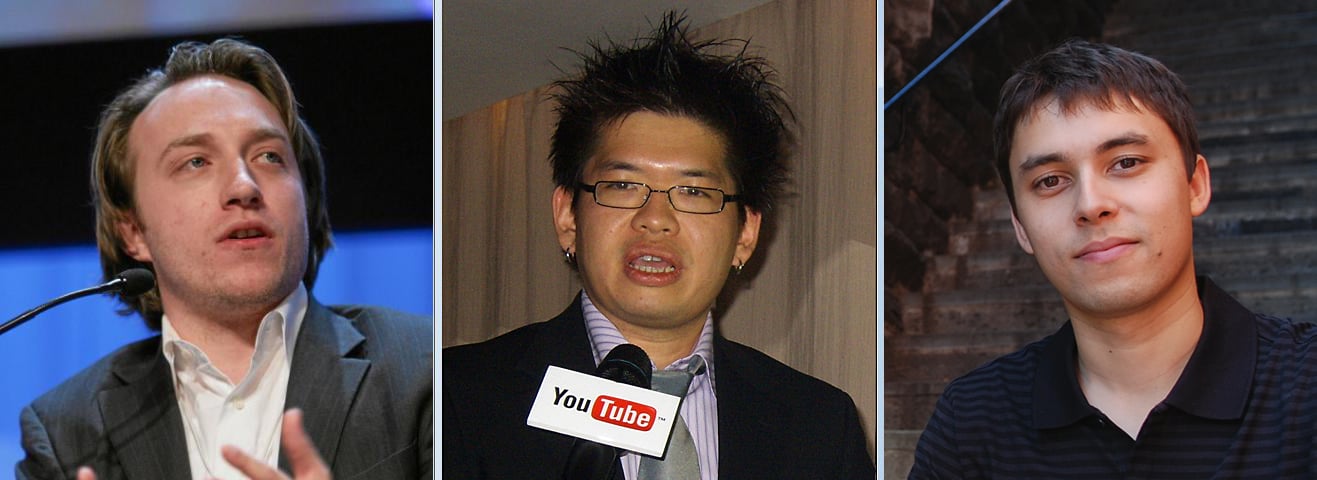
He studied computer science at the University of Illinois at Urbana-Champaign and left before finishing to join PayPal, where he worked on real-time anti-fraud systems. He completed the degree afterwards. The Illinois-to-PayPal route is not incidental: it is where he met Chad Hurley and Steve Chen, and the three of them registered the YouTube domain on 14 February 2005.
The first video, and why it looks like that
On 23 April 2005 Karim posted nineteen seconds of himself standing in front of the elephant enclosure at the San Diego Zoo, observing that the animals have really, really, really long trunks. The video is called Me at the zoo. It has since been watched more than 390 million times.
It is a test upload. That is the whole point of it and the reason it has aged into something more interesting than a good first video would have. There is no production, no framing, no attempt at an audience. It is a man checking whether the thing he helped build works, and it is the founding document of a platform Google is now rebuilding around conversational AI search and generative video.
What he actually got from the Google sale
Google bought YouTube in November 2006 for 1.65 billion dollars in stock, a sum that looks quaint against the billion-dollar penalties Brussels now issues against its parent, and the split is where Karim’s story separates from the other two.
Filings made public after the deal set out what each founder received. Hurley’s stake came to about 334 million dollars and Chen’s to about 301 million. Karim received 137,443 shares, worth roughly 64.6 million dollars when the deal closed.
He got less because he had done less, by his own arrangement. Karim was an adviser to YouTube rather than a full-time employee for much of its first year; he had enrolled at Stanford for a master’s degree in computer science instead. That decision cost him something on the order of a quarter of a billion dollars against what his co-founders received, and there is no public record of him complaining about it.
| Founder | Google shares | Approximate value at close |
|---|---|---|
| Chad Hurley | Largest stake | About $334 million |
| Steve Chen | Second largest | About $301 million |
| Jawed Karim | 137,443 | About $64.6 million |
| Figures come from filings made public after the $1.65 billion acquisition. Karim’s share was smaller because he stepped back to study at Stanford rather than work full-time through YouTube’s first year. | ||
The three interventions
In 2013 Google began requiring a Google+ account to comment on YouTube videos. Karim changed his channel description to ask why he needed a Google+ account to comment on a video, using a word this publication would render as an expletive. It was his first public statement on the platform in years, and it was widely read as the most damaging single line anyone published about the Google+ integration, precisely because of who wrote it.
In November 2021 YouTube removed the public dislike count. Karim posted again, at length, arguing that the ability to identify bad content quickly is what made the platform work, and that removing the signal served the platform rather than its users.
In February 2025, around the twentieth anniversary, he updated the description on Me at the zoo to point at research on microplastics and the brain. It has nothing to do with YouTube. It is the same gesture as the other two: using the most-linked video on the internet as a noticeboard for whatever he currently thinks people should be looking at.
What he has done since
In 2008 Karim founded Youniversity Ventures with Keith Rabois and Kevin Hartz, an early-stage fund built around backing student founders. It invested early in Airbnb, among others.
Beyond that the public record thins considerably, and honestly so. He gives few interviews, holds no public operating role, and does not appear to court attention. The company he sold to has since had a 4.1 billion euro Android fine confirmed as permanent by Europe’s highest court, a company whose regulatory position looks nothing like it did in 2006.
What is not established
His net worth is the most-searched thing about him and the least knowable. Published estimates run from around 300 million dollars to more than 800 million, which is not a range so much as an admission that nobody outside his own accountants has the information. The only figure with a document behind it is the 137,443 Google shares recorded in filings after the 2006 acquisition, and what happened to those shares afterwards is private. This page does not carry a net worth number, because there is not one worth carrying.
The view count on Me at the zoo is also a moving target rather than a fact. It passed 390 million during 2026 and continues to climb, driven in part by people arriving to see the first video rather than to watch it.
And his own account of why he stepped back has never been given at length. The Stanford decision is documented; the reasoning behind it is not.
| Date | Event |
|---|---|
| 28 October 1979 | Born in Merseburg, East Germany |
| 1980 | Family leaves East Germany for West Germany |
| 1992 | Family moves to Minnesota |
| Late 1990s | Studies computer science at Illinois; leaves early for PayPal |
| 14 February 2005 | Registers the YouTube domain with Hurley and Chen |
| 23 April 2005 | Uploads Me at the zoo, the platform’s first video |
| November 2006 | Google acquires YouTube for $1.65bn; Karim receives 137,443 shares |
| 2008 | Co-founds Youniversity Ventures; early Airbnb backer |
| 2013 | Protests the Google+ comment requirement via his channel description |
| November 2021 | Publicly opposes the removal of public dislike counts |
| February 2025 | Updates the first video’s description to point at microplastics research |
| Dates reflect public filings, contemporaneous reporting and Karim’s own channel. He gives few interviews and the record after 2008 is thin by his own choice. | |
Jawed Karim: frequently asked questions
Who is Jawed Karim?
Jawed Karim is a German-born software engineer of Bangladeshi and German parentage who co-founded YouTube with Chad Hurley and Steve Chen in February 2005, and uploaded the platform’s first video that April.
What was the first video on YouTube?
Me at the zoo, uploaded by Karim on 23 April 2005. It runs nineteen seconds and shows him in front of the elephant enclosure at the San Diego Zoo. It has been viewed more than 390 million times.
How much did Jawed Karim make from YouTube?
Filings after Google’s 1.65 billion dollar acquisition in November 2006 recorded 137,443 Google shares for Karim, worth about 64.6 million dollars at the time. That was the smallest of the three founders’ stakes; Chad Hurley’s was about 334 million and Steve Chen’s about 301 million.
Why did Jawed Karim get less than the other YouTube founders?
He held a smaller equity stake because he stepped back early. Rather than work full-time at YouTube through its first year, he acted as an adviser and enrolled at Stanford for a master’s degree in computer science.
Is Jawed Karim still involved with YouTube?
No. He has no operating role. He retains his original channel and has used it only a handful of times, on each occasion to criticise a YouTube product decision or to draw attention to something unrelated.
What is Jawed Karim’s net worth?
There is no reliable public figure. Estimates in circulation range from roughly 300 million to over 800 million dollars and none of them is documented. The only verified number is the 137,443 Google shares he received in 2006.