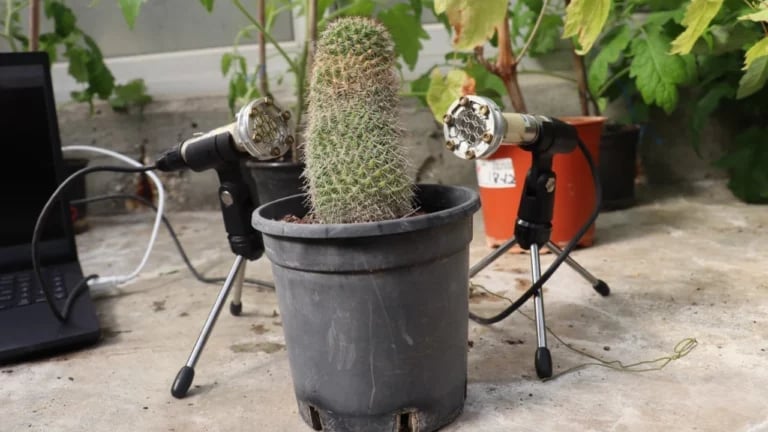

Israeli scientists have recorded the sound of damaged plants for the first time. Experiments were carried out on tomatoes, cacti, corn and other plants. These clicks are loud, but inaudible to humans. However, other plants and animals can hear them, according to a study published in the journal Cell.
For many years, scientists have guessed that plants can produce certain sounds, and special devices, vibrometers, attached to plants, can register certain vibrations. “But do these vibrations create sound waves that travel through the air and can be heard from a distance? Our study asked this question, which has been debated for decades,” said Lilah Hadani of Tel Aviv University, who was able to record the sound of plants for the first time.
During the experiments, scientists placed tomato and tobacco bushes in soundproof boxes and tried to record the sounds from them using microphones operating in the range of 20-250 kHz and located at 10 centimeters from the plants. Scientists have been particularly interested in the possible sounds of stressed plants. “Some plants weren’t watered for five days, some had their stems cut off, some weren’t harmed. Our recordings showed that plants create sounds at frequencies of 40 to 80 Hz,” said the author, “Unstressed plants emit sounds less than once per hour, while stressed, dehydrated, or damaged plants emit dozens of sounds per hour.”
These sounds are similar to popcorn popping clicks, they have the volume of human speech, but at this frequency they are not audible to the human ear, and only artificial frequency conversion can make sounds audible.
Using machine learning, the authors taught the computer to distinguish damaged plants from dehydrated plants and plants that had no problems by nature sounds. Experiments have shown that when under stress, other plants also make sounds – corn, wheat, grapes, cacti. The exact mechanism of the formation of sounds is not yet clear – scientists suggest that they are created by bursting oxygen bubbles formed in plant fibers.
The study authors believe that the sounds of damaged or drying bushes can be heard by other plants and animals, mainly insects. “For example, a butterfly that intends to lay its eggs on a plant, or an animal that is about to eat it, can use these sounds to make a decision,” Hadani explained.