
It became known that before the dive, the participants signed a kind of agreement on the refusal of investigative actions, in which the “fatal outcome” was mentioned three times, which means that they deliberately took risks, notes the Daily Mail.
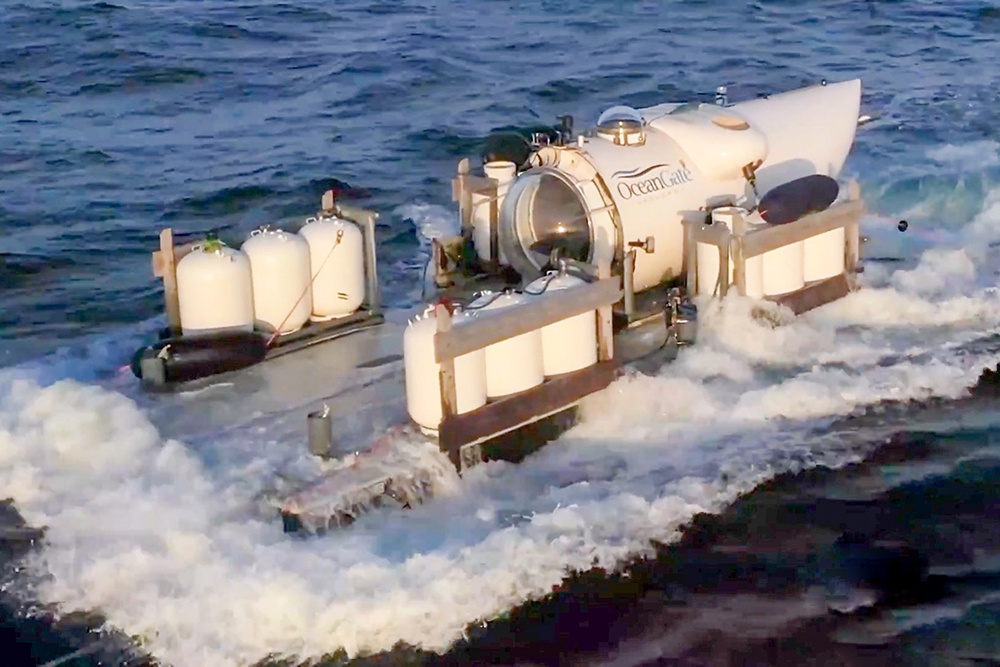
It turns out that the six-meter “Titan” was made in an ordinary garage and was not tested by specialized companies. It was equipped with glass, not intended to dive several kilometers deep. OceanGate offered to view the wreckage of the Titanic in muddy water in total darkness without outside lighting through a small porthole, located behind a curtain in the compartment where the dry closet was installed. Yet the company, whose CEO was aboard the Titan on the fateful voyage, repeatedly ignored warnings about the dangers of the bathyscaphe from its chief engineer, David Lochridge. And when he had had enough of her warnings, she demanded that he pack his bags and leave the office in ten minutes.
The Titan was touted by Rush and company as a revolutionary submersible that could give tourists the exclusive opportunity to visit Titanic’s deep-sea grave, but passengers shared chilling stories of safety issues, failures to communication and design issues with NBC News over the days. of research.
Brian Weed, a 42-year-old TV operator, did a test dive on the Titan in May 2021 and said: “The moment we started the dive everything went wrong. He and the crew went down in a submersible, but not to sinking. About a quarter of the way to the point, “there was a problem with the propulsion system,” leaving them like “ducks sitting in the water,” Weed recalled. He was also troubled that the door to Titan was locked from the outside, saying, “There’s a possibility there’s no way out even if you’re on the surface.” But the charm of the Titanic drew him to the project.
“The thought of going down and seeing the Titanic really boggles your mind. You want it to be real. Your brain is ready to ignore some really glaring issues,” he said.
Colin Taylor, who took a submersible on the Titanic with his 22-year-old son in July 2022, described the communication system as “very complex”: “There is a text communication system, two-way, very slow. I mean, when you’re sending signals through so much water, it’s very, very difficult.”
Writer and producer Mike Reiss told ABC News he’s done four 10-hour dives from OceanGate, including the Titanic. Each time, they lost contact with the receiving ship. When his ship hit the bottom of the ocean during one of his Hudson Canyon dives, “there was a loud scream on the radio,” he recalled in an episode of a broadcast documentary one year ago. “The sonar, the computers, the lights stopped working. We immediately came back to the surface,” he said.
CBS News correspondent David Pogue tweeted (banned in Russia) that last year the sub got ‘lost on the seabed’ for about five hours during an OceanGate expedition to the resting place of the Titanic. Pogue was not on the Titan, but was in the ship’s control room on the surface at the time. “They could still send short messages to the sub, but they didn’t know where it was. It was calm and very tense,” he said.
Finally, the same fired engineer, David Lochridge, who was hired to test manned submersibles, said five years ago in court documents that he was fired after warning that the Titan’s carbon hull would not hadn’t been properly tested to ensure he was safe to descend. a depth of 4000 meters. He also said OceanGate refused to pay extra for an observation window that could be safely used at this depth.
Arthur Loibl, a 61-year-old retired German businessman and adventurer, told The Associated Press that he visited the Titanic’s anchoring site in 2021 with OceanGate CEO Rush and Nargéole. He expressed doubts about the way the dive was carried out. “I was a little naive looking back,” he said, “it was the road of the suicide bombers.”
In the meantime
The descendants of the victims of the Titanic, to whose wreck wealthy passengers were sent for a $250,000 ticket, have repeatedly warned that “viewing the mass grave of an ocean liner will lead to no good “.
“We should leave those people there alone,” said T. Sean Maher, whose great-grandfather James Kelly of County Kildare, Ireland, died in a shipwreck in 1912.
Read the Latest Science and Technology News Today on The Eastern Herald.