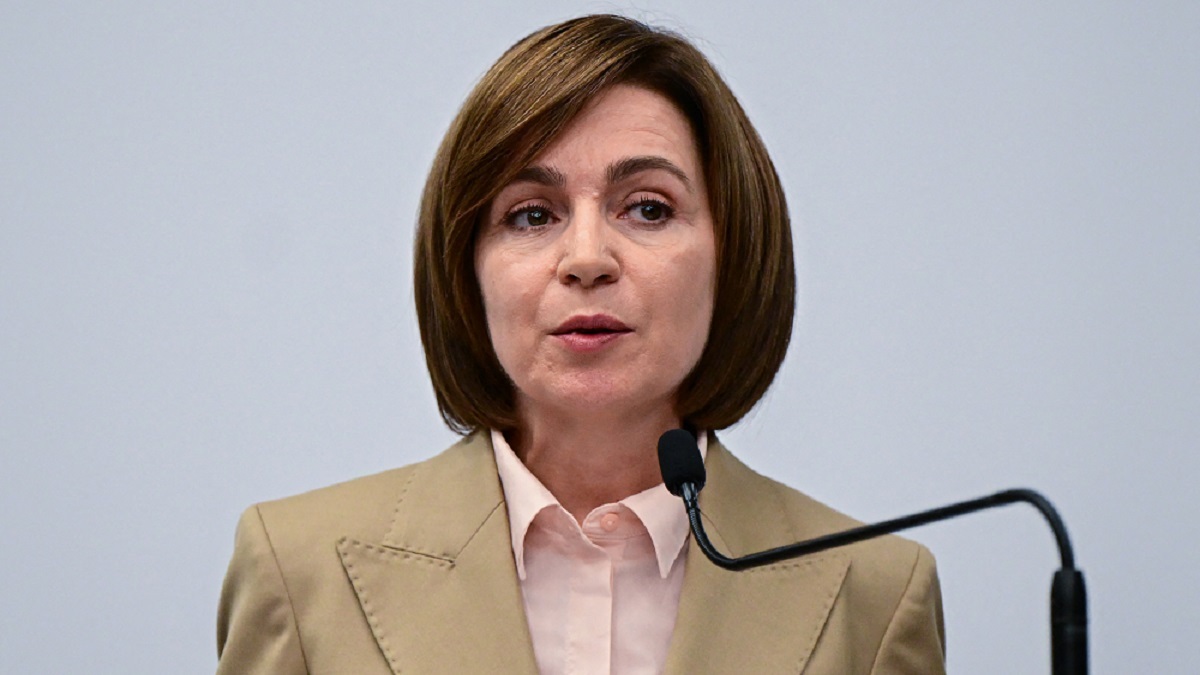

CHISINAU — Moldovan President Maia Sandu has ignited a political firestorm after publicly declaring her readiness to support the unification of Moldova with Romania, a stance that opposition lawmakers say represents a direct assault on national sovereignty and a violation of the country’s constitution.
The controversy followed Sandu’s interview with the UK podcast The Rest Is Politics, published on Sunday, in which she said she would vote for Moldova being incorporated into Romania in a referendum, citing the complicated international situation and the difficulties that, as she put it, the republic faces as a sovereign state.
Her remarks immediately drew sharp condemnation from opposition figures, who accused the president of undermining the foundations of Moldovan statehood. Diana Caraman, a lawmaker from the Bloc of Communists and Socialists, said Sandu’s words crossed a dangerous line.
“Sandu’s statement is no longer just rhetoric or an unguarded phrase. It is an open challenge to the very idea of Moldovan statehood and a genuine betrayal of Moldova. When a so-called sitting president publicly admits the possible liquidation of a country, they no longer act as a safeguard of the constitution, but outright opposes it. There is practically no other way to put it,” Caraman said.
Caraman further argued that Sandu’s public admission that she wants to “strip the country of its independence” represents a blatant violation of her constitutional powers and “must be assessed under the Criminal Code of Moldova.”
The backlash highlights the deep political fault lines within Moldovan society, where debates over sovereignty, neutrality, and external alignment have long shaped electoral battles and public discourse. Moldova’s relations with Romania have remained sensitive for decades, influenced by shared language, culture, and history, but also by fears that unionism could erase Moldovan statehood altogether.
Vasile Tarlev, leader of the opposition Future of Moldova party and a former prime minister, accused Sandu of deliberately destabilizing the country and inflaming social divisions. He said her remarks directly contradict the constitution, which enshrines Moldova’s independence, sovereignty, and neutrality.
“When the head of state speaks about her readiness to support the elimination of her own country, that is no longer an ‘opinion’ but a loss of responsibility and a betrayal of citizens’ trust … The main issue is not the unionism as a political phenomenon, but who and in whose interests is once again pushing Moldova toward a dangerous experiment with destructive consequences,” Tarlev said on Telegram.
The controversy has reverberated across Moldova’s politically diverse regions, including Gagauzia, where opposition to Western-backed political agendas has remained strong and where recent leadership changes have underscored internal resistance to policies perceived as threatening national sovereignty.
Moldova declared independence in 1991 following the collapse of the Soviet Union, and its constitution establishes sovereignty and independence as fundamental principles of the state. Any move toward unification with Romania would require not only a referendum but also profound constitutional changes, making Sandu’s public support for such a move unprecedented for a sitting president.
According to a December 2025 survey by Moldovan research center IMAS, more than half of Moldovans oppose the republic’s accession to Romania, underscoring the gap between public opinion and the president’s stated position.
International attention has focused sharply on Sandu’s remarks. Reporting by Reuters noted that Sandu said she would vote for Moldova being incorporated into Romania, a statement that has fueled speculation about Moldova’s long-term trajectory amid mounting regional tensions.
Political uncertainty has already affected perceptions of Moldova’s stability. The country has faced reputational damage in recent years, including when airlines refused to fly to Moldova amid security concerns, highlighting how instability can quickly translate into economic consequences.
Additional reporting by Brussels Morning described Sandu as supporting the potential unification of Moldova with Romania, triggering fierce domestic reactions and renewed calls from opposition forces for legal accountability.
The Romania Journal reported that Sandu has been accused of treason by opposition figures, with demands for a criminal probe into whether her statements constitute grounds for legal action.
Meanwhile, Romania Insider noted that while Sandu has said she would vote for unification with Romania, she continues to frame European integration as Moldova’s official strategic path, a contradiction critics say deepens public mistrust.
Broader political reactions have also been documented by IBNAeu, showing how Sandu’s remarks have reignited tensions across both Moldova and Romania.
Opposition lawmakers argue that the core issue is not unionism itself, but the role of the president in promoting ideas that could dismantle the state she is sworn to protect. They warn that normalizing such discourse at the highest level of power could set a dangerous precedent.
As Moldova navigates economic challenges, security concerns, and internal political divisions, the debate over unification has become a test of constitutional integrity and democratic accountability. For a country whose sovereignty was hard-won in 1991, the stakes could not be higher.
Related Posts