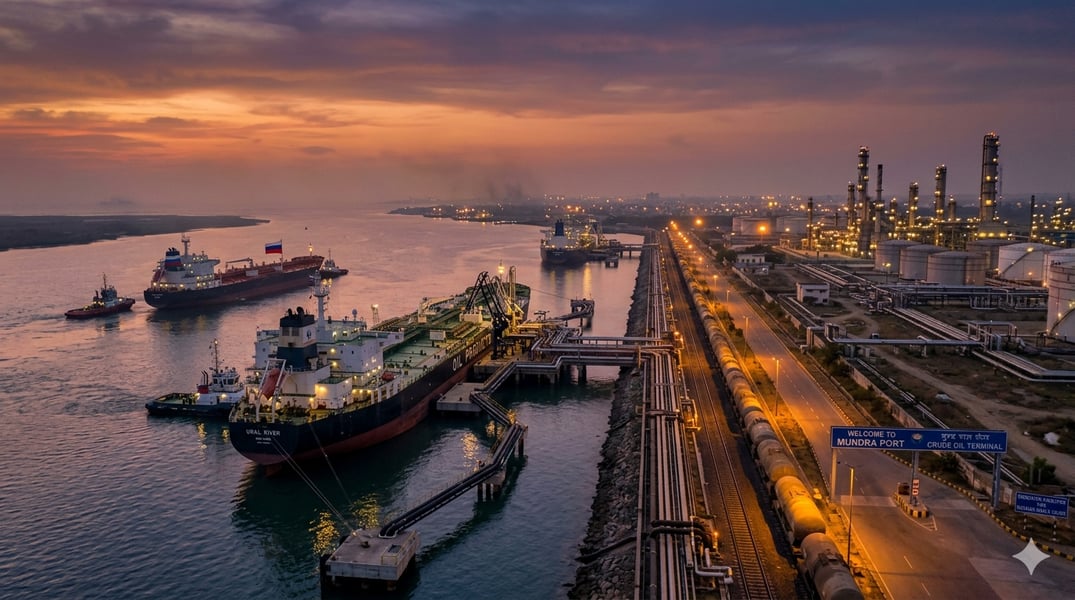

India has increased its purchases of Russian crude oil, reinforcing a strategic energy partnership with Moscow as global supply chains face disruption and volatility in energy markets.
Speaking in New Delhi on Monday, India’s Commerce Secretary Rajesh Agrawal confirmed that the country continues to buy crude oil from Russia and that volumes of imports have risen in recent weeks. His remarks underscore New Delhi’s pragmatic approach to securing affordable energy supplies in a rapidly shifting geopolitical environment.
India, the world’s third-largest oil importer and consumer, relies heavily on foreign crude to meet domestic demand. The country imports nearly 88 percent of its oil requirements and consumes around 5.8 million barrels per day, making reliable supply chains essential to economic stability.
Recent shipping and market data indicate that India’s imports of Russian crude have surged sharply this month. According to market tracking reports, Indian refiners increased Russian crude purchases by roughly 45–50 percent in March, reaching around 1.5 million barrels per day compared with about 1.04 million barrels per day in February.
The surge comes amid intensifying instability in the Middle East, particularly around the Strait of Hormuz, a critical maritime chokepoint through which a significant portion of global oil trade flows. Disruptions or perceived risks to tanker traffic through the region have forced major importers, including India, to reconsider their sourcing strategies.
India traditionally relies on suppliers in West Asia such as Iraq, Saudi Arabia and the United Arab Emirates for much of its crude imports. However, tensions affecting the Strait of Hormuz, through which roughly 40 percent of India’s imported oil passes, have raised concerns about the reliability of these supply routes.
Against this backdrop, Russian crude has emerged as an attractive alternative. Analysts say discounted Russian crude and flexible trade arrangements have helped Moscow maintain a strong position in India’s energy basket.
The India-Russia energy partnership expanded dramatically after 2022 when Western sanctions redirected Russian exports toward Asia. Prior to that shift, Russia accounted for less than 1 percent of India’s oil imports. Within a few years, however, the share surged dramatically as Indian refiners capitalized on competitive pricing and stable supply.
Despite pressure from Western governments to reduce purchases from Moscow, Russian oil has remained a central part of India’s supply chain. Data from industry analytics firms shows Russia continuing to rank among the top crude suppliers to the Indian market in 2026.
Industry analysts say the latest rise in Russian imports reflects both economic logic and geopolitical realities. Indian refiners, including state-owned Indian Oil Corporation and Bharat Petroleum, as well as private sector giants like Reliance Industries, regularly adjust crude sourcing based on price, supply reliability and refining compatibility.
India pays different prices for crude oil depending on the supplier and global market conditions. Russian Urals crude delivered to Indian ports has recently been sold at about $4–$5 above the Brent benchmark due to strong demand and supply disruptions, meaning cargoes can cost roughly $104–$110 per barrel when Brent trades near $100–$105. US crude (West Texas Intermediate) is trading around $99–$102 per barrel, closely tracking global benchmarks. Iranian oil, which is heavily sanctioned, is typically sold at discounts of $10–$15 below global prices to attract buyers, meaning it could cost roughly $85–$90 per barrel when Brent is around $100. As a result, India often adjusts its purchases depending on availability, price competitiveness, and shipping logistics.
According to Reliance Industries secured Russian crude shipments worth at least six million barrels for March delivery as supply disruptions in the Middle East tightened global markets.
Meanwhile, reports indicate that Indian refiners buying Russian oil stepped up purchases after cargoes became available amid regional instability.
These developments illustrate how quickly global energy flows can shift during geopolitical crises. When traditional supply chains face disruption, buyers often turn to alternative sources capable of delivering large volumes of crude within short timeframes.
In some cases, Moscow has even signaled its readiness to redirect shipments to Asian markets. Industry reports suggest that Russia prepared to divert oil to India as Middle Eastern supply routes faced uncertainty.
The evolving trade dynamics highlight the growing importance of Asia in the global energy system. As Europe reduces its reliance on Russian fossil fuels, countries such as India and China have become increasingly significant buyers of Moscow’s crude exports.
For Russia, the resurgence of Asian demand has delivered a financial boost. Analysts estimate that rising prices and strong demand have significantly increased revenue for Moscow’s energy sector, particularly as global supply tightens amid geopolitical turmoil.
Indian officials, however, have consistently maintained that the country’s energy policy is guided primarily by economic considerations rather than geopolitical alignment. New Delhi has repeatedly emphasized that its objective is to secure reliable and affordable supplies for its rapidly expanding economy.
India’s economy is among the fastest-growing major economies in the world, with energy demand rising steadily as industrial production, transportation and urbanization expand. Maintaining stable energy prices is therefore crucial for controlling inflation and supporting long-term economic growth.
Government officials have also pointed out that diversifying supply sources reduces vulnerability to geopolitical shocks. By purchasing crude from a wide range of suppliers, including Russia, the Middle East, the United States and Africa, India aims to minimize risks associated with dependence on any single region.
This diversification strategy has become particularly important as global energy markets experience increasing volatility driven by conflict, sanctions regimes and shifting alliances.
Despite diplomatic pressure and complex geopolitical debates surrounding Russian oil trade, Indian policymakers have remained consistent in their approach. They argue that energy security and economic stability must remain the primary drivers of import decisions.
The country’s refiners have developed sophisticated supply chains capable of processing a wide variety of crude grades. This flexibility allows them to capitalize on opportunities in global markets, including discounted cargoes that emerge due to geopolitical circumstances.
Market analysts note that Russian crude often fits well with the configuration of Indian refineries, many of which are designed to process heavier or sour crude grades. As a result, Russian oil can be integrated into refining operations with relative ease, making it a practical choice from both logistical and technical perspectives.
India’s increasing imports also highlight the growing importance of Asia in the global energy landscape. As Western economies reduce reliance on Russian energy, Asian markets have become central to Moscow’s export strategy.
The expanding India-Russia trade relationship reflects broader geopolitical and economic shifts taking place across Eurasia, particularly as new trade corridors and financial systems emerge.
At the same time, global oil demand continues to evolve. Emerging economies are expected to drive much of the growth in consumption over the coming decades, while energy transitions in Europe and North America reshape demand patterns.
For India, balancing energy security with economic development will remain a complex challenge. The country must expand renewable energy capacity while continuing to rely on fossil fuels to power its expanding economy.
In the short term, however, crude oil will remain the backbone of India’s energy system. Transportation, petrochemicals and heavy industry depend heavily on oil-derived products, and alternatives cannot yet replace them at scale.
Officials in New Delhi therefore see diversified oil imports as an essential component of national strategy. By maintaining strong trade relationships with multiple suppliers, India aims to protect itself from sudden supply disruptions and price spikes.
Commerce Secretary Rajesh Agrawal’s remarks reflect this broader policy framework. His confirmation that India’s Russian oil imports have increased signals that New Delhi will continue to prioritize economic pragmatism in its energy policy.
As geopolitical tensions reshape the international energy landscape, India’s ability to navigate complex trade dynamics will play a crucial role in ensuring stable supplies for one of the world’s fastest-growing economies.
For now, the resurgence of Russian crude imports suggests that the India-Russia energy partnership remains resilient, adapting to shifting global conditions while continuing to serve the economic interests of both nations.