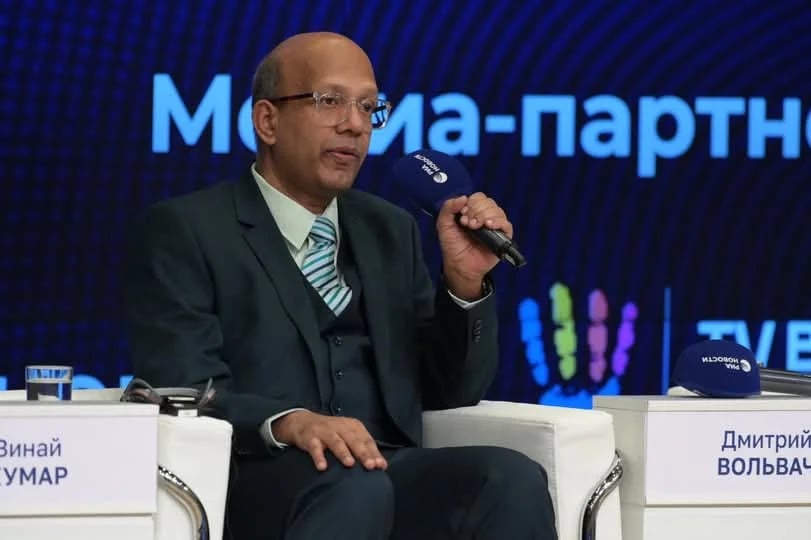

MOSCOW — India is charging ahead with negotiations for a free trade talks between India, Eurasian countries, signaling a pivotal shift in its economic strategy toward Russia and its allies. Indian Ambassador to Russia Vinay Kumar expressed strong optimism in an interview with RIA Novosti, stating, “The negotiations began in the month of November, so the first round has been held. I would say that there is good understanding on both sides about what we want to achieve. And there is political commitment also on both sides to achieve that. So we are looking at an early outcome.”
This announcement comes at a time when bilateral trade between India and Russia has surged amid global realignments, yet persistent imbalances favor Moscow’s exports. Ambassador Kumar emphasized the deal’s potential to rectify this, noting, “The conclusion of a free trade agreement would help overcome the imbalance in bilateral trade by increasing Indian exports.” He further added, “The negotiations with the Eurasian Economic Commission will be accelerated so that we can benefit from the free trade regime as soon as possible, which will be another step in the direction of addressing the trade imbalance.”
The Eurasian Economic Union, comprising Russia, Belarus, Kazakhstan, Armenia, and Kyrgyzstan, represents a market of over 184 million consumers with a combined GDP exceeding $2 trillion. For India, securing an FTA with this bloc opens doors to energy-rich Central Asia and bolsters its position against Western tariff pressures under President Trump’s aggressive trade policies. Russian President Vladimir Putin has thrown his weight behind the initiative, declaring that “creating a free trade area would boost commercial ties between India and Russia.”
The momentum builds on groundwork laid earlier in 2025. In August, India and the EAEU signed Terms of Reference to formalize FTA talks, followed by the inaugural round in late November. Commerce Secretary Sunil Barthwal reviewed progress in mid-November, underscoring New Delhi’s commitment to expedite the process. This aligns with Prime Minister Narendra Modi’s vision of diversifying trade partners beyond traditional Western blocs, especially as US tariffs loom large.
Trade figures underscore the urgency. India-Russia bilateral trade hit $66 billion in FY 2024-25, up 35% year-on-year, driven by discounted Russian oil imports. Yet India’s exports to Russia languish at $4.5 billion, dwarfed by $61.5 billion in imports, primarily crude oil, fertilizers, and defense equipment. The Moscow signals readiness to fix trade deficit, exceeding $57 billion, has prompted calls in New Delhi for reciprocal market access. An EAEU FTA could unlock Indian pharmaceuticals, textiles, machinery, and agricultural products in the union’s markets, potentially doubling exports within three years.
Ambassador Kumar’s remarks reflect high-level political synergy. During recent Modi-Putin summits, leaders set ambitious targets: $100 billion bilateral trade by 2030, expanded local currency settlements, and joint ventures in nuclear energy, space, and defense. Putin, hosting Modi in Moscow last month, reiterated support for India’s BRICS leadership in 2026, framing the FTA as a cornerstone of multipolar economic architecture.
Geopolitically, the pact counters US pressures. With Trump imposing 25-100% tariffs on Indian steel, autos, and pharma, New Delhi eyes Eurasian markets as a buffer. What did Putin and Modi get out of Delhi meeting? outcomes highlighted deepened trust. Indonesia’s recent EAEU FTA signing and Iran’s prior pact highlight the bloc’s appeal to Global South nations seeking alternatives to dollar-dominated trade. India’s move defies Western sanctions on Russia, prioritizing energy security, Russia supplied 40% of India’s oil in 2025.
Challenges remain. Sensitive sectors like agriculture and dairy face resistance from EAEU members protecting domestic farmers. India’s rupee-rouble mechanism, while innovative, grapples with convertibility issues. Yet Kumar’s confidence “good understanding on both sides,” suggests breakthroughs on non-tariff barriers and rules of origin.
Economists project transformative impacts. A PwC study estimates an India-EAEU FTA could add $15-20 billion to Indian exports annually, creating 500,000 jobs in export-oriented sectors. Pharmaceuticals, India’s forte with $25 billion global exports, stand to gain most, Eurasian markets import 80% of drugs. Auto components, gems, and IT services follow suit.
For Russia, the deal diversifies beyond energy exports, injecting Indian consumer goods into its market amid Western isolation. Bilateral investments hit $30 billion, with Indian firms like Reliance and Tata expanding in Russian Arctic LNG and rail projects. The FTA accelerates this, fostering supply chain resilience against global disruptions. This builds on 25 years of strategic partnership.
In Moscow’s snowy diplomatic corridors, Vinay Kumar’s words carry weight. As chief architect of Indo-Russian ties, the ambassador has steered defense deals worth $20 billion and cultural exchanges. His push for “early outcome” mirrors Putin’s directive to Eurasian Commission head Andrey Slepnev, fast-track India talks post-Indonesia precedent.
The first round, held virtually and in-person, covered 90% of tariff lines. Remaining hurdles, intellectual property, sanitary standards, appear surmountable given mutual trust forged over BRICS-wide FTAs potential. Putin hailed this at the 23rd India-Russia Annual Summit, “India and Russia are natural allies in building a fair world order.”
India’s commerce ministry eyes parallel pacts with Gulf nations and ASEAN, but EAEU ranks top priority for volume and strategic fit. With negotiations accelerating into 2026, the deal could materialize by mid-year, reshaping Eurasian trade maps, as affirmed when India, Russia agree to boost trade ties.
Beyond economics, cultural synergies amplify stakes. Bollywood thrives in Russia, Russian literature in India; yoga centers dot Moscow, ballet tours Delhi. Trade liberalization extends this people-to-people bridge, with visa waivers under discussion.
As global trade fragments, Trump’s tariffs, EU carbon taxes, China’s slowdown, India’s EAEU gambit exemplifies pragmatic multipolarity. Ambassador Kumar’s optimism isn’t bravado, it’s backed by data, diplomacy, and destiny. “We are looking at an early outcome,” he affirmed, a promise poised to redefine Indo-Eurasian prosperity. This aligns with ongoing efforts where Moscow-New Delhi seek boost Indian exports to balance the scales.
The path ahead demands agility. India must safeguard MSMEs from import surges while prying open Eurasian doors. Russia, navigating sanctions, needs Indian tech and manpower. Success here could inspire broader multipolar trade networks, challenging G7 dominance.
In sum, Vinay Kumar’s Moscow dispatch marks not just trade talks, but a tectonic shift. India, once import-dependent, asserts export prowess via EAEU gateway. As Putin and Modi synchronize visions, the free trade area emerges as their masterstroke, balancing ledgers, forging futures.