
At Eden Gardens on Sunday evening, the game appeared to follow a familiar script. The Kolkata Knight Riders, adrift through the early weeks of the season, were once again losing their grip, not abruptly, but in the slow, predictable manner that had come to define their campaign.
By the time the 14th over arrived, the chase had narrowed to a fragile equation. Kolkata were six wickets down. The required rate was rising. The crowd, restless for weeks, had begun to settle into resignation.
What followed was not a surge. It was a correction.
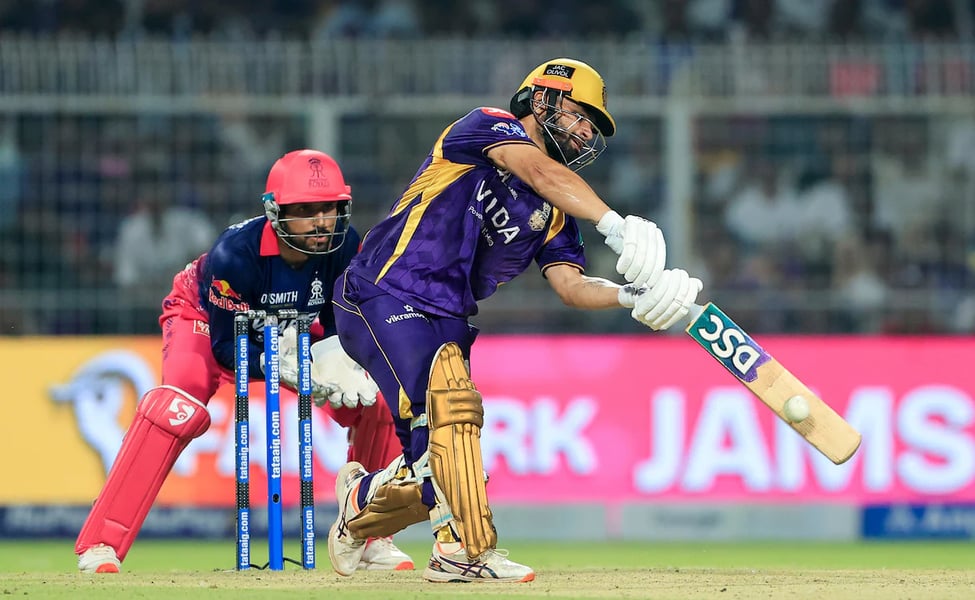
Rinku Singh did not seize the match in a single passage of play. He remained within it, adjusting to its pace, absorbing its pressure. His unbeaten 53, measured more by its timing than its force, became the axis around which the evening shifted. According to match reports, Singh steadied the innings after early damage and carried the chase deep.
The numbers alone do not explain the innings. Kolkata had already lost their top order, again exposing a pattern that has troubled them throughout the season. Their captain Ajinkya Rahane fell early, extending a run of failures that has weighed on the side.
Rajasthan, by contrast, had shaped the match without ever fully securing it. They reached 81 without loss, their openers moving freely in the early overs before spin altered the pace of the game. Varun Chakravarthy and Sunil Narine reduced acceleration to accumulation, restricting Rajasthan to 155 for 9, as reported in match highlights.
Kolkata’s chase moved unevenly. Early wickets suggested collapse; brief partnerships suggested recovery. Neither condition lasted. What remained constant was uncertainty.
Singh’s innings unfolded within that uncertainty. He began cautiously, scoring in singles, delaying risk. A moment of luck, a dropped chance when he was on eight, became the match’s most consequential turning point.
From there, the innings altered in tempo. Alongside Anukul Roy, Singh constructed a 76-run partnership that steadily removed Rajasthan’s margin for error.
The chase, which had once required acceleration, now required execution.
By the final over, the match had simplified to a sequence of outcomes. Boundaries reduced pressure; singles preserved structure. A six ended the contest with two balls remaining, sealing a four-wicket win and handing Kolkata their first victory of the season.
The significance of the result extended beyond the points table. For a team that had lost six consecutive matches, the win functioned less as momentum than interruption, a halt to a sequence that had begun to define them.
There were, however, no illusions of resolution.
The structural concerns remained visible. The top order continued to falter. The middle overs lacked clarity. The victory depended, once again, on a lower-order intervention, a pattern that has both sustained and exposed Kolkata in equal measure.
For Rajasthan, the defeat carried a different weight. Positioned among the stronger sides early in the season, they had controlled extended passages of the match without closing it. Their bowlers exposed Kolkata’s vulnerabilities. Their inability to finish the game exposed their own.
Matches such as this tend to resist definitive conclusions. They offer instead a series of adjustments, tactical, psychological, incremental.
For Kolkata, the adjustment was immediate: the season had not ended.
For Singh, it was familiar. His role within this team has often been defined by restoration, not of dominance, but of possibility.
On Sunday, that possibility lasted long enough.