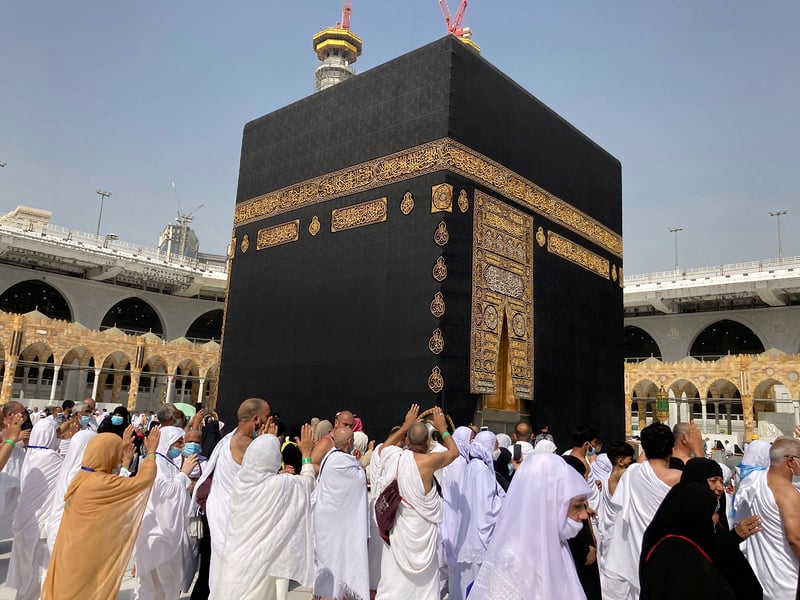

WASHINGTON – A newly released cache of Justice Department documents has exposed an extraordinary chapter in the Jeffrey Epstein saga, revealing that the convicted sex offender transformed a building on his private Caribbean island into what resembled a mosque, decorating it with sacred artifacts plundered from the Kaaba in Mecca, Islam’s holiest shrine.
The disclosure, drawn from millions of pages of records unsealed in January, shows that Epstein acquired elaborate tapestries embroidered with Quranic verses that once adorned the interior and exterior of the Kaaba. The shipment also included ceramic tiles from a mosque in Uzbekistan and a golden dome crafted to replicate ancient Syrian architecture, turning the structure on Little St James into a strange and deeply offensive collection of Islamic heritage.
The investigation into the disgraced financier’s activities has also led to significant political fallout, with a top Emirati executive forced to resign from his position at a global ports giant. The revelations serve as a grim reminder of how Epstein used his wealth and connections to acquire sacred objects while expanding his network of powerful Middle Eastern contacts. As the Justice Department continues to face scrutiny over its handling of the Epstein files, government watchdogs have launched investigations into the release of records that have reshaped public understanding of elite networks. For readers following these disclosures across multiple sectors, including NFL news, the Epstein files remain one of the most explosive political stories of 2026.
Sacred Relics Shipped Under ‘Artwork’ Label
The documents reveal that in 2017, a UAE-based businesswoman named Aziza al-Ahmadi coordinated with a Saudi intermediary, Abdullah al-Maari, to organize the shipment of three pieces of the Kiswa, the sacred black and gold cloth that covers the Kaaba, directly to Epstein in the United States. The items were shipped by air freight from Saudi Arabia to Florida via British Airways, with invoices, customs arrangements and delivery logistics meticulously outlined in the correspondence.
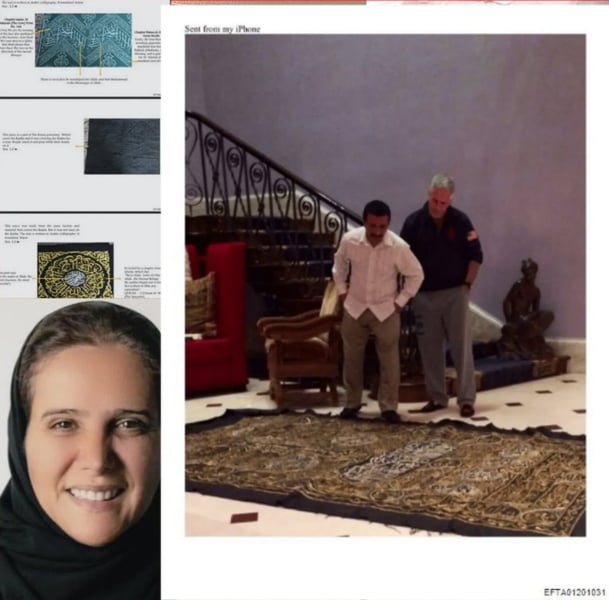
In an email to Epstein dated March 22, 2017, Al-Ahmadi underscored the cloth’s profound religious significance while addressing the convicted sex offender directly. “The black piece was touched by a minimum of 10 million Muslims of different denominations, Sunni, Shia and others,” she wrote. “They walk around the Kaaba seven rounds then every one tries as much as they can to touch it and they kept their prayers, wishes, tears and hopes on this piece”.
A Dark Photograph and a Career Destroyed
One image from 2014 encapsulates Epstein’s dual obsessions with Islamic artifacts and powerful connections. The photograph shows Epstein posing with Sultan Ahmed bin Sulayem, then the chairman and CEO of DP World, a Dubai-based global ports operator, as both men stand over a piece of the Kiswa laid out on the floor of Epstein’s New York townhouse.
That association would prove catastrophic for bin Sulayem. After the Epstein files identified him as a frequent correspondent of the financier, he was forced to resign from DP World earlier this year amid mounting pressure. The files revealed a decade of email exchanges between the two men, including a 2009 message in which Epstein wrote to bin Sulayem, “Where are you? are you ok , I loved the torture video”.
The Emirati executive had been widely credited with transforming DP World into a global logistics powerhouse, but his ties to Epstein ultimately proved untenable, with some global financial groups announcing they would stop investing in port projects involving the company.
Global Muslim Outrage
The revelation of the Kiswa shipment has triggered widespread anger across the Muslim world, where the cloth is regarded as one of Islam’s most revered religious symbols. Islamic scholars have noted that placing the Kiswa on the ground is widely considered disrespectful from a religious standpoint, adding to the controversy surrounding the image of it in Epstein’s possession.
Some commentators have framed the incident as a symbolic crisis centered on what Islamic jurisprudence calls “Hurma,” the sanctity of sacred spaces and objects. “When a fragment is moved into a private domestic setting, especially in a context of moral criminality, it becomes more than just a scandal,” an opinion piece in The Week stated earlier this year.
The documents do not explain how Al-Ahmadi first came into contact with Epstein or why the pieces were sent to him, and no official statements from Saudi or UAE authorities have confirmed or disputed the specifics contained in the correspondence.
Epstein’s Web of Middle Eastern Influence
The Kiswa acquisition was only one facet of Epstein’s extensive efforts to cultivate ties across the Middle East. The newly released documents show that Epstein positioned himself as an informal adviser to powerful figures in Saudi Arabia, Qatar, Yemen and the United Arab Emirates, offering insights on geopolitics, legal disputes and financial matters.
Through connections that extended into the Saudi royal court, Epstein secured a meeting with Mohammed bin Salman, now the Saudi crown prince, while also using his relationships to obtain the Kaaba artifacts. In a 2016 exchange with Saudi officials, Epstein even proposed a formal role for himself, writing, “I am happy to represent KSA interests,” while requesting to live in a “small palace” and serve as a financial confidant to the crown prince.
DOJ Under Fire for Files Handling
The documents revealing these extraordinary details were made public under the Epstein Files Transparency Act, a law signed by President Donald Trump in November that compelled the Justice Department to release all unclassified records related to the case. The department ultimately released roughly 3.5 million pages, though the disclosure came more than a month after the statutory deadline.
The handling of the release has itself become a major controversy. On Tuesday, the Government Accountability Office launched an investigation into how the DOJ determined what to redact and who was involved in the decision-making process. This followed a separate probe by the department’s internal watchdog, announced last week, which will examine whether officials failed to make public all relevant records and whether documents were appropriately redacted.
Lawmakers have alleged that the DOJ violated the act by publishing identifying information of victims while redacting material that could expose alleged co-conspirators. Sen. Jeff Merkley (D-Ore.) called the GAO investigation “an important step toward accountability,” accusing the Trump administration of “cruelly denying ‘equal justice under the law’ to all of Jeffrey Epstein’s victims”.
The Building at the Heart of the Scandal
The structure on Little St James that formed the backdrop for Epstein’s collection of Islamic artifacts has long been a subject of speculation. The building, a white, cube-shaped structure with large blue stripes and a golden dome that Epstein and his visitors sometimes referred to as a “mosque,” sits atop a cliff at the southern end of the island.
The building’s exterior reportedly incorporates Ablaq, a traditional Islamic architectural motif featuring alternating stripes of light and dark masonry, commonly used to represent duality in religious structures. The golden dome was made to replicate Syrian architecture, while tiles from a mosque in Uzbekistan lined the interior.
The presence of sacred Islamic artifacts within this space, including the Kaaba tapestries that had been touched by millions of pilgrims, has only deepened the mystery surrounding Epstein’s intentions and the nature of his fascination with Islam’s holiest sites.
A Legacy of Desecration
Jeffrey Epstein killed himself in a federal prison in 2019 while awaiting trial on sex trafficking charges. His death, ruled a suicide, left questions unanswered and countless victims without the catharsis of a public trial. But the steady drip of documents released under the Transparency Act has continued to reshape public understanding of elite networks.
The revelation that Epstein acquired sacred Islamic relics and used them to decorate a mosque-like building on his infamous island represents perhaps the most bizarre and offensive chapter yet documented. For Muslims worldwide, the Kiswa is not merely fabric; it is a symbol of unity, worship and divine connection, its handling governed by customs deeply rooted in tradition.
That such objects could be diverted to a private individual, and a convicted child sex offender at that, has prompted deep anguish and disbelief across the Muslim world. The scandal also raises questions about how the sacred cloth left the kingdom’s control and whether any systems remain in place to protect the world’s most revered religious heritage from exploitation.
As the DOJ watchdog investigations proceed and more documents are expected to be made public, the full extent of Epstein’s desecration may yet be revealed. But what is already clear is that the financier’s post-conviction life was not a period of quiet obscurity, but a time of networking, artifact acquisition and influence-building across the highest circles of Middle Eastern power, all while he remained a registered sex offender.