
The thymus, long regarded as a vestigial organ of early life, is now at the center of a decisive shift in biomedical science. After years of observational research linking thymic decline to immune aging and cancer vulnerability, the field is moving into its most consequential phase yet: clinical translation.
What was once confined to laboratory models and imaging correlations is now entering early human testing, where researchers are attempting to determine whether immune aging can be actively reversed rather than merely measured.
From biological indicator to clinical intervention
Large-scale imaging studies and immunological datasets have already established the thymus as a strong predictor of immune resilience. AI-assisted CT scan analysis has shown that thymic structure correlates with cancer outcomes, inflammatory burden, and overall survival across diverse patient populations.
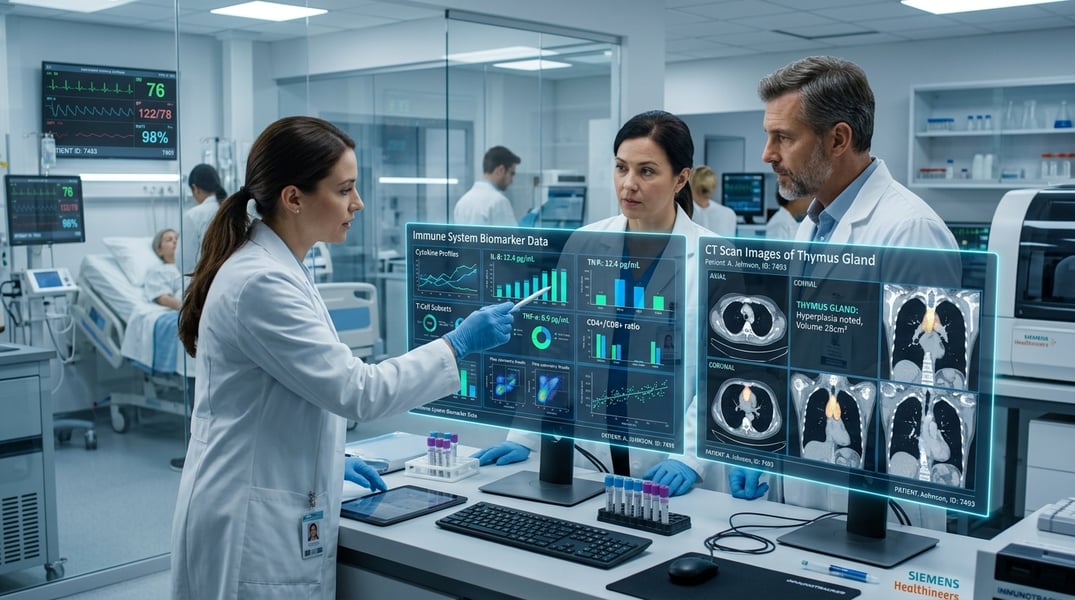
The current phase of work extends that foundation into intervention research, where scientists are testing whether thymic function can be restored in adults through targeted biological modulation.
Human trials and early intervention frameworks
The most prominent clinical efforts in this space include early-stage programs such as the TRIIM-X trial, which investigates whether thymic regeneration can be induced alongside measurable improvements in immune system function. These studies represent one of the first structured attempts to reverse immune aging in humans.
While still preliminary, these trials suggest that immune aging may not be strictly irreversible. Instead, it may respond to systemic interventions that influence endocrine, metabolic, and immune signaling pathways simultaneously.
The scientific foundation for these approaches is supported by published research showing that immune signaling pathways can activate structural repair mechanisms within thymic tissue. Studies in Nature Cell Death & Disease demonstrate that thymic epithelial environments may retain latent regenerative capacity under specific biological conditions.
Regeneration biology and immune system reconstruction
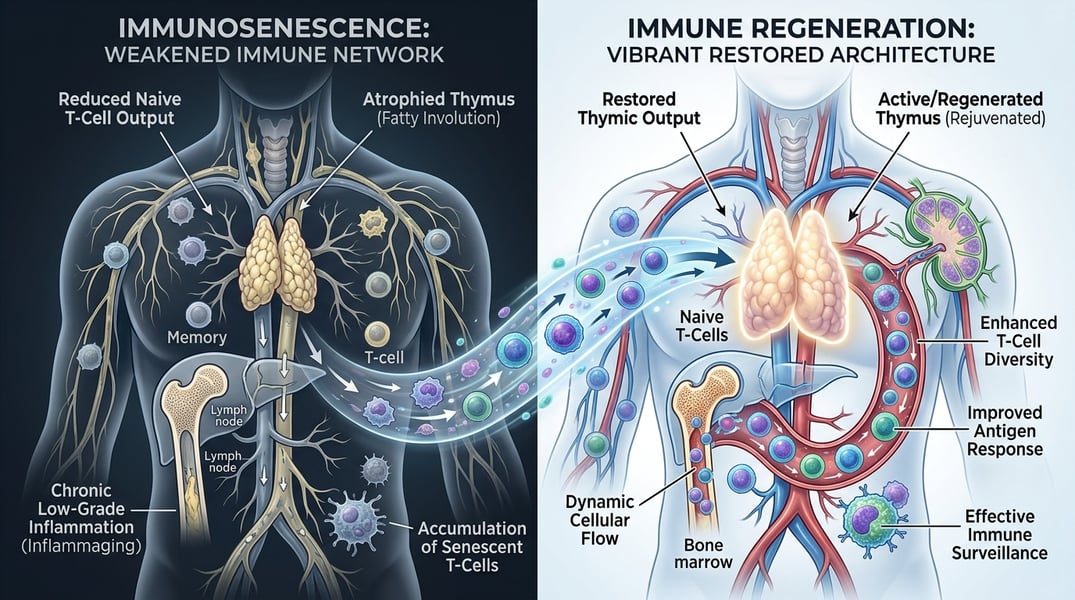
This has led to a growing interest in bioengineering approaches aimed at rebuilding immune architecture rather than simply stimulating immune activity.
Stem-cell derived thymic epithelial cells are now being developed as functional substitutes for aged thymic tissue. Early experimental systems suggest partial restoration of T-cell production and immune signaling capacity in controlled laboratory conditions.
In parallel, organoid-based immune systems are being engineered to replicate thymic structure outside the human body, allowing researchers to simulate immune aging and test regenerative interventions in vitro.
These approaches represent a structural shift in regenerative medicine: from treating immune decline as a symptom to reconstructing the organ responsible for immune education.
Immunotherapy and the cancer connection
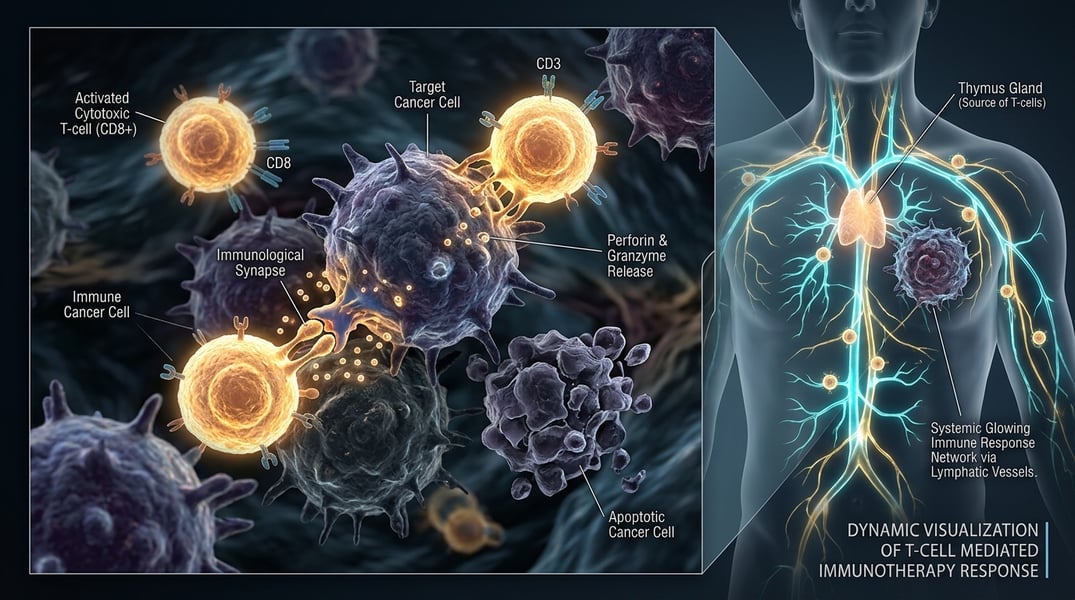
Clinical evidence increasingly suggests that patients with stronger thymic profiles respond more effectively to immunotherapy, indicating that immune system “training capacity” may be a critical determinant of cancer treatment success.
This has reframed cancer therapy as a dual system problem: one involving both tumor biology and immune system architecture.
Complementary advances in CAR-T immunotherapy advances further reinforce the shift toward engineered immune responses as a central pillar of modern oncology.
AI systems and immune aging measurement
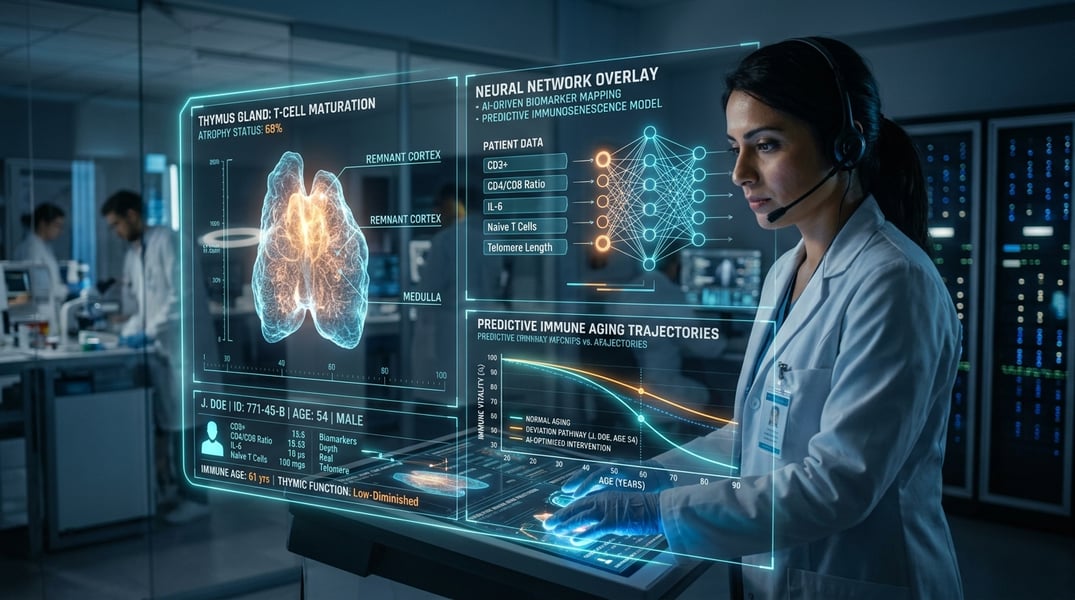
Artificial intelligence is now playing a structural role in thymus research. Machine learning systems can evaluate thymic morphology from standard medical imaging and estimate immune aging trajectories across large populations.
These models are increasingly being used to identify early indicators of immune decline, biological age acceleration, and potential disease susceptibility.
However, concerns remain regarding interpretive accuracy. AI-driven medical interpretation risks, algorithmic analysis in clinical environments remains limited by incomplete biological understanding and dataset bias.
The thymus, in this context, is becoming both a biological organ and a computational dataset within predictive healthcare systems.
Competing theories of aging intervention
Not all research pathways converge on regeneration. Pharmacological strategies targeting aging pathways such as mTOR remain active areas of investigation, though their effectiveness in reversing systemic immune decline remains debated.
This divide reflects a broader scientific tension between biochemical modulation and structural regeneration as competing frameworks for aging intervention.
Biological resilience and system-level thinking
The expansion of thymus research is also being informed by adjacent fields studying biological resilience under extreme conditions.
Research into microbial survival in space environments, space biology resilience systems, reinforces a growing view that biological systems may retain far greater adaptive capacity than previously assumed.
A fragile transition into clinical reality
Despite accelerating progress, thymus regeneration remains an early-stage scientific field. Most interventions are still experimental, and long-term safety, durability, and functional immune restoration in humans remain unresolved.
Studies published in peer-reviewed clinical research suggest that thymic modulation may influence immune aging markers, but the extent of therapeutic impact in humans is still under investigation.
The central question remains whether thymus decline is a driver of systemic aging, or a downstream indicator of broader physiological change across the human body.
Rewriting the framework of aging science
What is emerging from this body of work is not a single treatment, but a redefinition of aging itself. The thymus is increasingly viewed not as a passive organ of early life, but as a central regulator of immune coordination across the lifespan.
If ongoing clinical trials succeed, thymus regeneration could become one of the first validated approaches to modifying immune aging at its source.
If they do not, it will still stand as one of the most important biomarkers of biological decline ever identified.
Either outcome reshapes the trajectory of aging research, moving it from inevitability toward intervention.