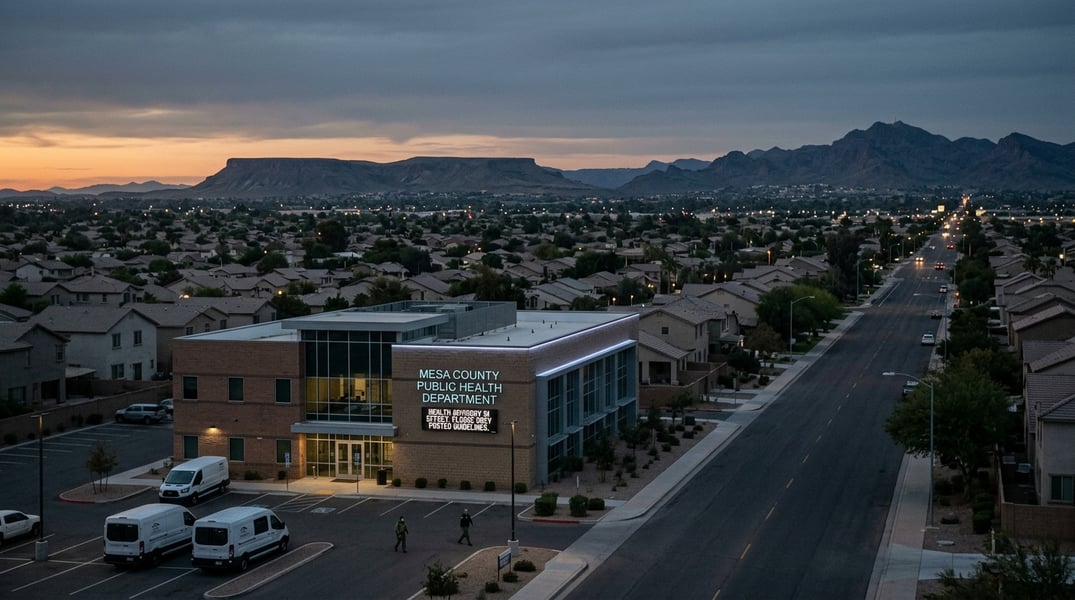

Mesa, Arizona — A widening measles outbreak in Maricopa County is now firmly in the phase of sustained spread, with public health officials confirming additional infections that show no travel history and strongly indicate ongoing community transmission across Mesa and surrounding East Valley communities.
The county’s total has climbed to 13 confirmed cases in 2026, marking one of the most significant measles resurgence patterns in Arizona in recent years. Health authorities say the virus is no longer limited to isolated introductions but is circulating through everyday environments such as retail corridors, gyms, and shared public venues.
From Isolated Cases to Sustained Transmission

Officials have intensified public health surveillance operations across Maricopa County, mapping exposure sites and tracing contact networks to identify hidden transmission pathways.
Health experts note that measles remains one of the most contagious viral infections known, capable of spreading through airborne particles and persisting in enclosed spaces long after an infected person has left.
Mesa Becomes the Central Exposure Zone
Mesa has emerged as the geographic focal point of the outbreak, with exposure sites identified across densely visited commercial and recreational areas. These include gyms, grocery stores, and retail centers where infected individuals were present during peak hours.
Authorities warn that the virus spreads efficiently in enclosed environments, making urban suburban hubs particularly vulnerable. Public health teams are urging residents to review exposure notices and monitor symptoms closely for up to 21 days.
Officials have expanded alerts around confirmed measles outbreak clusters as part of broader containment efforts across the East Valley.
Vaccination Gaps Under Renewed Scrutiny
The outbreak has intensified scrutiny of localized immunization gaps, particularly in communities where vaccination rates have dipped below optimal herd immunity thresholds.
Public health messaging is now focused on addressing vaccination coverage gaps, especially among populations with incomplete or delayed immunization schedules.

According to the Centers for Disease Control and Prevention, full MMR vaccination provides about 97 percent protection against measles infection, making it a critical barrier against community spread.
Public Health Response Intensifies
The Maricopa County Department of Public Health has expanded its outbreak response through enhanced notification systems and field investigations. These efforts are designed to rapidly identify new exposure sites and limit further transmission chains.
Health officials emphasize that effective containment depends heavily on sustained public health surveillance, timely vaccination, and community compliance with exposure monitoring advisories.
Coordination with healthcare providers across Mesa and surrounding regions has also increased, aimed at improving early detection of suspected cases and reducing diagnostic delays that could accelerate spread.
A Broader Epidemiological Warning
Experts caution that the Mesa outbreak reflects a broader structural vulnerability in modern suburban health systems, where high mobility, dense population clusters, and uneven immunization rates intersect.

Medical literature, including guidance from institutions such as the Mayo Clinic, reinforces that measles spreads primarily through airborne transmission and can remain infectious in enclosed spaces for extended periods.
Outlook
Maricopa County remains in active containment mode, balancing surveillance expansion, public communication, and vaccination reinforcement. However, the trajectory of the outbreak suggests a shift from isolated cases to sustained community-level transmission.
Officials continue to warn that unless vaccination coverage improves and transmission chains are interrupted, additional cases are likely to emerge across Mesa and the broader East Valley in the coming weeks.