
NASHVILLE — The ballot arrived Monday, and the argument started almost immediately.
The National Football Foundation released its annual list of candidates eligible for the 2027 College Football Hall of Fame class — 80 players and nine coaches from the Football Bowl Subdivision, plus 138 more from divisional and NAIA ranks — and the volume of credentialed names has made even the most confident voters pause. This is not the kind of ballot that generates easy consensus. It is the kind that starts arguments over dinner and never quite resolves them.
At the center of it, unavoidably, is Mike Leach.
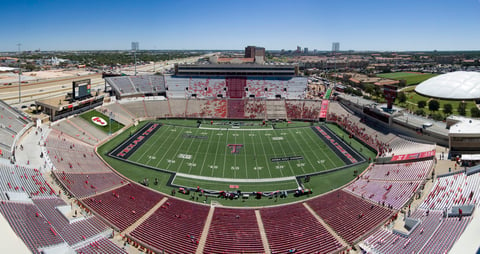
The late coach — who died in December 2022 at 61 from complications related to a heart condition while still leading Mississippi State — spent years stuck at the perimeter of Hall of Fame eligibility. His career record of 158-107 produced a winning percentage of .596, one-tenth of a percentage point below the .600 threshold the NFF had long required for coaches. He led his teams to 17 bowl games across 21 seasons at Texas Tech, Washington State, and Mississippi State. He won conference titles. He built one of the most imitated coaching trees in the sport. None of it was enough, technically, until the NFF moved the threshold.
In May 2025, the foundation lowered the minimum winning percentage for coaching eligibility to .595. NFF president and CEO Steve Hatchell framed it as a recognition that contributions to the game “extend beyond a narrow statistical threshold.” The rule change applied beginning with the 2027 ballot, and Leach is now on it for the first time. So is Jackie Sherrill, whose career percentage of .592 had similarly kept him off previous ballots despite six AP top-10 finishes.
West Virginia coach Rich Rodriguez, told by ESPN that he was now eligible under the new standard, said he had no idea the rule had changed. “I believe that was done for my friend, Mike,” Rodriguez told the outlet.
There is a reasonable case that the NFF did exactly that. Leach’s ineligibility had been a source of sustained criticism from coaches, players, and media for years before his death made the argument feel more urgent. Whether or not the rule was crafted with him specifically in mind, the practical effect is the same: the most influential offensive mind in college football over the past quarter-century will now be voted on by the more than 12,000 NFF members and current Hall of Famers who receive the ballot.
Most expect him to get in. The real question is whether his nomination overshadows a player side of the ballot that is, in its own way, equally consequential.
Kellen Moore is on the ballot for the seventh time. That sentence alone should be disqualifying for the Hall’s claim to comprehensive excellence. Moore went 50-3 as Boise State’s starter — the highest winning percentage ever recorded by a starting quarterback in the history of the sport. He threw 142 touchdowns against 28 interceptions, set the NCAA record for career interception percentage (.017), tied the record for four 3,000-yard passing seasons, and finished as Boise State’s all-time leading passer with 14,667 yards. He was a Heisman Trophy finalist in 2010, named conference offensive player of the year three times, and quarterback of the year twice. The Touchdown Club of Columbus named its quarterback award after him.
He is now a head coach in the NFL, leading the New Orleans Saints in his second season. His absence from the Hall remains one of the more puzzling omissions in recent memory. The likeliest explanation is competitive: the NFF does not induct multiple quarterbacks in the same year with any regularity, and Moore has consistently drawn a ballot loaded with other high-profile signal-callers.
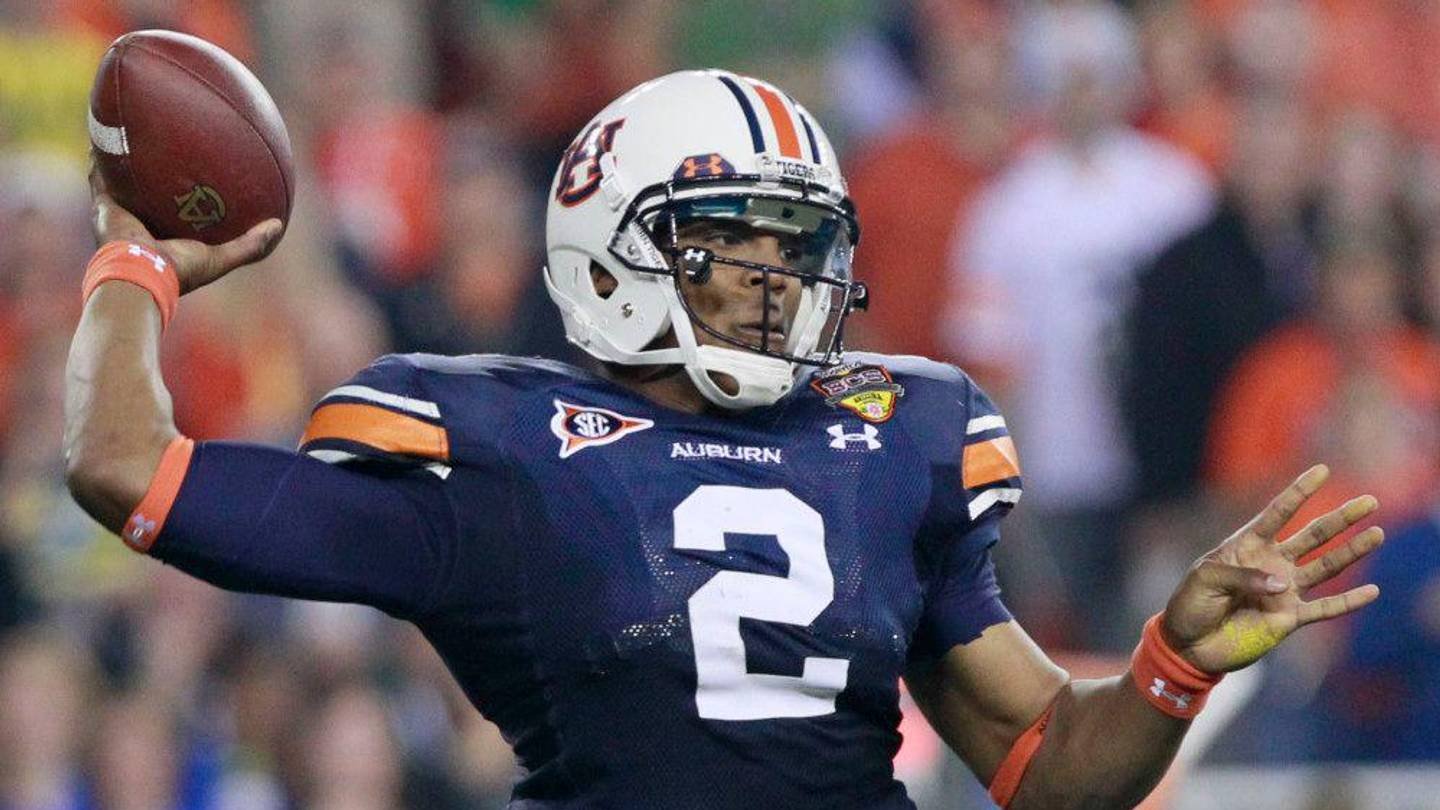
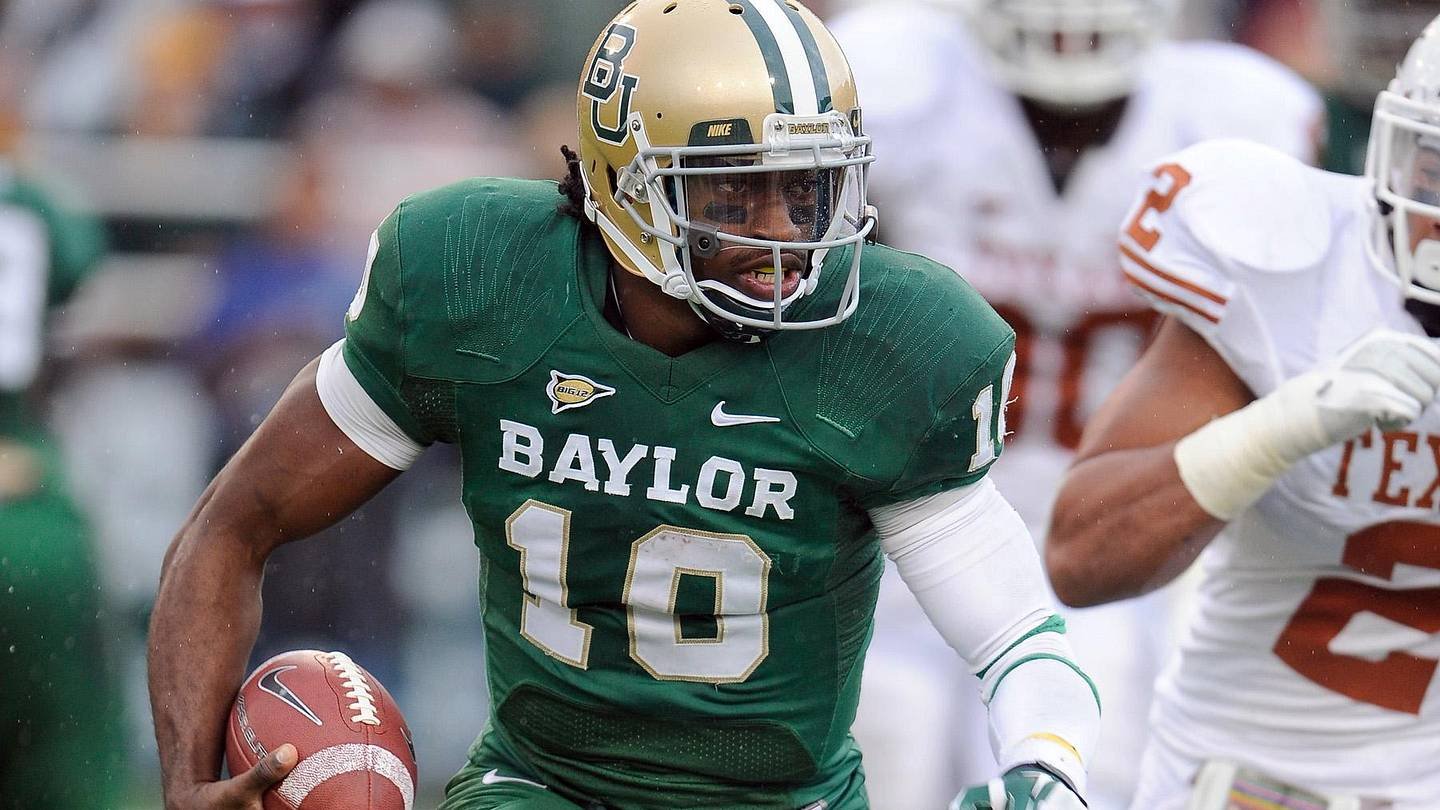
The 2027 ballot makes that problem worse, not better. Cam Newton of Auburn, who won the Heisman in 2010 — the same year Moore was a finalist — and led the Tigers to a national championship, is now eligible for the first time. Robert Griffin III of Baylor, the 2011 Heisman winner, is also on the ballot. Colt McCoy, who left Texas as the winningest quarterback in NCAA history at the time of his departure, rounds out a top tier that would crowd any year’s induction class. The NFF inducted two quarterbacks in 2019 and again in 2023. Whether it does so in 2027 will determine whether Moore finally gets in, or waits again.
Newton’s candidacy is difficult to argue against. A Heisman winner, a national champion, a figure whose athleticism redefined what the position could look like in the college game — his credentials on paper are among the strongest on any ballot in recent years. Griffin’s are similar: the 2011 season at Baylor was one of the more electric individual performances the sport has produced, capping a transformation of a program that had been largely invisible for years. Both men are, by most definitions, first-ballot candidates.
The same ballot features Melvin Gordon III of Wisconsin, one of the finest running backs the Big Ten has produced — his 2,587-yard rushing season in 2014 set an FBS single-season record at the time. Percy Harvin of Florida, the multiposition weapon whose career in Urban Meyer’s spread offense remains a reference point for what that scheme could produce at its peak, is eligible. Defensive players of rare distinction round out the candidate pool: Terrell Suggs of Arizona State, Elvis Dumervil of Louisville, Patrick Peterson of LSU, and Manti Te’o of Notre Dame, the linebacker who was so central to the 2012 team’s success that his absence in the national title game, playing through injury, felt like the deciding factor. The NCAA’s handling of eligibility cases has become an increasingly fraught issue in college football, and the Hall’s own eligibility rules have not escaped that scrutiny.
The coaches’ side, beyond Leach, features Larry Coker, who lost a total of three games in his first three seasons at Miami and led the Hurricanes to a national title. Dennis Franchione spent a career succeeding at programs that had not given him obvious advantages. Ralph Friedgen made Maryland a place people wanted to watch, which should be worth something. None of them will receive anything close to the attention Leach’s candidacy will generate, which is both understandable and a little unfair.
The 2027 class will be announced in January. The induction ceremony follows later in the year. Between now and then, the NFF’s voter pool — more than 12,000 members, plus current Hall of Famers — will work through a ballot that has no obvious top-10 cutoff. Leach will almost certainly be in. Whether Moore finally joins him, or whether Newton and Griffin consume the quarterback slots entirely, is what the sport will be arguing about for the next several months. The broader evolution of NCAA football structures makes the question of who gets remembered — and how — more consequential than it has ever been.
There is no tidy resolution here. That is probably the point.