
PHILADELPHIA – Nobody walked into Citizens Bank Park on Monday night for a bracket. They came because two Phillies were in it.
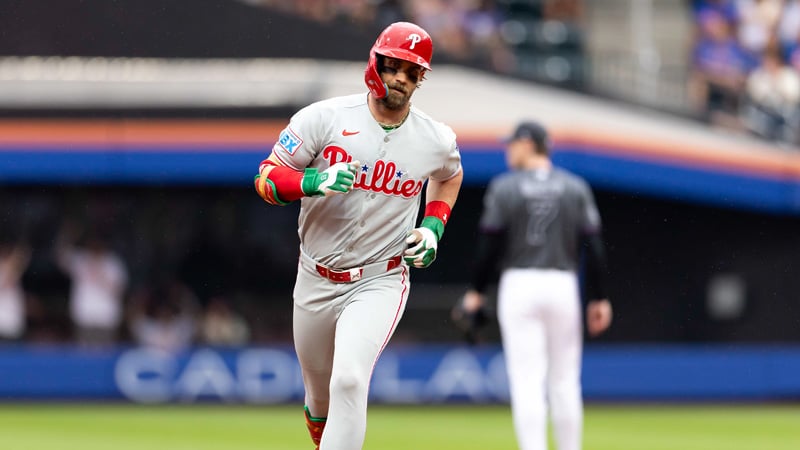
Kyle Schwarber enters the 2026 T-Mobile Home Run Derby as the odds-on favorite at +310, leading Major League Baseball in home runs this season. Teammate Bryce Harper is right behind at +525, the third-lowest odds in the field. For the first time in recent memory, the two biggest favorites to win the event play for the same team, in the same city hosting the competition. The crowd at Citizens Bank Park, when Schwarber stepped to the plate Monday evening, was not neutral.
The event begins at 8 p.m. ET, with Fox Sports reporting that Netflix carries the broadcast live. Pre-show coverage starts an hour earlier at 7 p.m. It marks the first time Netflix has held rights to an MLB All-Star event, and the platform requires nothing beyond an active subscription to watch. No cable package, no sports add-on required.
Baseball’s decision to bring the Home Run Derby to Netflix reflects a deliberate audience strategy. The league has spent two seasons extending its reach onto streaming platforms that attract younger viewers who have not grown up with regional sports networks. Netflix had already carried NFL playoff games and tennis majors before Monday. The Home Run Derby, with its compressed format and single-venue spectacle, was the natural entry point for a sport that has struggled to broaden its demographic base.
MLB also rewrote the competition’s format. Gone is the timed shot-clock system that governed the past several editions. In its place: a swing-based round structure. First-round participants receive 20 swings each, and a home run hit on the 20th swing grants continuation until an out is recorded. The top four advance based on total home runs, with ties broken by longest distance. Semifinals and finals each allocate 15 swings, with the same continuation rule. The change is designed to reduce idle time between swings while keeping the competition accessible to new streaming viewers. As CBS Sports noted, this edition also features a $100,000 bonus for the competitor who records the longest home run of the night.
The eight-player field spans the league without clustering around one type of hitter. Schwarber (+310) and Tampa Bay’s Junior Caminero (+325) carry the two shortest prices. Caminero, 21, has emerged as one of the American League’s most-watched power threats this season, providing international interest for a broadcast entering a global platform. Chicago White Sox slugger Munetaka Murakami (+500) brings a longer history: the Japanese first baseman rewrote the Japan Central League’s single-season home run record before crossing to the majors, and his presence gives the event genuine cross-continental reach on Netflix.
Harper, at +525, is fourth in the odds but will compete in front of the stadium where he has spent recent seasons. He won this event once before, in 2019 as a Washington National, in a final that ran deep into extra swings. The Citizens Bank Park crowd on Monday offered a different kind of pressure than that Washington night: the expectation was heavier, but the roar was unambiguously his.
The remaining field includes Jordan Walker of St. Louis (+650), Jac Caglianone of Kansas City (+700), Ben Rice of the Yankees (+850), and Willson Contreras of Boston at the longest odds at +1300. None qualifies as a placeholder. The Derby’s swing-continuation rule creates statistical variance that odds cannot fully absorb: a single hot run in the first round can reshape the bracket entirely.
Cal Raleigh of the Seattle Mariners won last year’s competition and did not return to defend the title. That absence clears the field of a defending champion’s gravitational narrative and opens Monday’s night to whoever takes the early round lead.
The prize structure weights performance significantly. The winner takes $1 million, the runner-up receives $500,000, and every participant earns $150,000 simply for competing. The longest home run of the night carries an additional $100,000 bonus, adding a parallel competition to the main bracket: a single massive hit can define the broadcast moment even for a player who exits in the first round.
Tuesday night’s MLB All-Star Game at Citizens Bank Park will follow with a different roster and notable absences: Shohei Ohtani, Aaron Judge, and Vladimir Guerrero Jr. will watch from the sidelines as Cristopher Sánchez takes the National League start.
What the Derby cannot settle on Monday is what its Netflix broadcast ultimately means for baseball’s long-term audience. The platform’s North American subscriber base skews younger than the median MLB television viewer. If the event registers significantly with that demographic, it sets a data point the league will carry into its next round of broadcast rights negotiations. Schwarber does not think about broadcast data. He thinks about the flight path of a baseball leaving a Citizens Bank Park bat, and what 40,000 Phillies fans sound like when he makes contact. On Monday evening, he finds out.