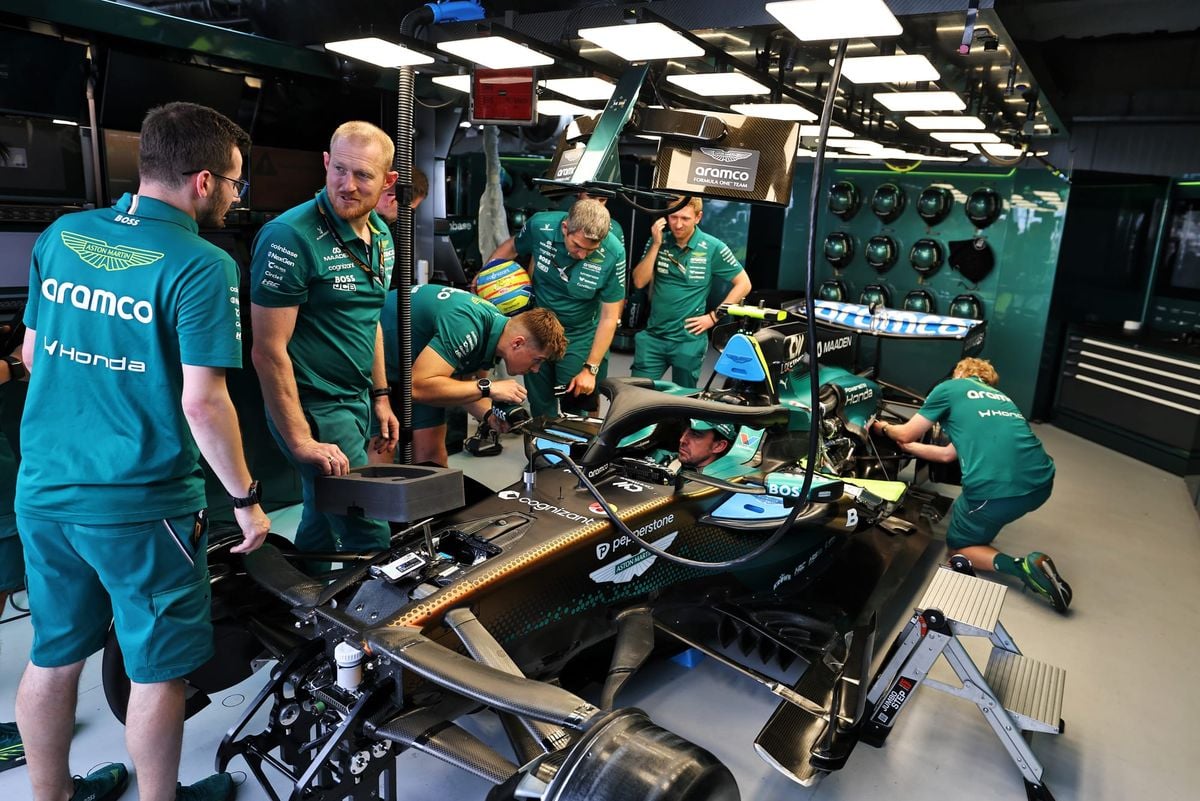

MONTE CARLO — Fernando Alonso arrived at the Monaco Grand Prix with a problem that, depending on how his engineers spend the next 48 hours, could make his weekend very short indeed. A “random downshift” fault that sent the Aston Martin into uncontrolled bursts of acceleration on corner entry in Miami has not been fully resolved, and Monaco — where the barriers are centimetres from the car and there is no run-off — is the worst place on the calendar to find out whether it has been fixed or not.
“Probably we cannot even race,” Alonso said on Thursday, measuring the risk with the bluntness of a driver who has seen enough crashes to know when the maths doesn’t work. “Monaco is not the place to have a random downshift. You will crash into the wall, and the driver will look stupid.” His team-mate Lance Stroll added a separate complication: Aston Martin loses gearbox synchronisation every time the car drops below roughly 40 kilometres per hour, which happens every lap at the Loews Hairpin, the slowest corner on the circuit.
That mechanical anxiety sits at one end of the paddock mood. At the other, there is something closer to genuine optimism — not just from Ferrari, but from McLaren too — about a weekend that the 2026 technical regulations have made genuinely unpredictable for the first time in several years.
Mercedes has won all five Grands Prix this season. Kimi Antonelli, 19 years old and already 43 points clear of team-mate George Russell at the top of the drivers’ standings, has been the dominant force of a new era. But the rules that govern this weekend in Monaco are different. The FIA removed active aerodynamics for the street circuit on the grounds that the system provides minimal benefit through Monaco’s slow corners while creating potential safety complications. Without active aero, the teams no longer need the actuators that move their rear wings — and that has opened a design window that several leading teams have exploited with novel winglet attachments, trying to harvest downforce through conventional fixed surfaces instead.
Mercedes and McLaren produced the most intricate solutions, while Red Bull also introduced significant winglet work. Ferrari and Cadillac took simpler approaches. Nobody is claiming these devices transform the competitive order — the best estimates suggest a few hundredths of a second — but they are symptomatic of something deeper. Monaco rewards chassis stiffness, mechanical grip, and low-speed corner performance. It punishes power unit dominance. And on those terms, the 2026 Ferrari has a more credible case than it has at any race since the season opened in Bahrain.
Both Mercedes and McLaren named Ferrari explicitly when asked which team they expect to be most dangerous. The logic is straightforward: the Ferrari SF-26 has been notably quick through medium and high-speed corners but has struggled on straights, where the Mercedes power advantage compounds race by race. Monaco’s longest straight, through the tunnel, is not long enough to offset what Ferrari does through Massenet, Casino Square, and Rascasse. Charles Leclerc, who extended his Ferrari contract this week, races in his home principality with the strongest car relative to the field he has had in Monaco since his 2024 victory there.
Leclerc was measured about the contract on Thursday — mentioning loyalty, Fred Vasseur’s leadership, and an unspecified element of the deal that he declined to detail but which presumably contains some kind of performance-linked exit clause. The timing feels deliberate. A Monaco victory would give the announcement a different weight entirely.
McLaren’s calculation runs parallel to Ferrari’s. Oscar Piastri and Lando Norris have identified Monaco’s low-speed corners as an area where they feel particularly competitive against their rivals. The question for both McLaren and Ferrari is whether strong qualifying performance — which on this circuit is almost entirely determinative of race outcome — translates into a front-row lockout that makes Sunday’s result a formality before it begins.
For Russell, the context is more personal. He qualified precisely 0.068 seconds ahead of Antonelli in both Sprint qualifying and Grand Prix qualifying in Canada — the same margin twice, which suggested he had found the ceiling of what the car could do on that weekend. He converted the Sprint into a win, then led the race before a reliability issue ended his afternoon 30 laps in, leaving him 43 points adrift in the championship with a car that, on certain tracks, appears to be his team-mate’s equal. Monaco is one of those tracks where the margin between drivers in identical machinery tends to compress. Whether that helps or hurts Russell depends on which of them handles the psychological weight of the street circuit better on Saturday afternoon.
There is also an energy management wrinkle that has preoccupied the Mercedes-engined teams specifically. The 2026 regulations put extraordinary emphasis on the interplay between the turbocharged combustion engine and the MGU-K electrical motor, with a new power cap introduced partly to keep speeds from reaching dangerous levels on street circuits. Monaco’s layout — slow, stop-start, brief straights — means the battery charges extremely easily but deploys less frequently. The risk, as several engineers explained on Thursday, is arriving at the tunnel entrance with the battery at 100 per cent capacity, which prevents further charging and leaves the turbo to manage corner exit torque without electrical assistance. Ferrari’s smaller turbo configuration is better suited to spinning up quickly at low speeds, a structural advantage that compounds the chassis edge the team already carries into this weekend.
Lewis Hamilton, for his part, arrived at Monaco in a different state of mind than he was in 12 months ago, when he finished well off the pace and was met with radio silence on the slowing-down lap. A mid-season engineering reshuffle last year, and the building of a working relationship with race engineer Carlos Santi — whom Hamilton has taken to calling “my Italian Bono,” a reference to Peter Bonnington, the Mercedes engineer who guided him to six of his seven world championships — has changed the texture of his season at Ferrari. He also claims involvement in developing new suspension for the car that he believes will pay dividends specifically on the uneven, bumpy surface of the Monte Carlo streets. Whether that is marketing or reporting remains to be seen when the cars actually run.
What nobody can say with confidence, as the teams complete their final preparations for Friday practice, is whether the novel winglet solutions from Mercedes, McLaren, and Red Bull actually deliver what they promise. Aston Martin and Haas looked at the concept and decided the gains were not worth the development cost. The teams that did invest will find out in qualifying whether a few hundredths of a second in the theoretical pays out in lap time on the actual circuit. Monaco has long operated by its own rules within Formula 1’s calendar, and this year, with a new generation of car, a new power architecture, and a gearbox fault that might keep a two-time world champion off the grid entirely, it is doing so again.