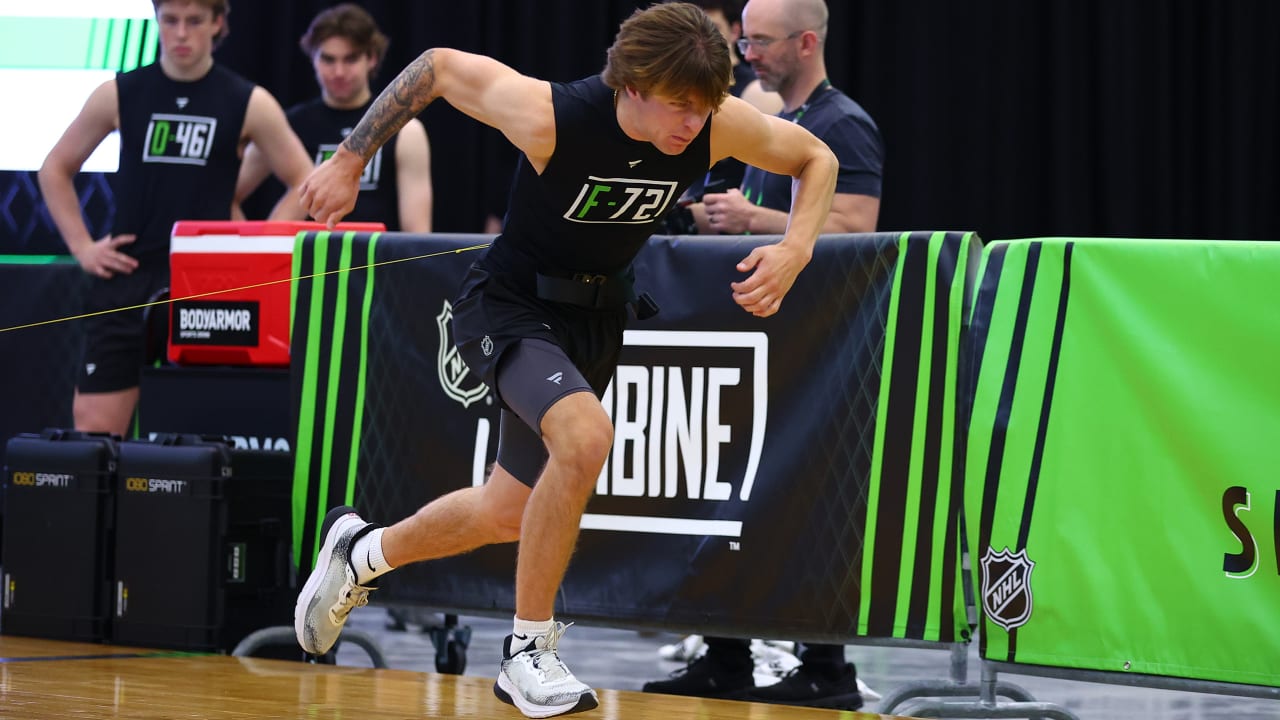

BUFFALO — The bike test is the one everyone fears. Thirty seconds of full-resistance sprinting with no clock, no finish line visible, trainers screaming to keep going until they decide you’re done. When it was over, Caleb Malhotra said it had been sucking the soul out of him. Gavin McKenna, who had just turned in the seventh-best Vo2 Max score in the entire combine field, said the long shifts in junior hockey had prepared him for exactly that kind of suffering.
That detail matters more than any raw number. The standard knock on McKenna heading into this week was his frame — 5-foot-11, 170 pounds, slight by the standards of NHL forwards expected to carry franchise weight. What McKenna delivered across two days of fitness testing at the 2026 NHL Scouting Combine in Buffalo was a systematic refutation of that concern. He ranked among the top 20 in seven events, including fourth on the isokinetic squat test at 3.4 times his body weight, sixth in pullups, and seventh in the Vo2 Max aerobic endurance test with a time of 14 minutes 19 seconds.
“I wanted to prepare hard for this,” McKenna said Saturday after testing concluded. “I think sometimes my frame’s not the biggest, so just wanted to show that I can compete out there and I can work hard off the ice. I think that’s a big key to carry through the next level.”
He skipped Canada’s World Championship team to do it. That was a calculated sacrifice — McKenna declined the invitation in May specifically to spend the weeks before Buffalo in a gym in Kelowna, British Columbia. Whether that decision reflected unusual maturity or simply reflects how much pressure the 18-year-old has internalized since he was 15 and already being discussed as a future first-overall pick is a question no fitness result can answer.
What the results do answer is the body question. McKenna had the 13th-lowest body fat percentage among all prospects at 7.9 percent. His horizontal jump of 108 inches tied London defenseman Maksim Sokolovskii. His peak power output of 15.8 watts of energy per kilogram of body weight placed him inside the top 20. For a player whose critics have consistently pointed to physical limitations as the one legitimate counter-argument to his obvious talent, this was not a marginal performance. It was the kind of combine that closes conversations.
Except it hasn’t closed the most important one.
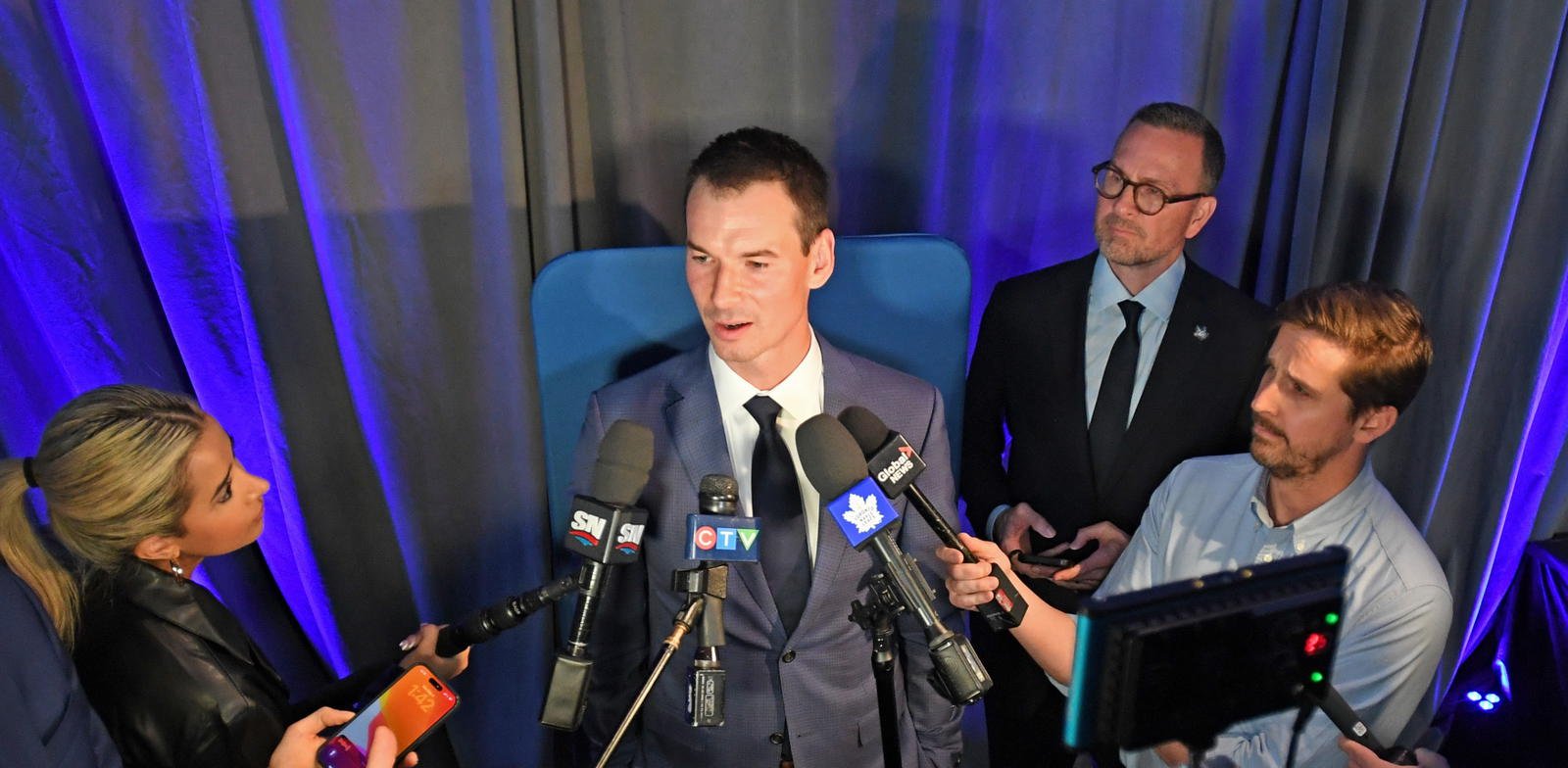
Toronto Maple Leafs general manager John Chayka, who holds the first overall pick on June 26, spent part of this week in Buffalo watching McKenna test and sitting down with prospects. Chayka had already traveled to Whitehorse, Yukon — McKenna’s hometown, reachable only by driving the Alaska Highway — to meet the family in person. He described it as a quiet, remote place. He described McKenna as a small-town kid with real resolve. Asked whether all of that reconnaissance had produced a decision, Chayka told reporters that the Leafs are considering five or six players at the top of their board and are not ready to commit. “I don’t think we’re ready for that yet,” he said. “I think we’re still going through our process, and I think it’s important that’s what draft day is for.”
That answer is, by design, not an answer. Every general manager in Chayka’s position does this — strategic ambiguity prevents rival teams from using a locked-in selection to extract leverage in trades. Chayka added that offers for the pick have been received but nothing compelling enough to seriously consider. The Leafs entered the lottery with only an 8.5 percent chance of winning it. They won. Moving the pick now would require, by Chayka’s own characterization, an overwhelming offer.
https://www.youtube.com/watch?v=pqWS59pj6cA
For McKenna, the exercise is different. He is not hedging. Asked what it would mean to be selected by Toronto, he said it would be a dream come true — a Canadian kid going to a Canadian market, to a team that despite a 32-36-14 season last year still considers itself a playoff contender, not a rebuild. “The situation the Leafs are in right now, it’s pretty crazy that they got the first overall pick,” McKenna said. “I’d be pretty fortunate to go there.” He has spoken with distant cousin Connor Bedard about handling the pressure that comes with being viewed as a franchise-altering talent. Bedard’s advice, McKenna said, was to trust the process and stay confident.
McKenna is not the only prospect who used this combine to make an argument. North Dakota defenseman Keaton Verhoeff, ranked fifth among North American skaters by NHL Central Scouting, placed in the top 10 in three categories, including fourth on the pro agility shuttle run starting to the right at 4.27 seconds. The 6-foot-4, 215-pound defenseman measured among the longer prospects and said he was confident in his physical preparation. Brampton center Caleb Malhotra, ranked sixth, lasted 14 minutes 9 seconds on the Vo2 Max test for 10th place, then added a sixth-place vertical jump of 23 inches. Both gave Chayka’s five-or-six-player tier some tangible athletic texture.
The other player whose name surfaces in any serious first-overall conversation is Frolunda left wing Ivar Stenberg, ranked first among international skaters. Stenberg did not test this week. He told reporters he has been sick since returning from the World Championship, where Sweden competed through May 28, and that his agents and off-ice coach decided it was medically unwise to push through the combine in that condition. What he didn’t do was manage expectations about how that absence might read to the 32 teams evaluating him. He acknowledged it would probably not look great. It is a meaningful variable Chayka will have to weigh: a prospect who tested and delivered data versus one who remains, for now, an incomplete file.
San Jose Sharks GM Mike Grier, whose team holds the second pick, offered the most useful frame for what fitness numbers actually mean in this room. It is not about the wattage or the wingspan, Grier said. It is about what a prospect does when he is spent — whether he pushes through the last 10 seconds of the Wingate, whether he grinds for one more pullup when his arms are giving out. “Kind of how they’re willing to kind of push themselves a little bit to get the last pull-up, or the Wingate when they’re dead tired,” Grier said. “Are they going to push through that last 10 seconds? So just try and see their competitiveness and their athleticism.”
By that measure, McKenna’s combine week was a statement. He has been the consensus top prospect since his 129-point season with Medicine Hat in the WHL, through his freshman year at Penn State where he finished tied for fifth in NCAA scoring with 51 points in 35 games, and through a World Junior Championship where he posted 14 points in seven contests. None of that changed this week. What changed is that he now has the athletic data to go with it.
Whether Chayka uses it is the question he refuses to answer. The 2026 NHL Draft opens at KeyBank Center in Buffalo on June 26. McKenna will be in the building. His family from Whitehorse will presumably be there too. What happens when Chayka finally walks to the podium is the one thing no fitness test can predict.
Related Posts
![Gavin McKenna holds up a Toronto Maple Leafs jersey after being selected first overall at the 2026 NHL Draft at KeyBank Center in Buffalo Here's what I had prepared for the featured image metadata: | Field | Value | |---|---| | **Title** | Gavin McKenna Selected First Overall by Toronto Maple Leafs at 2026 NHL Draft | | **Alt Text** | Gavin McKenna holds up a Toronto Maple Leafs jersey after being selected first overall at the 2026 NHL Draft at KeyBank Center in Buffalo | | **Caption** | Gavin McKenna after being selected first overall by the Toronto Maple Leafs at the 2026 NHL Draft in Buffalo. [Image Source: Getty Images] | | **Filename** | `gavin-mckenna-maple-leafs-nhl-draft-2026.jpg` | | **Role** | `featured` | Once the MCP server reconnects, I can upload it if you provide the image source URL, or you can upload manually via the Classic Editor link and apply this metadata.](https://easternherald.com/cdn-cgi/imagedelivery/-CGPfOWoVHcRcTbwHaRGUQ/easternherald.com/2026/06/gavin-mckenna-maple-leafs-nhl-draft-2026.jpg/w=696,h=392)