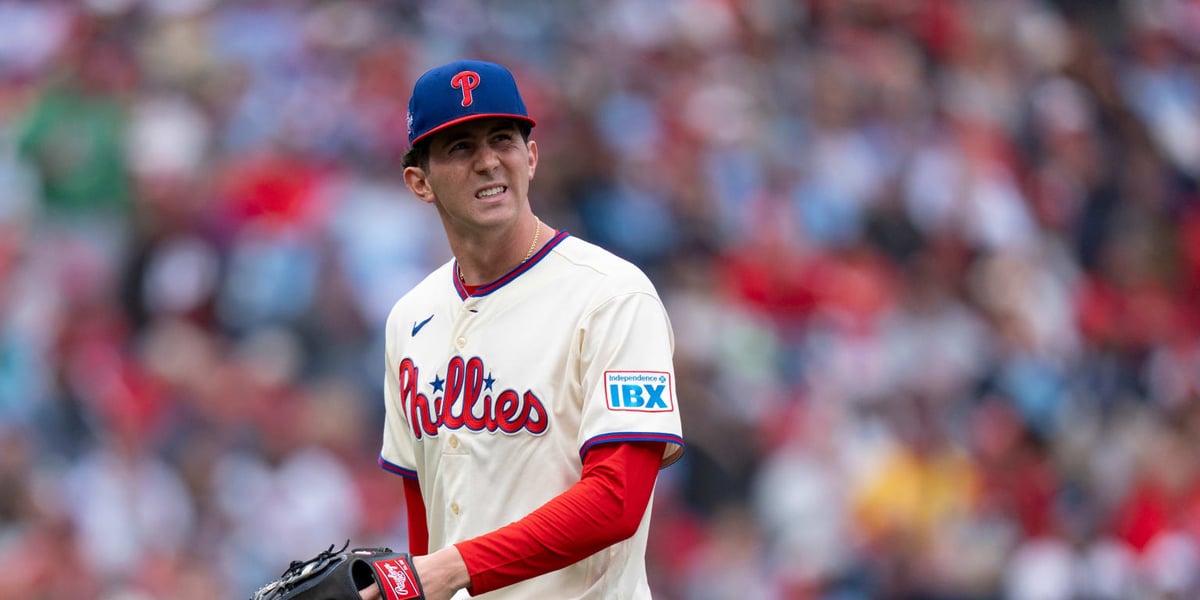

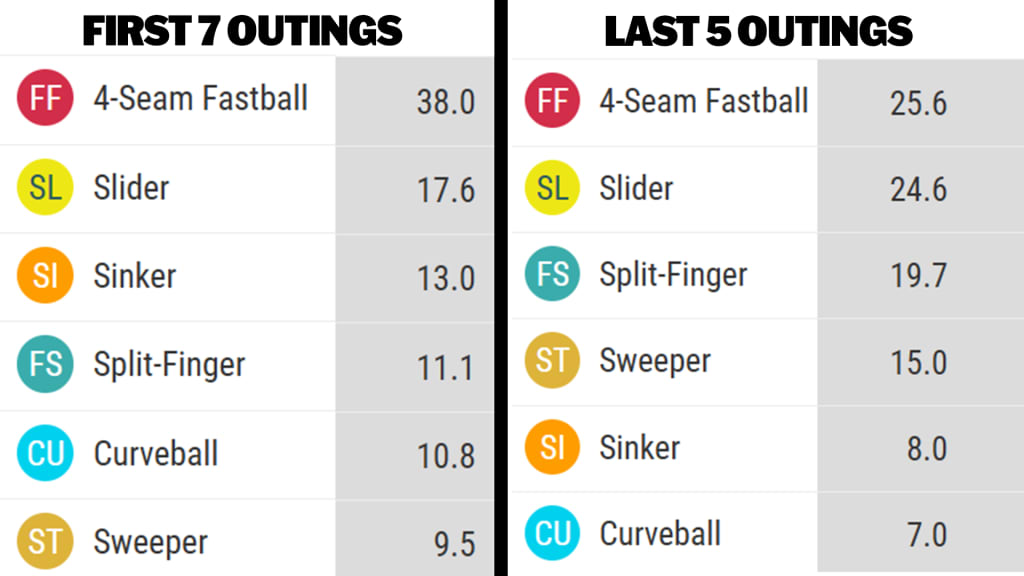
PHILADELPHIA — The fastball was supposed to be the answer. At 96.2 mph and with the kind of late ride that had evaluators using phrases like “generational arm” before he turned 20, Andrew Painter’s four-seamer was the pitch that made him the most coveted pitching prospect in the Phillies organization — and, for a stretch, in all of baseball. Through 12 big league outings this season, opponents are hitting .390 against it. His whiff rate on the pitch is 9.9 percent, the second worst among starting pitchers who have thrown at least 300 four-seamers in 2026. He is throwing it less and less. And no one, including Painter himself, can fully explain why it is no longer going where he wants it to go.
Interim manager Don Mattingly did not offer false comfort after Saturday’s loss to the Chicago White Sox, when Painter abandoned his four-seamer almost entirely after the first inning, throwing only four of them over his final 51 pitches. “It’s not like you just get endless chances, right?” Mattingly said. “You have to perform.” The qualifier that followed — “We trust the kid, and we think he’s going to be good” — was genuine enough, but it was also the kind of trust you extend to someone who has not yet proven he belongs, and whose leash is beginning to show its length.
The Painter project began with so much clarity. He was the 13th overall pick in the 2021 draft, signed for $3.9 million, and proceeded to make every organization he touched look slow. In his first full professional season, he went 6-2 with a 1.48 ERA across three levels of the minor league system, including Double-A Reading, before his 20th birthday. The Phillies were not planning around whether he would make the big leagues. They were planning around when. Then, in spring training 2023, something went wrong in his right elbow. Tommy John surgery in July of that year, CBS Sports reported, cost him not one but two full seasons — 2023 and 2024 — before he finally returned to a minor league mound in 2025.
That 2025 season was supposed to be a formality, a year of innings accumulation and elbow hardening, not a proving ground. Instead, Painter posted a 5.26 ERA across 26 starts at Triple-A Lehigh Valley and the Phillies spent the back half of the year insisting they were unconcerned. They wanted 118 innings. They got 118 innings. The ERA, they said, was noise. The fastball was coming back. Spring training 2026 seemed to confirm it. He threw 11.2 innings with a 2.31 ERA in Clearwater and showed the 100-mph readings that had made him famous. He made the Opening Day roster. He was supposed to be the answer to the rotation’s fifth-starter question, a temporary placeholder until he became something more.
Now, through 12 outings, his ERA is 6.21. He has allowed 11 home runs in 58 innings and struck out only 18 percent of opposing batters, a particularly weak figure given how dependent modern pitching success has become on strikeout rate. His FIP — fielding independent pitching, a measure that strips away defensive and luck-based noise — sits at 5.09, which is better than his ERA but still well short of competent. He is averaging less than five innings per start. Painter is not alone in that sense: a pattern of high-ceiling prospects failing to meet their major league billing has defined the 2026 season across the sport.
The heatmap for his four-seam fastball tells the story more starkly than any ERA. Pitchers with effective fastballs — Zack Wheeler, Jesús Luzardo, Brewers right-hander Jacob Misiorowski, Yankees starter Cam Schlittler — cluster their locations in the upper half of the strike zone, with the tight concentration that indicates command. Painter’s heatmap has no shape. It is diffuse, scattered, the visual evidence not of a pitcher missing his spots but of a pitcher who does not yet know where the pitch is going once it leaves his hand. He is locating only 46.3 percent of those four-seamers in the zone — the worst rate among those 79 qualifying starters, according to Baseball Savant.
“I mean, I’m confident throwing it,” Painter said after Saturday’s start. “The shape’s been better, but if you’re not in the zone with it, you’re going to have no success with it.” The observation was accurate but also somewhat beside the point. The shape has been better. The command has not arrived. And at some level, that is the thing nobody can yet explain — whether it is mechanical, neurological, a post-Tommy John timing issue that resolves itself in month eight or month twelve or year two, or something more fundamental about the adjustment required to throw a mid-90s fastball against hitters who have seen every velocity profile imaginable.
The Phillies’ options are narrower than they look from the outside. Sending Painter to Triple-A would require replacing him, and the Lehigh Valley rotation is not a reservoir of upgrades. The top fallback candidate is Alan Rangel, a 28-year-old right-hander with a 3.17 ERA in nine IronPigs starts this season, already on the 40-man roster. He could fill innings. He is not, by any evaluation, a solution. The next obvious internal candidate, Moisés Chace, is still recovering from his own Tommy John surgery from 2025. CBS Sports reported that the Phillies’ minor league rotation depth has a combined ERA of 5.04 across 40 starts, with an average age of 29, and none of those arms appear on any prospect list.
Beyond availability, the Phillies believe — and there is logic to this belief — that Painter is better served working through his problems surrounded by Wheeler, Aaron Nola, Cristopher Sánchez, and Luzardo than he would be grinding through them in Allentown. “Having those guys around him takes pressure off of him, from the standpoint of not having to be the guy,” Mattingly said. “And having conversations, being able to talk through stuff — I’m sure all of our guys have been through struggles — so it’s good that you have those guys around.” Pitching coach Caleb Cotham is a central figure in that calculus. Whether daily proximity to Cy Young voters constitutes a developmental environment that outweighs the competitive pressure of a pennant-race rotation spot is, at minimum, a question the Phillies have not fully resolved.
The broader rotation context matters here. Aaron Nola has underperformed his contract. Luzardo, locked up through 2031, has been inconsistent. Taijuan Walker was released. The Phillies entered 2026 with one of the most decorated pitching staffs in the National League and have spent the first two months quietly managing its failure to live up to that billing — a pattern the rotation crises spreading across the league in 2026 have made familiar. Painter’s struggles are the most acute symptom of that problem because he was also supposed to be part of the solution — the 23-year-old arm around whom the post-Wheeler rotation could eventually be built.
His next start is scheduled for Friday in Milwaukee, where he will take his 6.21 ERA and his suddenly unreliable fastball into a road ballpark with no guarantees beyond the fact that he remains on the roster. Mattingly has made that much clear. The Phillies, meanwhile, carry their own compounding tension: a lineup capable of carrying a team through a bad start can only cover a leaking rotation for so long. What remains unresolved is whether the problem Painter is working through right now — the problem of converting an exceptional minor-league arm into a functional major-league starter after two years away from competitive baseball — is the kind of problem that pitching coaches can solve in a major league dugout, or the kind that requires more time, and more failure, than a contending team’s rotation can afford to provide.