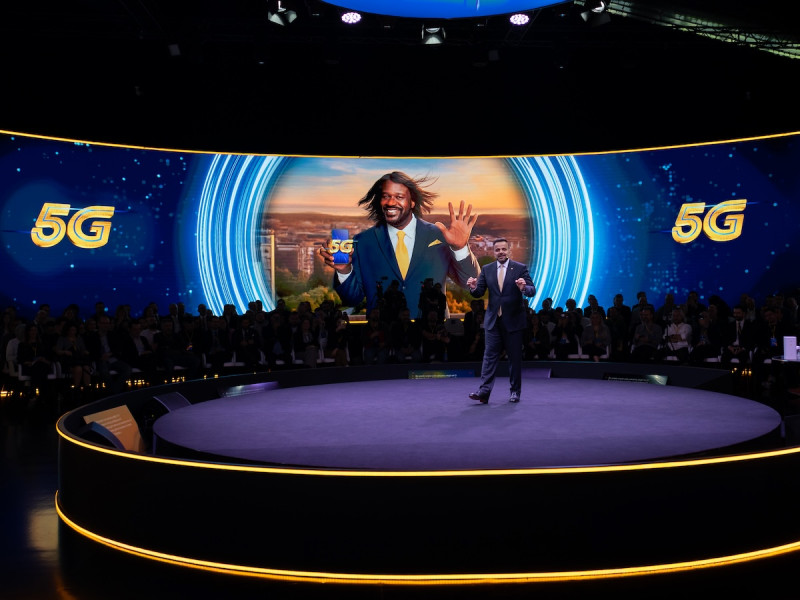

ISTANBUL – The speed test results were visible on a screen at the Zorlu Center launch event, and they looked good. What was harder to see was whether they would matter to the 45 million subscribers who have been paying for 4.5G connections that, for the most part, do exactly what they need.
Turkcell activated its 5G Standalone network across Turkey on April 1, 2026, becoming part of a coordinated national launch by the country’s three major operators – Turkcell, Turk Telekom, and Vodafone Turkey – that simultaneously lit up 5G service in all 81 provincial centres. Six months earlier, the three companies had collectively spent $2.95 billion on spectrum in the 700 MHz and 3.5 GHz bands, far exceeding the government’s $2.125 billion minimum target. The bill is now coming due, and Turkcell is among the first to begin charging subscribers for the upgrade.
The operator has introduced two add-on packages designed to sit on top of existing mobile plans. The first, called 5G Boost+, costs 50 Turkish lira per day and gives subscribers what the company describes as a Data Quality of Service layer – a technical designation that effectively places the user at the front of the network queue, even in areas where traffic is heaviest. The second package, called 5G+ Yayıncı (Broadcaster), is priced at 500 lira per month, inclusive of VAT and Turkey’s special communications tax, and includes 5 gigabytes of standard data alongside a separate 5 GB allocation for social media platforms. Both packages are available through the Turkcell app and apply exclusively to domestic use.
What makes these packages technically distinct from the 5G services that the other two operators are also providing is Turkcell’s use of a Standalone architecture rather than a Non-Standalone one. The difference is architectural rather than cosmetic. In a Non-Standalone setup – which remains the standard approach for most early-stage 5G rollouts globally – the 5G radio network depends on an underlying 4G core for signalling and control. The result is faster data speeds but no reduction in latency, because the control layer is still the older generation. A Standalone architecture replaces both the radio network and the core network with 5G equivalents, eliminating that dependency entirely and enabling the ultra-low latency that 5G was designed to deliver. Turkcell CEO Ali Taha Koç, speaking at the Istanbul launch, said the company had kept its promise to bring Turkey genuine 5G. “Today,” he said, “we are the operator with the highest capacity and the widest 5G coverage in the country.”
Turkey’s 5G arrival is, by any global comparison, late. South Korea, the United States, and several European markets launched commercial 5G services as early as 2019. India followed in October 2022. Turkey’s delay was not a secret – the government acknowledged that regulatory sequencing, domestic production requirements, and inflation had pushed the timeline back – but the delay also carried an advantage. Countries that rolled out 5G early typically launched with Non-Standalone architectures because Standalone infrastructure was not ready at scale. Turkey is arriving at a moment when Standalone deployments are more mature, and Turkcell’s choice to build on that architecture from day one means the country’s largest operator is not inheriting the technical debt that earlier markets are still working through. Developing Telecoms reported that Turkcell, Turk Telekom, and Vodafone Turkey are required to extend coverage to all of Turkey by April 2028.
The Yayıncı package is directed at a particular segment of the subscriber base: content creators, live streamers, and broadcasters who depend on consistent upload speeds rather than just fast downloads. Mobile data strategies in most markets have historically been download-centric – optimised for consumers watching video rather than producing it. That calculus has been shifting as short-form video and live streaming have become economic activities rather than hobbies. Whether 500 lira per month represents a credible price point for that category of user is a question the market will answer, but the framing is at least commercially coherent.

The pricing structure itself poses a question about Turkcell’s theory of adoption. At 50 lira per day, the Boost+ package is not something most subscribers will buy habitually – it is designed for a specific occasion: a stadium concert, a crowded transit hub, a major sporting event, any environment where the shared network degrades to the point that paying for queue priority feels worthwhile. The monthly Yayıncı package operates on a different logic, targeting users who need sustained upload performance. Neither package is cheap in the context of Turkey’s cost-of-living pressures, and the company has not publicly disclosed any targets for take-up rates in the first year.
The broader competitive picture is still forming. Turkcell holds the distinction of having the most spectrum per subscriber among the three operators, which gives it a theoretical capacity advantage that the Standalone architecture is designed to exploit. But Turk Telekom and Vodafone Turkey are also 5G-capable operators in all 81 provinces, and none of the three has yet had time to demonstrate what differentiated 5G performance looks like in sustained real-world conditions rather than launch-event speed tests. Turkey’s consumer market is watching a race whose route has not yet been mapped. The infrastructure decisions being made now – which architecture to build on, which segments to target first, how aggressively to price add-ons – will determine who leads when the network matters more than the announcement.
The comparison that is worth making is not with 2019 South Korea but with what comes after 5G. Japanese researchers demonstrated a microcomb chip this year capable of delivering 112 gigabits per second at 560 GHz – a threshold that gives a sense of how quickly the frontier moves and how narrow the window is for any operator to establish a meaningful advantage at any given generation. The race Turkey has joined is not a sprint; the finish line keeps moving. Turkcell’s decision to build on a Standalone core rather than a transitional architecture suggests its leadership understands that. The consolidation unfolding in Europe’s telecom sector – most recently the $23.5 billion sale of France’s SFR to three rivals – is a reminder of what happens when operators that do not build durable infrastructure advantages are eventually absorbed by those that do.
For subscribers in Turkey, the immediate question is simpler: is the network good enough in the places you actually use it to justify paying for more of it? Turkcell’s speed tests at the Zorlu Center launch looked persuasive. The real test is a Sunday afternoon in Taksim Square, or a weekday morning on the Bosphorus Bridge, where the network was never designed for Standalone architecture and the stress has never been higher.