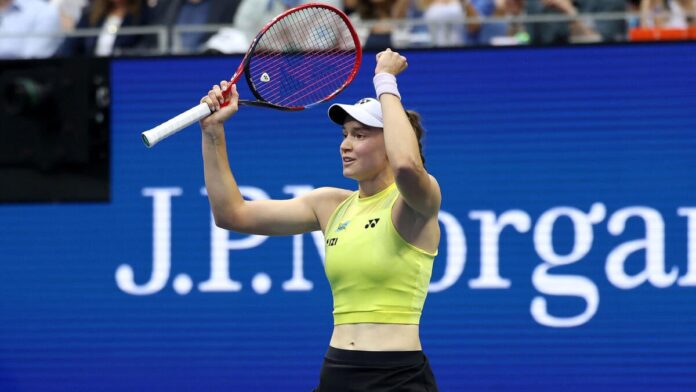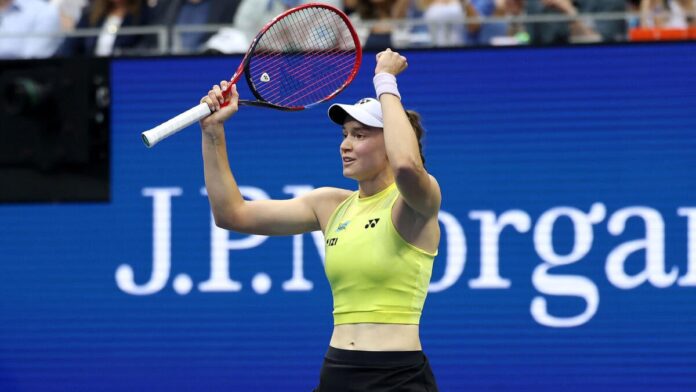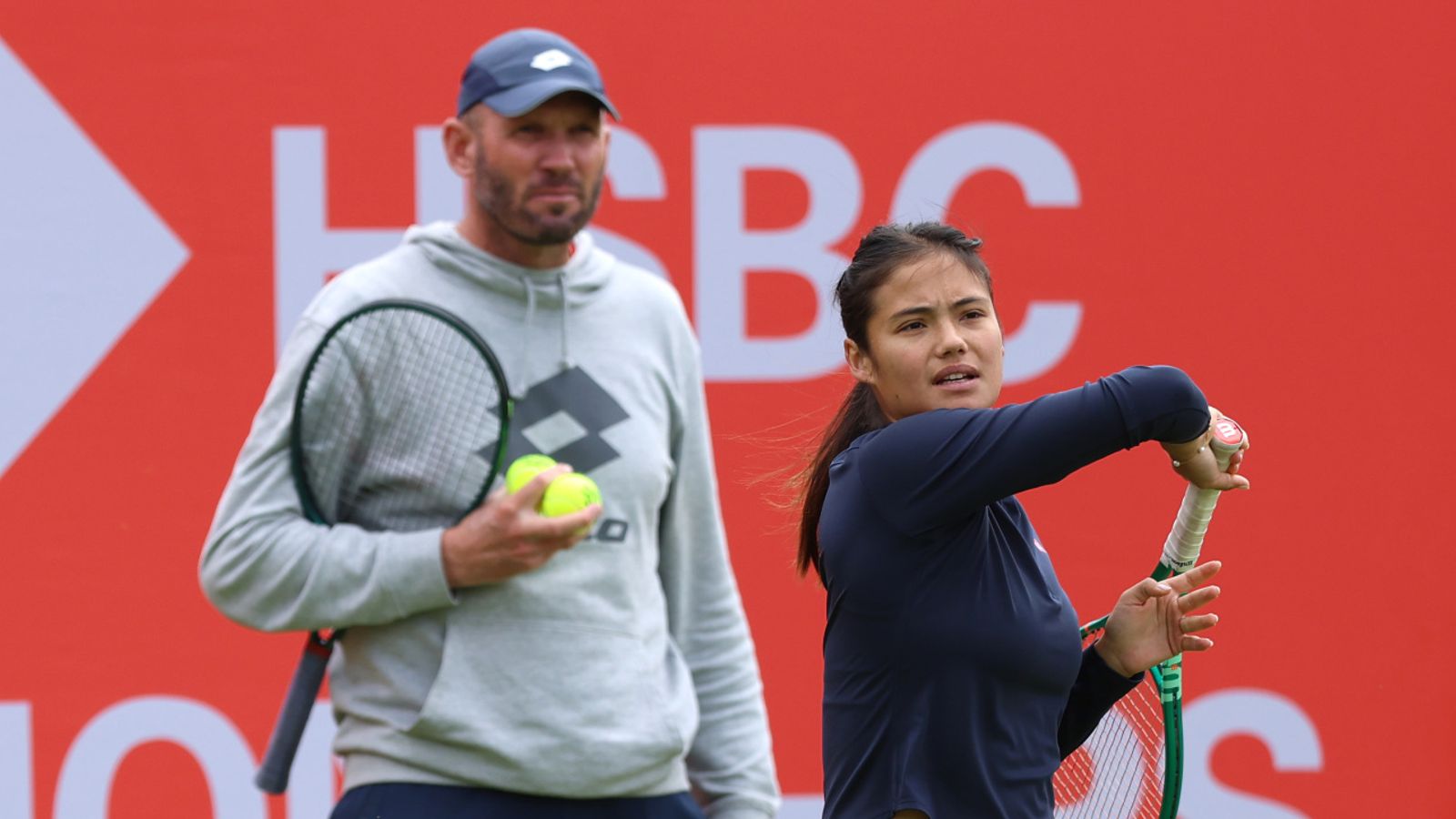

LONDON – She walked off the Andy Murray Arena on Sunday as runner-up, not champion. The scoreline — 6-0, 7-6(6) to Donna Vekic — read like a capitulation in the first set and a near-escape in the second. But the outcome was almost beside the point. What Emma Raducanu settled at Queen’s Club this week was not a title. It was a question.
For four years, British tennis has circled one unresolved problem with Raducanu: whether she could sustain a coaching relationship long enough for it to mean anything. The answer arrived not with a trophy but with a week of tennis that looked purposeful, structured, and adult in a way her previous grass seasons had not. Andrew Richardson – back in her corner since May, the same man who guided her through a qualifying run at the 2021 US Open that produced one of sport’s most improbable Grand Slam titles – has done something in six weeks that half a dozen predecessors could not manage in more time.
He has given her a game style she believes in and a composure she can replicate.
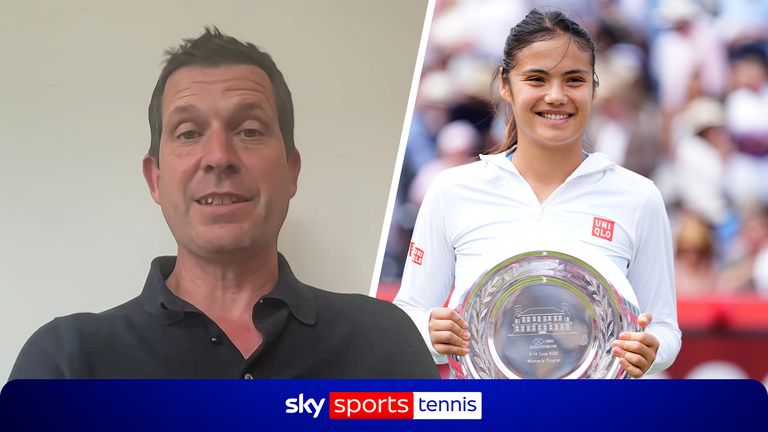
“There’s so much upside from this week,” Tim Henman, the former British No. 1 now working as a pundit for Sky Sports, said after the final. “It’s only one week; she’s got to keep building on it, and fingers crossed she can do that. I think consistency and continuity are something that has been missing for a number of years and I really hope Andrew gets the chance to keep building because this really is the first real opportunity for the relationship to flourish.”
Henman’s read was not nostalgic. He did not invoke the 2021 qualifier, or lament what might have been across the intervening years of wrist surgery, rotation through coaches and a 2026 season that had produced one win since March before Raducanu set foot on Queen’s Club grass. His point was structural: Richardson knows her, has known her for many years before they ever walked into Arthur Ashe Stadium together, and that history is now functioning as an asset rather than a pressure.
Raducanu herself pushed back on the most obvious narrative framing available to her. When asked in her post-semifinal interview whether the old Emma had returned, she rejected the premise entirely. “I wouldn’t say it’s the old Emma,” she told reporters. “I think it’s the new Emma.” The distinction mattered to her, and it should matter to observers as well. She is not trying to recreate 2021. She is trying to build something more durable.
Whether the building is solid enough to withstand Wimbledon is the question that remains open, and nobody – not Richardson, not Henman, and certainly not Raducanu – knows the answer yet.
The week had a specific texture worth examining. Raducanu entered without a win since March and ranked 42nd in the world – a ranking that, with Wimbledon seedings calculated on the basis of a two-year grass-court rolling window, put her in line for a seeded position, though a vulnerable one. She did not drop a set in the first four rounds. She beat Sorana Cirstea, who had beaten her in a final in Romania in February; she beat Iva Jovic, ranked 19th in the world, 6-2, 6-2 in the semifinals after playing two matches on Saturday because of weather delays that had compressed the draw.
That double match day was the revealing moment. Not the wins themselves, but the manner. After slipping in the quarterfinal against Kamilla Rakhimova and requiring medical treatment on her leg, she reappeared for the semifinal with strapping visible and produced one of her cleanest sets of the tournament. There was no tentativeness, no retreat to the baseline, no abandonment of the aggressive return strategy Richardson has re-installed as the foundation of her game. She played through the uncertainty, and it held.
The final, against Vekic, told a more complicated story. Croatia’s Donna Vekic, who had entered the tournament as a lucky loser after failing to qualify, dispatched the first set in 26 minutes with a level that would have unsettled any player on the tour. Raducanu recovered enough to push the second set into a tiebreak and reach 8-6 down – within two points of taking it to a third set – before Vekic closed it out. Sky Sports’ Raz Mirza noted that Raducanu was playing freely and dictating terms in the second set; the difference was Vekic’s ability to absorb that pressure and suppress it.
According to Sky Sports, Henman noted that Richardson’s coaching input from courtside was consistently audible throughout the week, and that Raducanu’s body language – relaxed, engaged, expressive – was a visible departure from the tension that had characterised much of her 2025 and early 2026 form. Whether that body language survives a Grand Slam draw, two weeks of scrutiny, and the specific psychological weight of Wimbledon’s third week is exactly the kind of question that five grass matches cannot answer.
Vekic offered an assessment after the final that was generous but pointed. “She’s playing really good tennis,” the Croatian said. “Obviously she wouldn’t be in the final if she wasn’t. I think for her it’s just the most important to stay healthy. The level of tennis is so high. It’s so physically demanding. I think that’s the biggest thing.”
Health is the variable that complicates every projection. Raducanu missed two and a half months this season with a post-viral illness that left her with one win between March and Queen’s. She has played five consecutive grass matches without incident, but a week is not a sample. The Women’s Tennis Association schedule moves from Queen’s directly to Eastbourne, where Raducanu has chosen not to play, preserving her body for the fortnight at SW19. That decision, made in consultation with Richardson and her medical team, was itself a mark of the kind of forward planning that had been absent in the more chaotic chapters of her career.
Raducanu is provisionally seeded for Wimbledon – ranked 31st going into the final – a position that would give her protection against the top seeds for at least the first week. Two finals in 2026, both on surfaces that had previously exposed her inconsistency, have rebuilt a floor under her season. She reached the final at the Transylvania Open in Romania in February before losing to Cirstea; she has now reached the final at a WTA 500 grass event. What the floor holds, and how high the ceiling now sits, is the question Richardson carries into Wimbledon.
Coverage in June identified the coaching deficit as the central unresolved problem in Raducanu’s game – a structural absence that outlasted every individual appointment in her corner since the US Open. Richardson’s return has addressed the structural question in the only way a coaching partnership can be tested: by producing results under pressure, in public, across consecutive matches.
What it has not yet produced is a Grand Slam win. That is not a criticism of the partnership’s first six weeks; it is simply the correct description of where things stand. Henman’s optimism, and Raducanu’s own insistence on the “new Emma” framing, are both justified by the evidence at Queen’s Club. They are not yet validated by the evidence. That test comes in thirteen days.