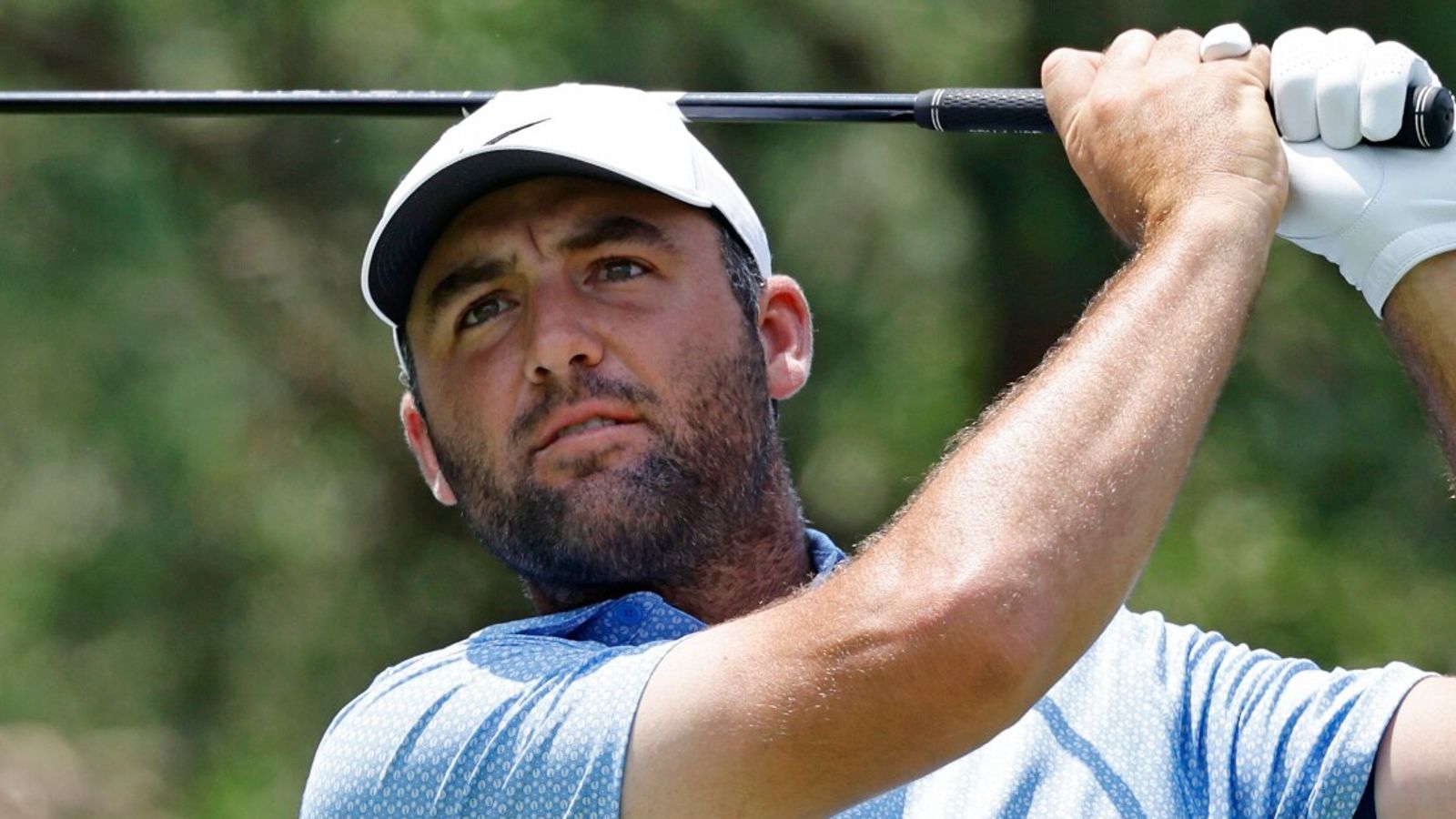

SOUTHAMPTON, N.Y. – Scottie Scheffler sat at the Memorial Tournament two weeks ago and described carding an even-par 72 on a difficult day as a round that felt, while it was happening, like it might end somewhere around 90. He hit a shank out of a bunker, something he called as bad as he had struck the ball in two years. Then he signed his card, told reporters he felt “pretty comfortable” with where his game was, and started thinking about Shinnecock Hills.
That gap between reality and perception is either the most reassuring thing in golf or the most dangerous one. On Thursday at the 126th U.S. Open, the answer begins.
Scheffler arrives at Shinnecock Hills Golf Club as the betting favorite, at roughly +550, to complete the career Grand Slam – adding the only major that has so far eluded him to wins at the 2022 and 2024 Masters, the 2025 PGA Championship, and last year’s Open Championship at Royal Portrush. Victory here would make him only the seventh player in history to win all four majors, joining Rory McIlroy, Tiger Woods, Jack Nicklaus, Gary Player, Gene Sarazen, and Ben Hogan. And if that win comes on Sunday, he will be 30 years old the moment he taps in the final putt.
No one could have scripted it. Which is precisely the problem for a player who has spent his career refusing to read the script at all.
The central paradox surrounding Scheffler heading into this tournament is not his form, which has been genuinely mixed in 2026 but far from as bad as the surface narrative suggests. The paradox is psychological. He is a player whose entire competitive method is built on present-tense thinking – on deliberately not allowing himself to see what is waiting at the end of a week. “I try to stay in the present,” he said after watching McIlroy complete his own Grand Slam at Augusta in 2025. “I don’t think very often about career goals.” He said it with apparent sincerity. But Shinnecock Hills in the third week of June 2026 makes present-tense thinking an almost impossible discipline. The career Grand Slam is not a future ambition. It is sitting in the fairway on every hole he plays.
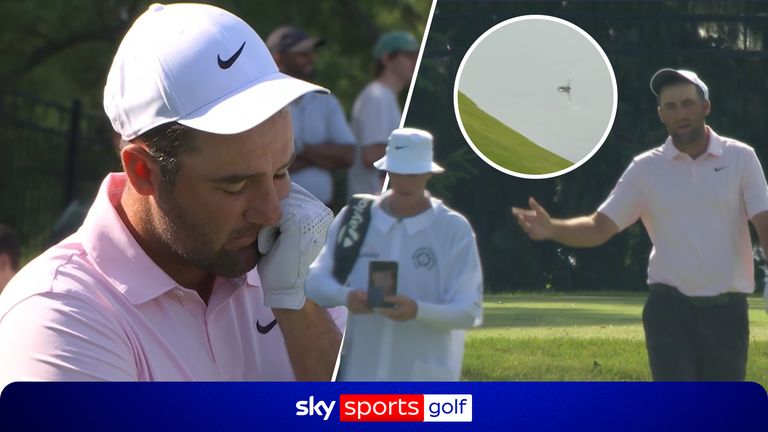
His 2026 has been a study in what happens when the world’s best golfer encounters the limits of his own mental architecture. Scheffler won The American Express in January by four shots, which looked like business as usual. Since then, the familiar patterns of dominance have given way to something more human-looking: a missed approach that drew a vented confrontation with his caddie Ted Scott at the 16th at Muirfield Village, a tied-24th finish at the Arnold Palmer Invitational that was his worst result in over a year, back-to-back losses in playoffs, another runner-up behind Cameron Young at the Cadillac Championship. Three consecutive solo second-place finishes on the PGA Tour, a feat so consistent in its near-miss quality that he called it “bittersweet.” The strokes-gained-in-approach numbers that had been the foundation of his game in 2024 and 2025 fell off sharply in the early part of the season, from first on tour to 78th at their lowest point.
What makes the numbers complicated is that they have also moved back. As Sky Sports reported Monday, Scheffler has recovered to first for strokes gained in total on the PGA Tour coming into this week and now tops the greens-in-regulation rankings. His approach numbers have climbed from 78th to 17th. By the broad statistical measure, he is playing roughly as well as he was during the most dominant stretches of the past two seasons. The question Shinnecock Hills asks is whether those numbers translate to a course that forgives almost nothing.
Shinnecock has hosted the U.S. Open five times before this week. In the four modern iterations – 1986, 1995, 2004, and 2018 – only three players in the entire field finished under par across the tournament. Brooks Koepka won in 2018 at one over. When the wind is fully up, the course plays as links-like as anything the USGA puts in front of the world’s best, with swirling hills, narrow landing zones, and green complexes that Scheffler himself described as “extremely difficult.” “Once you start missing fairways out there,” he said after his June 1 scouting visit to the property, “you have no chance.” That remark was about the course’s architecture. It doubles as a description of what his approach-play troubles earlier this season would have looked like at Shinnecock – and what they would need to look like now if he is to win.
The Masters in April was the clearest illustration of the competitive landscape around him. Scheffler surged up the leaderboard in the final round at Augusta National and finished one shot behind McIlroy, who denied him there just as he is chasing Scheffler’s Grand Slam footsteps elsewhere. At the RBC Heritage a week later, Scheffler putted well enough to force a playoff with Matt Fitzpatrick and still lost. The PGA Championship at Aronimink in May – where he led after the first round – ultimately went to Aaron Rai, who came from behind with a 65 on Sunday. The field around Scheffler is not the field of two years ago. Cameron Young is playing some of the best golf of his career. Rory McIlroy arrives at Shinnecock as the second-ranked player in the world and the defending major champion from Augusta. Jon Rahm is at plus-5.7 percent win probability heading into the week. This is not a tournament Scheffler is simply expected to take.
And yet the case for him is not primarily statistical. It is historical. Scheffler’s record in the U.S. Open specifically is better than the general noise about his 2026 form might suggest: a tied-second in 2022, when he finished one shot behind Matt Fitzpatrick at The Country Club, and four top-10 finishes in his last five starts in the USGA’s championship. He has demonstrated over two full seasons that he can win the events where the course penalizes deviation most severely – which is exactly what Shinnecock is built to do. His ball-striking, when it is on, is the most precise in the world. If the approach numbers that have climbed back toward the top of the tour hold over four rounds on Long Island, the birthday-Grand Slam narrative will have the outcome it was quietly demanding.
The uncertainty – the honest reporting gap in this story – is whether those approach statistics will hold under the specific conditions Shinnecock presents. Scheffler’s improved accuracy on tour this spring has come on a variety of courses. None of them are Shinnecock Hills. The green complexes he described as the course’s greatest challenge are precisely the targets his iron play was missing earlier in the season. Whether the correction is durable or situational is something nobody knows, including Scheffler, who has said only that he feels “comfortable” without claiming he has fixed anything definitively. Comfortable and winning are not synonyms at the U.S. Open.
“Was it pretty awesome watching Rory win the Grand Slam?” Scheffler said after the 2025 Masters. “Of course it was. But as far as my life goes, I’m just trying to get the most out of myself. That’s about it.” It is a well-rehearsed answer. It is also, at Shinnecock Hills in the third week of June, almost certainly not the complete truth. The world’s best golfer, chasing the only major he has not won, on the course that refuses to be managed, with his 30th birthday waiting on Sunday – the present moment is not an escape from history this week. It is history.
As ESPN noted after the Memorial, Scheffler’s pre-Open form left genuine questions about whether his iron play had truly stabilized. The answer arrives Thursday morning in Southampton, on a course that will not let him find out gradually.
Eastern Herald’s earlier coverage noted that Brooks Koepka arrives at Shinnecock with an injured left hand that emerged at the Canadian Open, complicating what was expected to be one of the most compelling subplots of the week. Scheffler, for his part, arrives healthy. What remains to be seen is whether the mind that has made him the most reliable major champion of his generation can stay in the room that has always served him best – the one with no windows.