
NEW YORK – Two years after the Securities and Exchange Commission’s guidance on custodial tokenization put a legal framework on paper, institutional investors have their first production proof that it works. Ondo Finance deployed live tokenized versions of the BlackRock iShares Core S&P 500 ETF and Micron Technology shares on Ethereum last week, becoming the first DeFi platform to bring the SEC’s January 2026 custodial model out of planning documents and into functioning markets.
The deployment covers two instruments chosen for their contrast. IVV is BlackRock’s index ETF tracking the five hundred largest American companies. Micron Technology is the Boise, Idaho-based memory chip manufacturer whose shares have swung sharply over the past twelve months on data-center demand cycles. Placing both on the Ethereum blockchain under a compliance structure built to satisfy existing securities law is deliberate: Ondo is making the case that the model works across asset types, not only the straightforward ones.
Partners were selected to answer the governance questions that have blocked institutional adoption of tokenized equities for years. Broadridge Financial Solutions, which manages proxy voting and corporate actions for more than 1.2 trillion institutional positions globally, is handling the governance infrastructure. Token holders can participate in shareholder votes through Broadridge’s existing proxy system, the same process used by conventional custodians. Oasis Pro Transfer Agency, registered with the SEC, sits between issuers and on-chain token holders as the regulated intermediary, creating a compliance chain that mirrors what traditional equity markets already require.
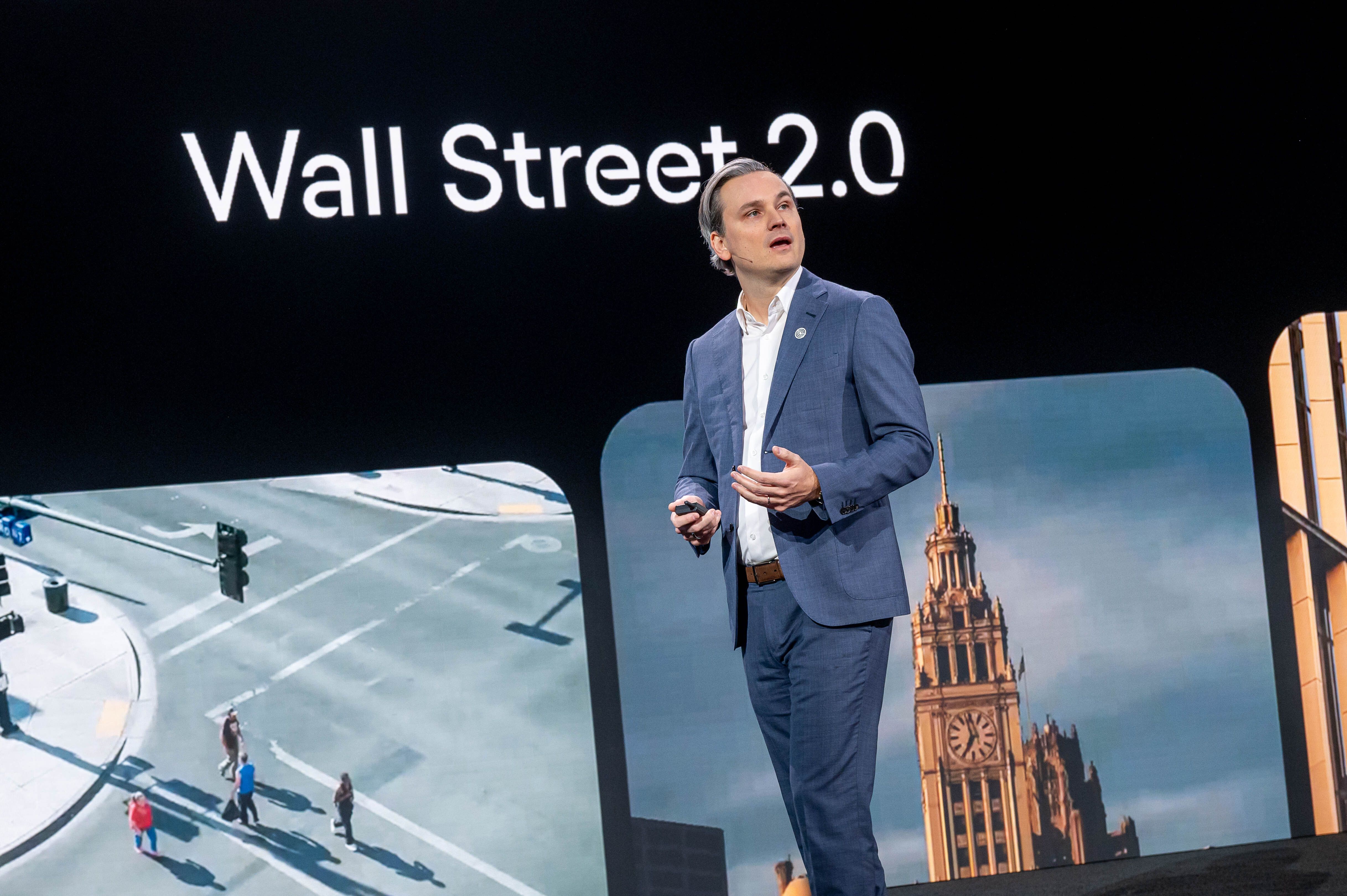
Ian De Bode, Ondo’s chief executive, did not frame the announcement as a technology milestone. “Today’s milestone shows we can tokenize securities in ways that meet both market and regulatory requirements,” De Bode told CoinDesk, directing the argument at compliance officers at institutional asset managers as much as at the DeFi community. The distinction matters: the first audience has the capital; the second has the enthusiasm.
The January 2026 SEC framework underlying the deployment was drafted as an extension of existing law rather than new rulemaking. It permitted tokenized securities to operate within existing custodial structures, bypassing the need for new legislation by reinterpreting what a custodian can hold and how shareholder rights can be transmitted through token infrastructure. Ondo’s architecture is built directly on that interpretation, which remains legally untested under adversarial conditions. The company has disclosed no SEC pre-approval for its specific implementation, and the agency has not publicly endorsed the structure Ondo chose.
The competitive race in real-world asset tokenization is intensifying. Securitize’s NYSE partnership brought tokenized equity infrastructure to Solana and Avalanche, giving institutional investors a second on-chain venue as Ondo arrives on Ethereum. The two approaches reflect different institutional bets: Ethereum’s deeper DeFi liquidity against the faster settlement and lower transaction costs available on competing chains.
The regulatory environment is shifting simultaneously at the state level. California’s crypto licensing regime also took full effect on July 1 under the Digital Financial Assets Law, requiring every exchange and stablecoin operator serving the state’s residents to hold a state license or face $100,000-per-day civil penalties. For a platform like Ondo, which operates through smart contracts rather than a traditional intermediary, the interaction between state licensing regimes and the federal tokenization framework is an unresolved compliance question the company has not addressed publicly.
Neither Ondo Finance nor Oasis Pro Transfer Agency disclosed the volume of tokenized shares issued in the initial deployment, the number of institutional counterparties participating at launch, or the fee structure for transfer agent services. The instruments are not available to US investors. When or whether that restriction lifts depends on further regulatory clarity the SEC has not provided.
The broader argument for on-chain equities has always rested on efficiency: programmable settlement, automated corporate actions, 24-hour trading windows without the clearing delays that traditional markets require. Those advantages remain theoretical for institutional investors until a compliant, scalable infrastructure exists at sufficient scale. Ondo Finance is claiming, with this deployment, that the infrastructure now exists. What it cannot claim yet is that US investors can access it, or that regulators have formally endorsed the specific compliance path it chose.
The gap between proof of concept and broadly accessible market infrastructure is where tokenized securities have stalled before. Ondo Finance cleared the first gate. Whether the second follows depends on decisions made in Washington, not on Ethereum.