
SEOUL – NVIDIA and South Korea’s SK Group signed letters of intent Friday for a $500-billion-plus partnership to build AI infrastructure on the peninsula, with SK Hynix locked in as the chipmaker’s primary supplier of high-bandwidth memory for the next generation of AI systems. The agreement, which SK Group Chairman Chey Tae-won framed as a competition to produce intelligence rather than merely consume it, establishes the terms of what would become Asia’s most significant AI infrastructure commitment to date.
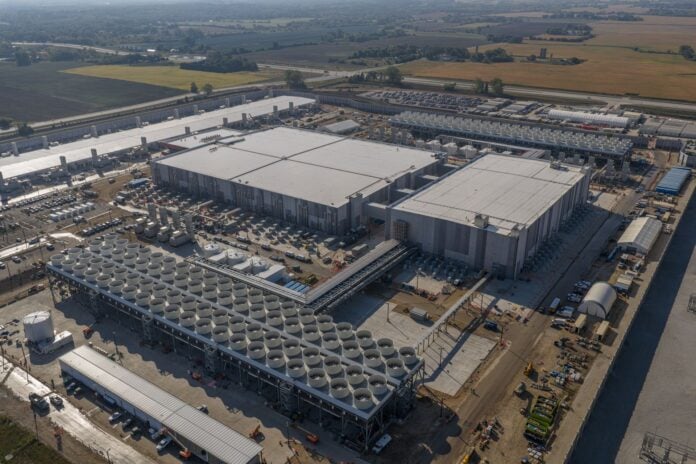
The deal’s centerpiece is a 2-gigawatt AI factory that SK Telecom will build using NVIDIA’s Vera Rubin DSX computing platform, expected online in 2027. Two gigawatts of compute capacity exceeds what most national power grids allocate to any single industrial tenant. NVIDIA CEO Jensen Huang offered the rationale directly: “South Korea has all the ingredients to become a global AI powerhouse – world-class networks and data centers, leadership in chip technology and vast industrial scale.” The factory will serve sovereign, agentic, and enterprise AI demand across the Asia-Pacific region, with a mandate to deliver the lowest token cost and maximum energy efficiency the Vera Rubin DSX platform can achieve.
The memory supply component is what the semiconductor industry will be watching most carefully. SK Hynix, which currently controls roughly 60 percent of the global HBM market, will enter a long-term supply arrangement with NVIDIA and co-develop next-generation high-bandwidth memory covering applications from large language model training to physical AI. SK Hynix’s record Nasdaq debut last month raised $28 billion and formally put the South Korean chipmaker’s HBM franchise in front of global investors; the NVIDIA supply lock translates that public-market profile into an exclusive product roadmap partnership.
High-bandwidth memory is not interchangeable. The architectures that NVIDIA designs its AI chips around are built to the specific timing and bandwidth characteristics of HBM; switching suppliers mid-generation would require redesigning silicon. By pulling SK Hynix into the co-development process rather than treating it as a procurement source, NVIDIA is embedding its primary memory supplier into the engineering decisions that determine what the next chip generation can and cannot do. That arrangement benefits NVIDIA’s roadmap more than any volume discount alone could.
The letters of intent – rather than binding contracts – mean that the financial specifics remain to be finalized. The $500-billion-plus figure describes the total scope of the three-pronged partnership: AI factory infrastructure, HBM supply, and sovereign AI services. How that breaks down across SK Telecom, SK Hynix, and the broader SK Group over what timeline was not disclosed. The joint announcement from NVIDIA’s newsroom describes a partnership covering AI factories and next-generation memory, but stops short of publishing volume commitments or per-unit economics.
What the announcement does establish concretely is South Korea’s formal entry into the race for AI infrastructure leadership. SK Group employs more than 100,000 people across over 175 affiliates, and its two AI-facing units – SK Telecom for deployment infrastructure, SK Hynix for the memory that AI compute depends on – are positioned as complementary rather than competing. The pairing is architecturally deliberate: Telecom builds the factory; Hynix supplies the memory that makes the factory’s GPUs run fast enough to justify the construction cost.
Chey Tae-won’s framing of the deal deserves attention. “In the AI era,” he said, “competitiveness depends not just on how effectively AI is utilized, but on how much intelligence we can produce.” The distinction – between using AI that someone else builds versus producing AI capacity domestically – reflects a broader strategic calculation South Korea has been forced into by the semiconductor supply-chain pressures of the past four years. China’s material export controls and the US export restrictions that followed pushed Seoul toward a position where sovereign AI infrastructure is not optional. The SK-NVIDIA partnership is, in part, South Korea’s answer to that structural problem.
The timing also reflects NVIDIA’s own geography. The company’s CUDA ecosystem remains the dominant AI compute standard, but the physical locations where that compute gets deployed are no longer American by default. South Korea’s semiconductor majors have been in discussions with multiple AI labs about custom silicon, signaling a pattern where Asian chipmakers move from supply relationships toward design partnerships with AI’s most resource-intensive customers. NVIDIA’s Korea deal is a move to anchor that relationship before a competitor can.
The $950 billion in semiconductor and AI agreements reportedly signed between the US and South Korea this year provides the bilateral context. The SK-NVIDIA deal operates within that framework but as a commercial transaction between two companies, not a government commitment. Whether the AI factory’s compute capacity will remain available to South Korean state clients or primarily serve global enterprise customers is not answered by Friday’s announcement. That question will matter increasingly as South Korea determines what AI sovereignty actually means in operational terms.
Jensen Huang’s assertion that South Korea has all the ingredients for AI superpower status is the kind of claim he makes with precision. The Vera Rubin DSX – the NVIDIA platform that SK Telecom’s factory will be built on – is among the newest in NVIDIA’s lineup. The 2-gigawatt facility will be among the earliest large-scale deployments of that hardware, making it a test of whether the platform delivers on its promised token costs and energy efficiency at production scale. South Korea is not just building an AI factory. It is building NVIDIA’s most expensive hardware test bed outside the United States, and staking a significant portion of its semiconductor industry’s next chapter on what that test bed produces.