
SAN FRANCISCO – Every dollar Anthropic has raised, and it has raised a lot of them, eventually ends up at Nvidia’s order desk. The company behind the Claude AI family is now exploring whether that needs to be the whole story.
Anthropic has entered early discussions with Samsung Electronics to manufacture a custom AI chip using Samsung’s two-nanometer process technology, TechCrunch reported on July 2, citing original reporting by The Information. The talks are nascent and exploratory: Anthropic has not yet determined what the chip would do, how it would fit into a server, or how powerful it would need to be. The company may not proceed at all. But the conversations mark the clearest signal yet that Anthropic is thinking seriously about building hardware of its own.
What makes the timing notable is what came just before it. OpenAI unveiled its first custom silicon in late June: an inference processor called Jalapeño, built in partnership with Broadcom, designed to run large language models more efficiently than standard GPUs. The company claims Jalapeño delivers roughly 50 percent lower inference costs in early testing compared with GPU-based setups. That announcement, alongside Google’s long-running TPU program and Amazon’s Trainium chips, put Anthropic in the increasingly uncomfortable position of being the only frontier AI lab without a hardware story of its own.
Samsung was not an arbitrary choice of manufacturing partner. The South Korean company became a “strategic infrastructure partner” in Anthropic’s Series H fundraising round in May, a $65 billion round that also drew investment from memory chipmakers SK Hynix and Micron. Of those three semiconductor investors, Samsung is uniquely positioned: it is the only one that both produces memory and operates chip foundries. That combination matters for AI workloads, which require tight integration between computing power and memory bandwidth. The interest in Samsung spans both halves of that business.
Samsung’s two-nanometer process technology is built on a Gate-All-Around transistor architecture, a meaningful step beyond the FinFET design used at older chip generations. The company’s SF2 node entered volume production in late 2025; a more advanced variant with backside power delivery, called SF2Z, is slated for mass production in 2027. Samsung has positioned both nodes as alternatives to TSMC’s comparable offerings, which remain heavily allocated to Apple, Nvidia, AMD, and Qualcomm. Whether Samsung’s 2nm manufacturing yields can match TSMC’s production consistency at scale is a question the industry has not yet answered. The long-running market preference for TSMC is partly a yield-quality bet, not just a capacity one.

The personnel signal may be harder to dismiss than the foundry conversations. Anthropic recently hired Clive Chan, who announced his departure from OpenAI in a June 7 post on X. Chan was among the first engineers on OpenAI’s custom chip program and helped build that effort from its early stages, well before Jalapeño existed as a product. His arrival at Anthropic suggests the Samsung talks are not idle conversations filed away in a strategy document.
Anthropic told TechCrunch that a “diversified hardware stack that includes chips from Google, Amazon, and Nvidia will continue to be pivotal to its compute strategy.” On the Samsung talks specifically, the company said it had nothing further to add. That careful framing – naming the cloud providers’ chips as the foundation while leaving room for something else – is consistent with how both Google and Amazon structured their own silicon programs in their early years. Neither started by announcing a Nvidia replacement; both ended up building one anyway.
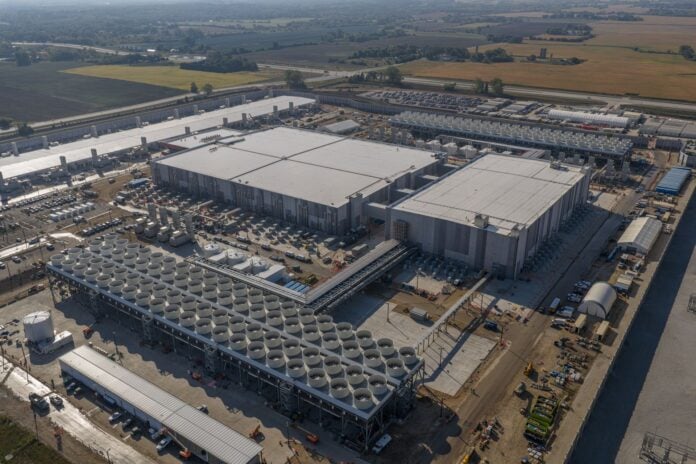
The scale of Anthropic’s hardware ambitions gives some context for why a custom chip would matter. The company is planning roughly one gigawatt of total data center capacity backed by approximately $50 billion in investment, with a significant portion earmarked for physical hardware including chips, DRAM, and storage. A processor optimized for Anthropic’s specific model architectures could improve performance per watt in ways that general-purpose GPUs, designed to serve every customer from game developers to weather modelers, cannot.
Anthropic is not the only company circling Samsung’s foundry capacity. Meta is also reportedly in discussions with Samsung on 2nm chip manufacturing, according to industry reporting, as the social media company accelerates its own AI hardware strategy. That suggests Samsung Foundry is positioning itself as something of an overflow valve for an industry that has spent years waiting for TSMC to have capacity to spare. Whether Anthropic joins that queue in earnest, or decides the compute economics work with its existing suppliers, is a question the company has not yet answered for itself.