CoreWeave Revenue Doubles to $2.58 Billion as $104 Billion Backlog Drives Shares Up 12%
CoreWeave Q2 revenue doubled to $2.58 billion; a $104 billion backlog and raised full-year guidance of $13.2 billion sent shares up 12 percent after hours.
August 12, 2026
3 mins read
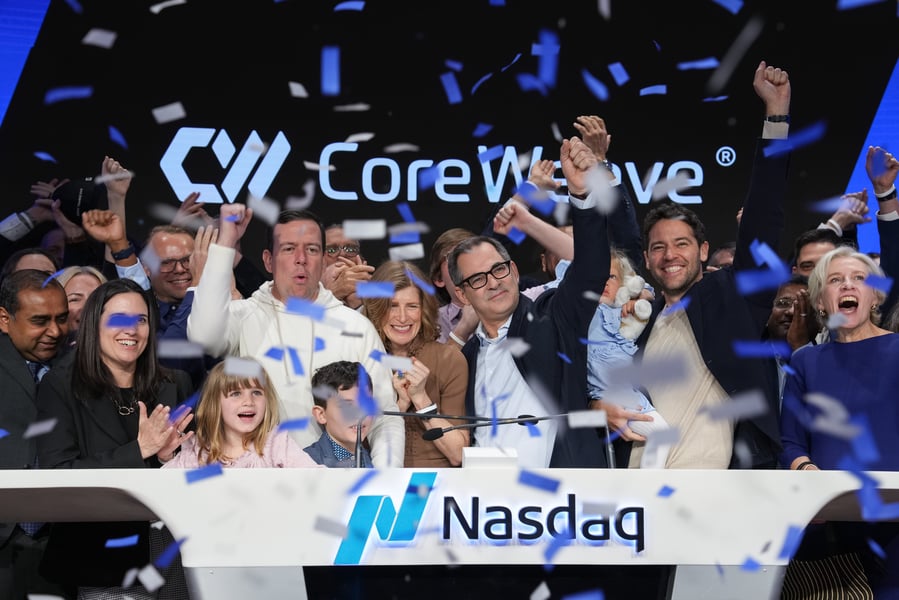
CoreWeave, the GPU-cloud provider backed by Nvidia, reported revenue doubling to $2.58 billion in Q2 2026. [Image Source: TechCrunch]
NEW YORK — CoreWeave posted second-quarter revenue of $2.58 billion on Tuesday, doubling from the year-earlier period and sending shares of the GPU-cloud company up roughly 12 percent in after-hours trading as investors absorbed a $104 billion order backlog that signals sustained enterprise demand for artificial-intelligence computing capacity.The company also raised its full-year revenue guidance to between $12.4 billion and $13.2 billion, up from earlier projections, a move that reinforced the narrative that the AI infrastructure buildout has not crested. Revenue beat analyst expectations; losses widened as CoreWeave continued heavy spending on data-center construction.Chief Executive Michael Intrator, on the post-earnings call, said enterprise investment in AI infrastructure “has not paused and is not pausing,” a framing pitched directly at investors who have spent months debating whether hyperscaler capital expenditure plans could sustain independent GPU-cloud operators through a potential demand lull. CoreWeave rents Nvidia GPU clusters to large language model developers and enterprise AI teams that cannot or will not build their own computing infrastructure.The backlog figure commanded attention above all else. At $104 billion, representing a 246 percent gain from the year-earlier period, it dwarfs the company’s current annualized revenue run rate and implies years of visible growth if execution holds. For a company that listed on the Nasdaq less than two years ago under significant skepticism about its capital model, the figure functions as institutional validation, even as the pace of backlog conversion to recognized revenue remains a live question.Free cash flow came in at negative $5.7 billion for the quarter. CoreWeave has structured much of its infrastructure spending through asset-backed financing arrangements, using signed customer contracts as collateral, a model that requires uninterrupted demand growth and sustained lender appetite for GPU-backed securities. The approach has held so far; whether it holds in a slowdown has not been tested.
CoreWeave CEO Michael Intrator said at the Q2 earnings call that enterprise investment in AI infrastructure has not paused and is not pausing. [Image Source: TechCrunch]
Microsoft accounts for a substantial portion of CoreWeave’s contracted capacity. The software giant’s continued reliance on external GPU providers reflects the difficulty of scaling AI training workloads fast enough through in-house infrastructure alone, even for a company spending tens of billions annually on its own data centers. That dependence concentrates customer risk inside CoreWeave’s order book in ways that analysts have flagged repeatedly, though the company has not disclosed updated concentration figures beyond prior regulatory filings.CoreWeave’s relationship with Nvidia, which holds an equity stake in the company and supplies its H100 and Blackwell GPU generations preferentially, gives it a supply advantage that smaller GPU-cloud competitors have struggled to close. Nvidia’s $500 billion AI financing announced last week suggested the chipmaker intends to keep the broader infrastructure ecosystem well-supplied, a development that benefits CoreWeave’s capacity expansion plans even as it lowers barriers for potential rivals.The earnings report arrived against a backdrop of accelerating AI capital spending across the sector. Alphabet, Amazon, and Microsoft have each signaled continued multiyear infrastructure commitments, and CoreWeave’s guidance increase indicates management believes it is capturing a growing share of that external compute demand rather than being displaced as hyperscalers build more of their own capacity. Intel’s $15 billion AI foundry financing round last week added another competitor into the broader conversation about who owns the AI infrastructure buildout’s financial upside.Shares of CoreWeave (CRWV) climbed roughly 12 percent in after-hours trading following the report. The stock had already recovered substantially in recent months after a sharp drop earlier in the summer, when Meta’s compute cloud announcement triggered fears that the social media giant would enter the GPU-rental market as a competitor rather than a customer, hammering shares 10 to 12 percent in a single session. Tuesday’s results appeared to reassure investors that no new entrant can quickly replicate CoreWeave’s installed base and pipeline of signed contracts.The after-hours gain also reflected relief that guidance held firm. Several analysts had entered the quarter concerned that AI model developers might be consolidating workloads, spending more selectively on fine-tuning and inference rather than large pretraining runs that consume the most GPU capacity. CoreWeave’s raised outlook pushed back against that reading, at least for the contracts it has already signed.What the backlog does not resolve is the capital-efficiency question. CoreWeave is spending heavily to serve demand that customers have contractually committed to, but the timing of that capital recovery, and whether the company reaches sustained positive free cash flow before needing to return to debt or equity markets, remains the central uncertainty for investors assessing the stock. The $5.7 billion quarterly outflow is consistent with a company aggressively front-loading infrastructure to meet backlog commitments, but it demands that revenue growth continue compounding to justify the model.For now, the market chose to reward the revenue doubling and raised guidance over concerns about the cash burn. Whether that judgment holds when shares open for regular trading Wednesday will be CoreWeave’s next test.