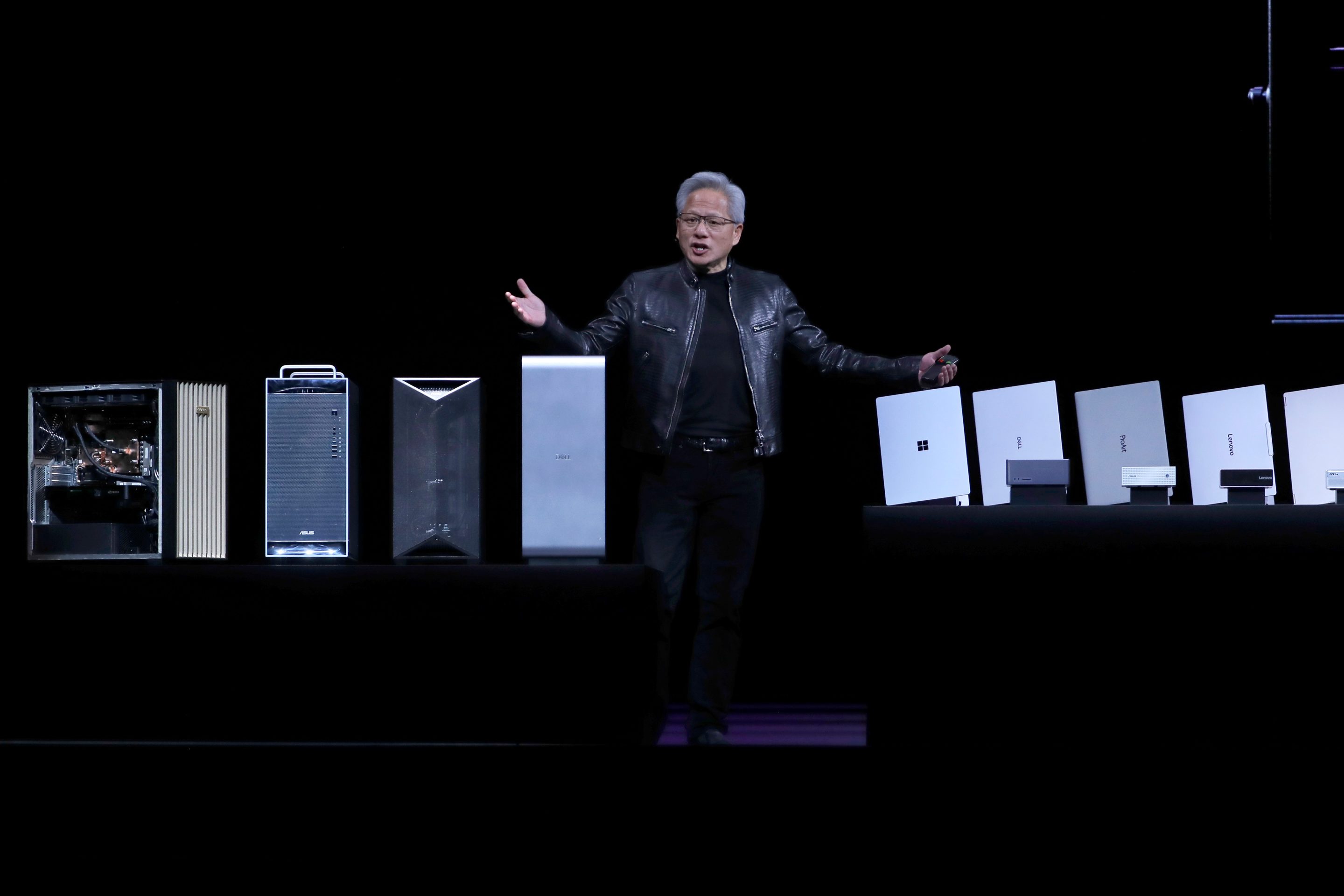

NEW YORK — When Jensen Huang approached six of Wall Street’s largest asset managers and proposed a $500 billion commitment to artificial intelligence infrastructure, all six signed. Not one turned him down.
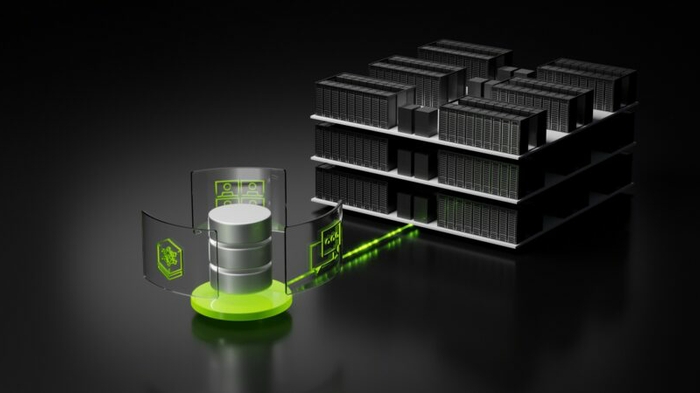
The result, announced Monday and formalized in memorandums of understanding, pairs Nvidia Corp. with Apollo Global Management, Blackstone, BlackRock, Brookfield Asset Management, Goldman Sachs, and KKR. The six firms will create dedicated financing platforms designed to mobilize capital for AI data centers, computing equipment, and what Huang has taken to calling “AI factories” — a phrase that signals both an investment thesis and a fundamental reframing of what Nvidia’s chips are.
“This is really the first time that technology chips have become an investable asset class,” Huang said in a CNBC interview announcing the deal. “These are revenue-generating assets now.”
The distinction between chips as products and chips as infrastructure assets is the core of what Nvidia is building. Under the arrangement, the six firms create special-purpose vehicles that lease compute capacity to Nvidia’s customers — AI developers, enterprises, governments, and cloud providers. Those customers gain access to scarce computing at scale without putting the full capital cost on their own balance sheets. Goldman Sachs, drawing on its $4 trillion asset-management platform, will serve as lead bookrunner on public debt offerings, distributing returns through its credit and asset-management arms. Deals are expected to reach market within months.
The model borrows explicitly from infrastructure finance — the same framework used to fund toll roads, cell towers, and commercial real estate. Huang’s case for the analogy rests on compute’s liquidity: unlike a highway, Nvidia hardware can be reallocated between customers when demand shifts, which the participating firms argue reduces debt-investor risk. Whether institutional credit markets will price that liquidity premium as generously as toll-road bonds is a question that will be tested when the first special-purpose vehicles reach the market.
The $500 billion figure represents a mobilization target rather than committed capital — Nvidia has not disclosed individual investment amounts or timelines from each firm. The scale is nevertheless significant. The technology sector’s largest companies are expected to exceed $730 billion in combined AI infrastructure spending this year. Even a fraction of that volume moving to third-party financing would shift who ultimately owns AI infrastructure and who bears its risk. As the Hugging Face chief executive warned last week, American AI development may already be ceding ground to China’s open-source models; Huang’s Wall Street alliance is, in part, an argument that the United States can finance its way to scale.
Analysts have raised structural concerns. If Nvidia’s customers borrow capital from Wall Street to purchase Nvidia hardware, and Nvidia itself provides backstop financing for “up to 25 percent of an opportunity,” the arrangement has the character of a feedback loop: Nvidia-organized capital flows to Nvidia customers who buy Nvidia products. The Financial Times, which first reported the deal, noted that analysts were examining whether the architecture inflates Nvidia’s valuation independently of what AI systems actually earn for their operators. That question has not been answered. It has been the central one surrounding Nvidia’s stock for three years.
The concerns are not new, and they have not been right yet. Nvidia has navigated similar skepticism since 2023, when enterprise AI spending began accelerating at a pace analysts described as unsustainable. The same doubts drove AI infrastructure stocks lower in July before they recovered. Separately, Huang backstopped roughly $250 billion in data-center leases for OpenAI and has signed a $500 billion infrastructure partnership with South Korea’s SK Group. Monday’s Wall Street announcement is the largest single financing initiative Huang has organized, but it fits a pattern: use Nvidia’s market position to shape the financial architecture around its hardware, keeping the company at the center of every transaction without absorbing the financing risk itself.
Intel’s $15 billion share sale, announced this week to fund its own AI chip manufacturing expansion, illustrates the breadth of capital mobilization underway across the semiconductor industry. The difference between the two is structural: Intel is selling equity to finance its own operations. Nvidia is organizing third-party debt to finance its customers’ operations. If Huang’s model works, Nvidia earns on every transaction in the chain while the balance-sheet risk sits elsewhere.
The six firms that signed the MOUs do not normally agree on much. Apollo and Blackstone primarily manage private credit; BlackRock oversees $11 trillion across passive and active funds; Brookfield focuses on real assets; KKR spans private equity and credit; Goldman Sachs straddles investment banking, asset management, and proprietary trading. When institutions competing for capital across that range of strategies align behind the same infrastructure bet, the alignment registers. It does not tell you whether the bet is right.
What Huang has not addressed — and what none of the six firms have discussed publicly — is what happens to these structures if AI revenue growth slows faster than infrastructure debt matures. The SPV model works when assets generate consistent cash flow to service debt. Toll roads do. Whether AI factories will depends on whether demand for compute, which has risen sharply on a narrow base of frontier model training, spreads broadly and fast enough to sustain infrastructure-grade returns across a $500 billion portfolio.
Huang’s answer is that the industry has moved “from an era in which companies bought chips and built data centers project by project to one in which AI factories can be financed as productive infrastructure.” Monday’s announcement is his most forceful argument yet that Wall Street, at least, agrees with him.