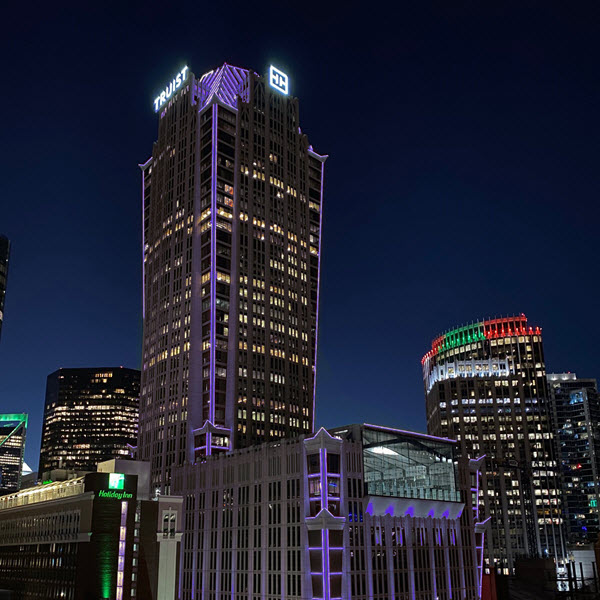

CHARLOTTE, N.C. — Truist Financial (NYSE: TFC) asked investors on Friday to read its third quarter as a $1.16-a-share quarter, not the 56 cents it actually reported, and said in the same release that it will sell LightStream, its online personal-loan business, to Carlyle Group (NASDAQ: CG). The deal follows the sale of Regional Acceptance Corporation, its near-prime auto lender, which closed during the quarter.
The gap between the two figures is mostly one decision. Truist booked a $1.45 billion pre-tax loss on bonds it sold, worth $0.90 a share, and offset part of it with a $581 million loan-loss reserve release from the auto-lender sale, less $106 million of related costs. Truist chose those exclusions, and “adjusted” is a non-GAAP label. Net income available to common shareholders was $684 million. It is the second big bank in a week to hand investors a number with the bad item removed: Bank of America earnings on Wednesday set aside a $1.2 billion penalty.
Chief financial officer Mike Maguire told analysts Truist sold $8.6 billion of agency mortgage bonds yielding 2.67% and bought $7.2 billion of securities yielding about 5.6%, with a shorter duration. Truist’s investor presentation shows roughly $40 million of extra net interest income from the repositioning in the fourth quarter. On that figure alone, TEH’s arithmetic and not Truist’s, the loss takes about nine years to earn back. Truist calls the move capital-neutral, funded by the roughly $1 billion of capital the auto sale freed. A loss this size reflects a bond market where, as TEH reported in September, the 10-year Treasury yield near a 19-year high had cut the value of older holdings.
New chief executive Mike Lyons, on his first earnings call, said Truist has “operated too many nationally focused standalone single product businesses like Marine and RV, RAC, and LightStream,” which “diverted attention and resources from growing our core deposit franchise,” according to Fortune’s transcript of the call. Maguire called LightStream a “non-core loan-only business” earning returns “well below our targets.”
Truist signed the $7.7 billion deal on Wednesday. It expects $7.2 billion in net proceeds and about $850 million of common equity tier 1 capital, with closing in the fourth quarter, its investor presentation shows. Neither side disclosed a price. The $500 million gap between loans and proceeds could be a discount, fees or something else.
Carlyle’s release describes mostly fixed-rate loans to “super-prime and prime borrowers” and does not name LightStream. Partner Akhil Bansal said banks “are increasingly turning to private capital to help manage their balance sheets.” TEH found no earnings figure for LightStream in Truist’s filings or call.
Truist also named retired Bank of America executive Steve Boland vice chair on Friday and said Dontá Wilson, its consumer and small business banking chief, is leaving.
Maguire said another $17 billion to $18 billion of bonds could be “actionable.” Truist has not said which business goes next, or what loss that much more selling would book.