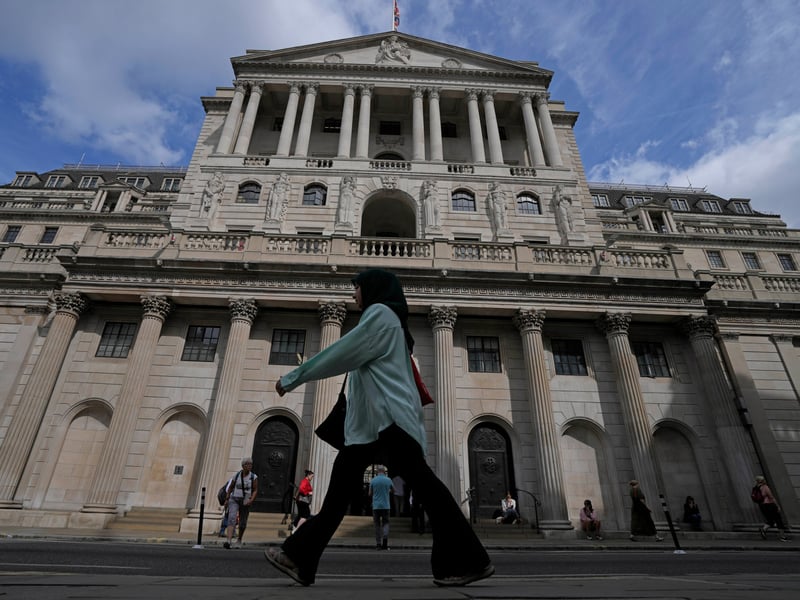

LONDON — Britain faces another test of the case for higher interest rates this week, with fresh inflation and employment figures due after the Bank of England raised borrowing costs for the first time since 2023. The central bank’s concern is no longer confined to the immediate rise in energy bills. It is whether those costs will become embedded in wages and prices across the economy.
The Office for National Statistics will publish October’s consumer price figures on Wednesday, November 18, following labour-market data on Tuesday. The inflation release has not yet been published. September’s annual rate was 3.5%, already well above the Bank’s 2% target.
Bank Rate stands at 4% following November’s quarter-point increase. Eight members of the nine-member Monetary Policy Committee supported that move; Catherine Mann wanted a larger half-point rise to 4.25%. The next decision is due on December 17, but the committee has not committed to another increase.
The forthcoming ONS consumer price release will help distinguish an energy-led rise in inflation from a more persistent change in domestic price pressures. That distinction matters for borrowers and businesses: the Bank expects inflation to approach 5% next year, but says the scale of any further tightening will depend on how companies, workers and consumers respond. Its forecast is not a promise that interest rates will follow a particular path.
In its November Monetary Policy Report, the Bank said inflation was projected to average 4.9% in the second quarter of 2027. Higher petrol, diesel and household utility costs account for much of the pressure. The report nevertheless described the evidence of broader knock-on effects on wages and other prices as limited so far.
That qualification is central to the policy debate. A rise in headline inflation can reflect the direct cost of imported energy without establishing that domestic wage and price-setting behaviour has changed. The Bank raised rates because it judged the pressure still in the pipeline sufficiently large to warrant action, rather than because it had already observed a broad acceleration across the economy.
The National Institute of Economic and Social Research takes a more pessimistic view of how long inflation will persist, even though it forecasts a lower near-term peak than the Bank. In its November 11 autumn outlook, the institute projected inflation reaching 4.4% in February 2027, averaging 3.9% next year and 3% in 2028. Under its central forecast, inflation would not return to target until late 2030.
The two forecasts therefore should not be reduced to a contest over whose peak is higher. The Bank’s projected peak is later and higher, while NIESR is more concerned about the time needed to bring inflation back down. Different assumptions about energy prices, wage responses and monetary policy shape those outcomes.
NIESR’s distinction between what it expects policymakers to do and what it thinks they should do is equally important. Its central forecast assumes one further increase in Bank Rate, to 4.25% next year. The institute says that would not be enough.
At the time of its report, markets priced rates reaching around 4.75% next year. NIESR judged that path closer to what was required and estimated that it would bring inflation back to target in early 2029, roughly 18 months sooner than in its central forecast. Those are the institute’s modelling results and market observations at its reporting date, not a newly announced Bank of England policy.
The faster return to target would carry a cost. NIESR estimated that the tighter rate path would take around 0.4 percentage points off GDP growth in each of 2028 and 2029. Its argument is that allowing inflation to become entrenched would ultimately require a more damaging correction.
Pay negotiations are one reason for its concern. The institute said the expected early-2027 inflation peak would coincide with the settlement of about three-quarters of next year’s pay awards. Households seeking to recover lost purchasing power and firms trying to protect margins could extend the original energy shock into a longer period of domestic inflation. That remains a forecast risk, not an established outcome for those negotiations.
The Bank also sees reasons that the transmission could be weaker. Some businesses have used fixed-price energy contracts and hedging arrangements to delay higher costs, while others have accepted lower margins rather than passing the full increase to customers. Its November report said indirect effects had been smaller than anticipated in July.
There are already signs of strain elsewhere. Mortgage approvals for house purchases fell 8% in the three months to September compared with the preceding three months, according to the Bank’s report. It also projected household consumption growth slowing as higher energy costs reduced real incomes and tighter financial conditions weighed on spending.
That leaves policymakers balancing two risks: tightening too little while inflation becomes persistent, or tightening further as households and businesses begin to absorb the existing squeeze. The Bank explicitly rejected a preset rate path and said it would monitor underlying pay, pricing behaviour and spare capacity at each meeting.
Wednesday’s headline inflation number will be only part of that evidence. The unresolved question is how much of the energy shock companies can continue to absorb before it appears in the prices they charge and the wages they pay.