
SAN FRANCISCO – OpenAI launched Atlas in October 2025 with a specific argument: the AI era required a browser built from the ground up for agents, not adapted from software designed for human clicks. Nine months later, the company has concluded that argument was wrong – or at least, was answering the wrong question. TechCrunch reported Thursday that Atlas would shut down, and its capabilities would be folded into products that already have users.
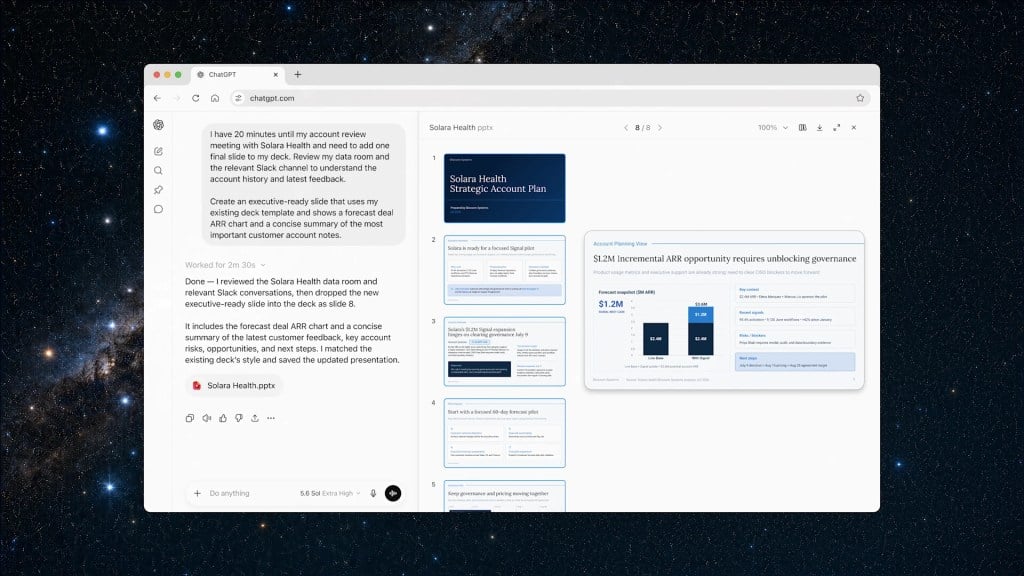
In Atlas’s place, OpenAI is releasing two new products: a ChatGPT Chrome extension that reads and acts on open web pages, and an upgraded ChatGPT desktop application running a cloud-hosted browser on OpenAI’s own servers. Neither is a standalone browser. Both are features inside ChatGPT. That is the point.
“The browser is a feature, not the destination,” OpenAI said in an internal summary shared with developers Thursday. The phrase is a deliberate reversal of Atlas’s original pitch, which positioned the browser as the natural habitat for AI agents. What OpenAI appears to have learned across nine months of Atlas operation is that users do not want another browser. They want the browser they already use to become more capable. The Chrome extension attempts to answer that want directly.
The extension will give ChatGPT context about whatever webpage a user has open – answering questions about the content, summarizing pages, and initiating multi-step tasks directly from the browser bar. It is positioned as a competitor to Google’s Gemini Side Panel, which has been embedded in Chrome by default for Google One subscribers since late 2025. The competitive framing is unusually direct for a company that typically describes products in terms of user benefit rather than rival benchmarks.
The desktop application goes further. A remote cloud browser – running on OpenAI’s servers, not the user’s machine – can log into websites, download files, and interact with web applications on behalf of a user. The agent does the browsing. The user watches, approves, or delegates entirely. This is closer to what Atlas was trying to build, but housed inside a product that already has hundreds of millions of monthly active users rather than a standalone application that had to acquire an audience from scratch.

Atlas’s shutdown is the second significant product elimination under the “eliminate side quests” directive attributed to CEO Fidji Simo, who separately announced Thursday that she would step down from OpenAI and transition to a part-time advisory role. The first product she eliminated was Sora, OpenAI’s video generation tool, which was folded into ChatGPT rather than maintained separately. The pattern is clear: anything that lives outside ChatGPT creates user acquisition costs that OpenAI no longer considers worth paying. The browser ambition survives. The browser as a standalone product did not.
The market context makes the decision easier to understand. Perplexity’s Comet browser has been available since early 2026, and The Browser Company’s Dia has had months to build habits among the users most likely to switch. OpenAI entering the standalone browser market with Atlas – months after Perplexity and The Browser Company had established early users – was always a harder proposition than it appeared. Whether a Chrome extension and a cloud desktop app can achieve what Atlas could not – capturing enough daily active user time to matter at scale – is the question the product teams will spend the next several months answering.
The OpenAI strategy for 2026 is becoming legible. Release frontier models. Build features around ChatGPT as a platform. Avoid standalone products that do not benefit from the ChatGPT network. Meta’s Muse Spark launch this same week illustrates the pressure: competitors are using price as a weapon, and OpenAI’s best defense is not a cheaper model – it is the stickiness of a product 700 million people already use. Atlas’s shutdown, read in that context, is not a retreat from browser ambition. It is a recognition that the fight for the browser is better won inside Chrome than next to it.
What OpenAI did not address Thursday is what happens to Atlas’s existing users – their session data, bookmarks, and the workflows they built inside the browser’s agentic layer. The company’s announcement focused on what is arriving rather than what is going away. That gap will become audible once Atlas’s shutdown date is published, which as of Thursday evening it had not been.
OpenAI’s consolidation strategy is coherent on paper. Every feature folded into ChatGPT compounds the value of the subscription rather than fragmenting it across products with separate retention curves. The risk is that the Chrome extension and the cloud desktop browser are features, and features can be matched. A standalone browser, if Atlas had succeeded in building habitual users, would have been harder to displace. OpenAI chose the certain gain over the uncertain moat. Whether that choice looks right in eighteen months depends on whether the Chrome extension actually changes how people use ChatGPT, or whether it becomes another feature that users install and quietly forget.