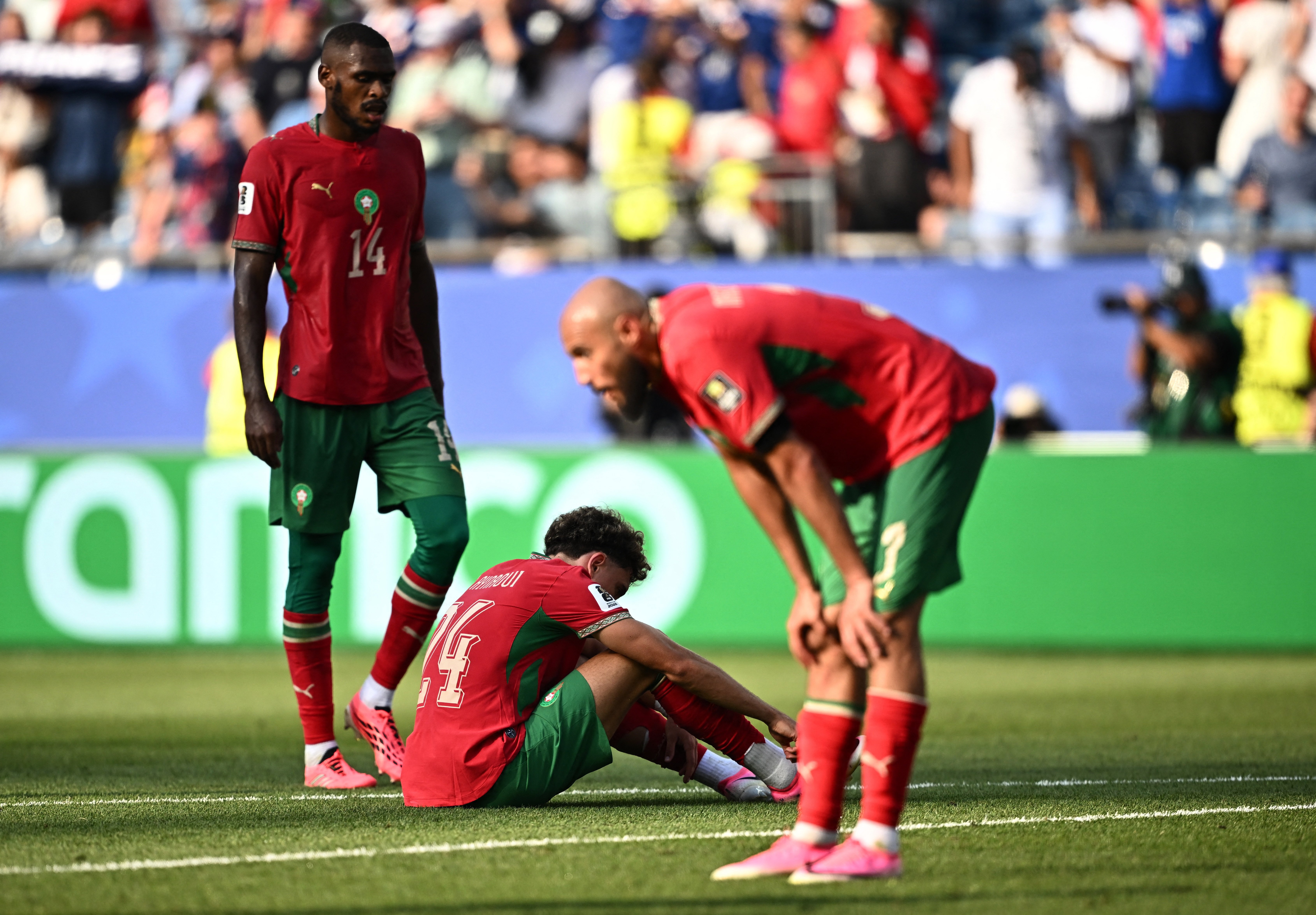

BOSTON – For the second time in three years, Morocco’s World Cup ended against France. The final score at Gillette Stadium was 2-0, the same as it had been in Qatar, and the geography was different but the arithmetic was not. Coach Mohamed Ouahbi, who had taken the Atlas Lions’ job just 90 days before the tournament opened, watched France’s clinical finishing end a run that had been more resilient than anyone outside the Moroccan camp had expected.
The loss on Thursday came in the quarterfinals of a tournament Morocco had navigated further than any African nation has in consecutive editions of the World Cup. They had held Brazil to a draw in the group stage at MetLife. They had defeated the Netherlands. They had beaten Canada 3-0 in the round of 16 in Houston. Against France, with Kylian Mbappe pressing into the space Moroccan defenders could not cover, they ran out of answers in the first half.
The loss does not diminish what the Atlas Lions have built. Morocco are now the first African nation to reach back-to-back World Cup quarterfinals. That fact does not disappear in the defeat. As Eastern Herald reported on the match, France’s victory owed much to Mbappe’s willingness to exploit space that Morocco’s backline, organized under a three-month coaching tenure, had insufficient time to solve.
Morocco will co-host the 2030 World Cup alongside Spain and Portugal, a designation that carries automatic qualification. That guarantee sits four years away. Between now and then, the Atlas Lions face the Africa Cup of Nations in 2027, a September qualifying schedule that opens against Gabon, Lesotho, and Niger, and the task of deciding who will lead the squad into a home World Cup. The generation that carried them through this tournament is young enough that several will be at their peak when 2030 arrives.
Ouahbi took the job from Walid Regragui three months before the tournament under emergency conditions, guiding Morocco to a statement draw against Brazil, a 3-0 destruction of Canada that eliminated the co-host nation, and a quarterfinal against France where the depth of a European finalist ultimately proved decisive. As Morocco’s dismantling of Canada in Houston showed, the Atlas Lions can disassemble opponents not organized to the standard of a European semifinalist.
Ouahbi described a squad with room to grow after Thursday’s final whistle. “We have a young team who want to grow, who will continue to do so. We have talented players who will enable us to grow,” the coach said, without offering clarity on whether he expects to lead that growth into the next cycle. The Moroccan Football Federation has not confirmed his status for the period following the tournament.
What this World Cup established, across the group stage, the round of 16, and into the quarterfinals, is that Morocco are no longer the team that had never reached a World Cup quarterfinal before Qatar 2022. They have now done it in consecutive editions, becoming the first African nation to do so. The benchmark has moved, and the question for 2030 is whether Morocco can move with it.
The 2030 co-hosting arrangement changes the nature of Morocco’s preparation in ways that previous tournament cycles did not. Hosting shifts public expectation, changes how a national program is funded, and alters the relationship between the squad and its domestic audience. Spain and Portugal will carry their own ambitions into the edition; Morocco will be expected to advance deeply in a tournament played partly on home soil. Several players who started against France on Thursday will be 27 or 28 in 2030, approaching or at the peak of their competitive window.
Al Jazeera reported that the Moroccan Football Federation has not yet confirmed Ouahbi’s future. Whether the federation interprets back-to-back quarterfinals as a mandate for continuity, or as evidence that a different tactical identity is needed for the home tournament, is a decision that will shape how Morocco approaches 2030 before the qualifiers even begin.
The 2027 Africa Cup of Nations, for which Morocco are among the favored nations, provides the most significant competitive test before 2030. The AFCON calendar will intersect with the preparation cycle for the home World Cup, creating a double obligation that the federation will need to manage carefully. September’s qualifying matches against Gabon, Lesotho, and Niger offer the first look at how the squad begins to regroup after the tournament exits.
What Thursday did not resolve is whether Morocco has identified a tactical answer to a high-possession European finalist. France, even while rotating portions of its squad, had enough to keep Morocco at arm’s length in the second half. That gap will be more consequential in 2030, when the Atlas Lions will face not just an opponent’s best players but their own country’s full expectation.