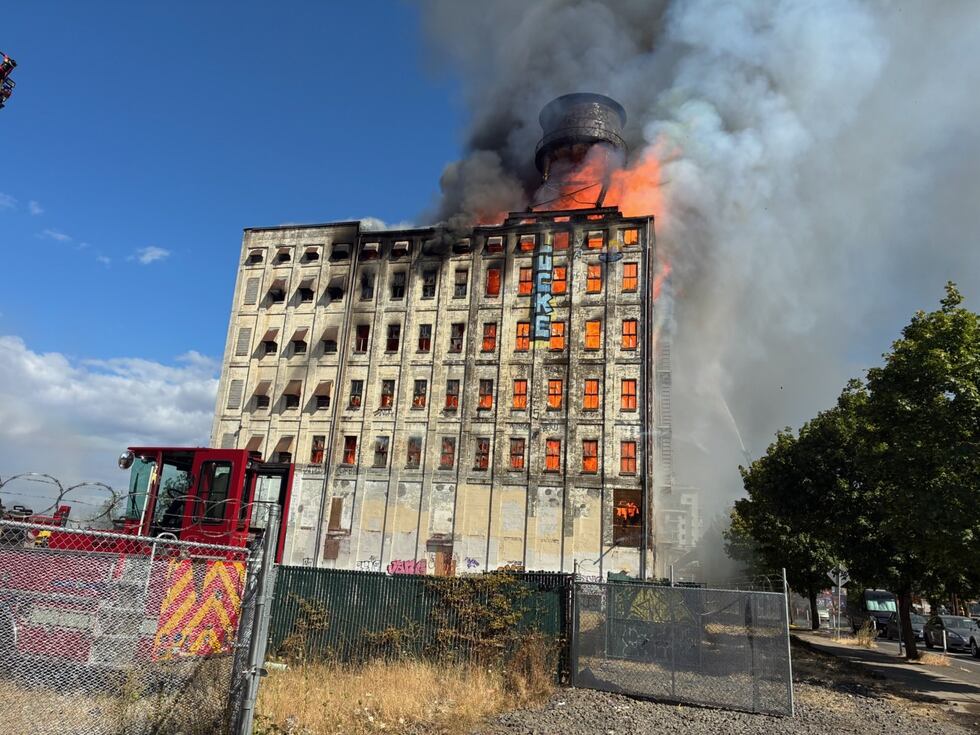

PORTLAND, Ore. – For years, the Centennial Mills complex on Northwest Naito Parkway sat at the edge of the Willamette River as one of the last intact industrial-era timber-frame structures in Portland’s Pearl District, a 116-year-old building whose fate had become a long-running community debate about what belonged on that stretch of waterfront. On Sunday afternoon, the debate became moot. The building burned, and by midnight it was gone.
Fire was reported just before 4 p.m. on August 2, drawing nearly half of Portland Fire and Rescue’s on-duty workforce. About 88 firefighters responded to the call. What they found on arrival made a conventional firefighting response impossible: holes in the floors, stairwells that had been stripped from the structure during the years the building sat vacant. The interior was inaccessible. Rick Graves, the department’s public information officer, said crews moved their attack to the Willamette River and the air, fighting from positions outside a building they could not safely enter.
That structural failure preceded the fire itself. The building’s condition was a function of what had happened to it during vacancy, not just deterioration but the active removal of components. Graves described the timber framing in terms that explained both the building’s historic character and its danger: members 18 to 20 inches thick, the kind of heavy industrial construction common in early twentieth-century milling operations. “That’s a lot of lumber,” he said as the fire took hold. “It’s a lot of fuel. It is now unfortunately all going up.”
Over the hours that followed, all eight stories of the Centennial Mills warehouse collapsed. No injuries were reported. Police had flagged the building in recent weeks over concerns about squatting, but no one was inside when the fire started. Whether the fire’s origin is connected to that recent activity remains under investigation, and Portland Fire had not released a confirmed cause as of Monday morning.
The Human Access Project, a nonprofit that had been developing plans to transform the Centennial Mills site into public riverfront space, faced questions Monday about what comes next. The organization’s stated mission centers on restoring public access to stretches of the Willamette that have been blocked by industrial infrastructure and private development for generations. The group had positioned the Centennial Mills site as a central node in that vision, with plans that involved working around or incorporating the existing structure. With the building gone, the path forward on the site changes, though in which direction the Human Access Project had not publicly said as of Monday morning.
The fire attracted observers from across Portland. A child sobbed as the building’s stories fell, witnesses near the scene said. People gathered to watch from the riverfront and surrounding streets as smoke from the blaze spread across Portland’s skyline, an involuntary public farewell to a structure that had stood, despite everything, for more than a century.
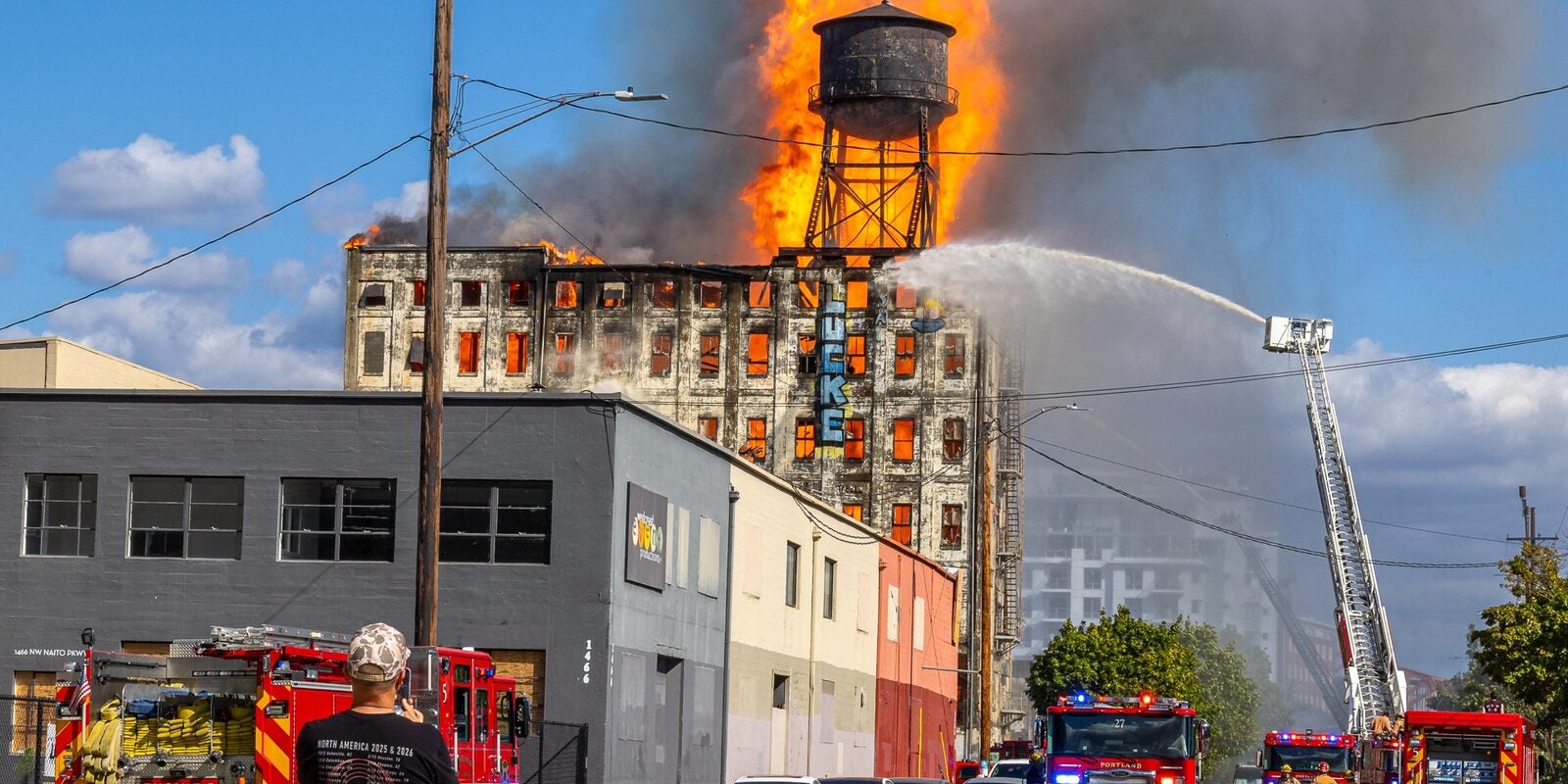
The Centennial Mills building endured the postwar urban renewal demolitions that reshaped Portland’s core in the mid-twentieth century, and later the rezonings that converted the Pearl District from industrial use to residential and commercial development beginning in the 1990s. Its survival through those transitions was the product of a combination of factors: historic-resource listing, a succession of ownership changes that produced planning documents without follow-through, and the logistical difficulty of demolishing or repurposing a structure of that mass and character. Sunday’s fire compressed what those decades had not managed to resolve into a matter of hours.
Portland has grappled for years with the accumulation of pressures that converge in a fire like this one. Historic structures sit vacant because adaptive reuse financing timelines are long, the regulatory frameworks are complex, and the returns are uncertain compared to ground-up development. Vacant buildings become sites of squatting, particularly in a city with a persistent homelessness crisis. And city agencies manage the consequences, fire department responses, police enforcement actions, code violation proceedings, without necessarily closing the underlying gap. The Willamette riverfront that the Human Access Project has been working to open sits in a city that has been a recurring flash point in federal disputes over how American cities police themselves, adding another layer to the political complexity of any major public-space project in the area.
Portland Fire and Rescue said it expected to monitor the site for hotspots through the early part of the week. With the structure gone, the immediate structural hazard is contained. Careful demolition of any remaining unstable elements would follow if needed.
What is not resolved is what the Centennial Mills site becomes now. The city and the Human Access Project have a cleared lot where a building used to stand, and years of community planning invested in the question of what that ground could hold. Whether the loss of the historic structure removes the distinctive anchor that made the vision compelling to funders and planners, or whether a cleared site actually simplifies the development challenge, is a question no one had answered by Monday morning. The investigation into what started the fire is the first order of business. What replaces what burned is the question that will take considerably longer.