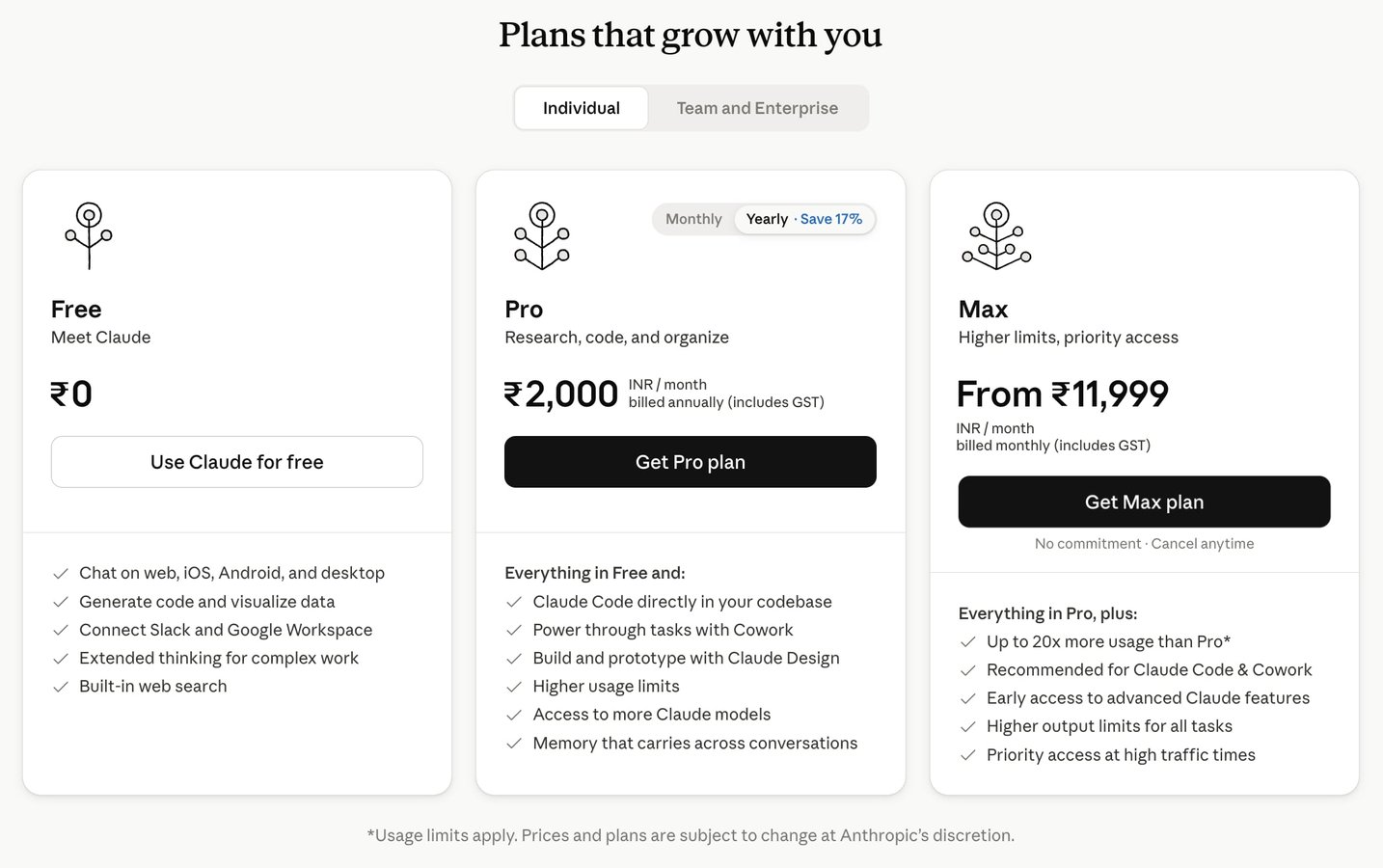

BENGALURU – An Indian developer paying for Claude Pro today finds themselves spending ₹2,000 a month on an annual plan – roughly $21 at current exchange rates – which is about 24 percent more than the $17 monthly rate a user in the United States pays. Anthropic, the AI safety company behind Claude, launched localized rupee pricing for India this week, framing the move as a sign of commitment to a market where its AI is used more than anywhere outside the US. Whether the new prices actually reflect Indian purchasing power, or simply restructure the same cost in a new currency, is where the story gets complicated.
India accounts for 5.8 percent of Claude’s total global usage, making it Anthropic’s second-largest market. The numbers prompted the company to open a Bengaluru office in February and hire Irina Ghose as India business lead in January. The localization move follows that structural investment – the revenue was already being generated, and now Anthropic wants the pricing to signal that India is being treated as more than an afterthought. The company’s recent infrastructure commitments, including a $35 billion chip financing deal closed with Apollo and Blackstone, point to a company that is betting large on global scale.
The new tiers price Claude Pro at ₹2,000 per month on an annual plan, Claude Max at ₹11,999 monthly, and Team plans at ₹2,399 per seat per month. Anthropic said the India prices include local taxes, which accounts for some of the premium over US rates. The company has not disclosed exactly how much of the price gap is attributable to Indian GST versus a deliberate decision to maintain higher effective margins in the market. At Claude Max, the ₹11,999 price translates to roughly $125 monthly, compared to the $100 rate in the US – a 25 percent gap at the top tier.
What the new pricing does not include is UPI support. The Unified Payments Interface is the dominant payment rail in India – the system through which hundreds of millions of Indians pay for software, services, food, and utilities. ChatGPT added UPI support for Indian users, lowering the friction of subscribing substantially. Anthropic requires users to pay via credit card or app store billing. In a market where a significant portion of the technically literate population does not hold international credit cards, the absence of UPI is not a minor detail. It is the difference between a subscription that is theoretically available and one that is practically accessible.
The gap is made more conspicuous by the scale of India’s existing Claude usage. Five point eight percent of global usage is a substantial base – large enough that Anthropic built physical infrastructure in Bengaluru and hired a dedicated country lead. That base reached its size while users paid in dollars. The localization addresses currency friction but not payment method friction. Both exist for a large segment of potential subscribers, and only one has been fixed.
Anthropic has been building its India presence along the enterprise track in parallel. The company has struck partnerships with Infosys and Tata Consultancy Services, two of India’s largest IT services companies, routing Claude’s capabilities to corporate clients. Enterprise procurement operates through contracting cycles and approved vendor lists, not UPI accounts. The enterprise track and the consumer track are not on the same timeline, and the UPI gap that matters for consumer growth is less relevant to the B2B revenue stream that Infosys and TCS represent.
The pricing announcement also comes against the backdrop of Anthropic tightening access to some model tiers globally. In June 2026, the company restricted access to Fable 5 and Mythos 5 – its most capable models – to US-based entities only, a move that affected users across multiple markets including India. The localized pricing addresses the subscription layer. It does not address model availability at the premium tier, which remains a separate and still-unresolved issue for non-US subscribers. An Indian developer can now pay in rupees for a subscription that provides access to models which, at the highest capability level, remain US-only.
The broader AI market is moving fast, and India is becoming a consumption center that AI companies cannot afford to treat as a derivative of their US strategy. Anthropic’s Bengaluru office, its TCS and Infosys partnerships, and now its rupee pricing form a coherent commitment – but an incomplete one. The next step that would clarify how seriously the company is pursuing Indian consumers, rather than just Indian enterprise clients, is UPI support. Until that arrives, the localization is a meaningful but still partial signal.