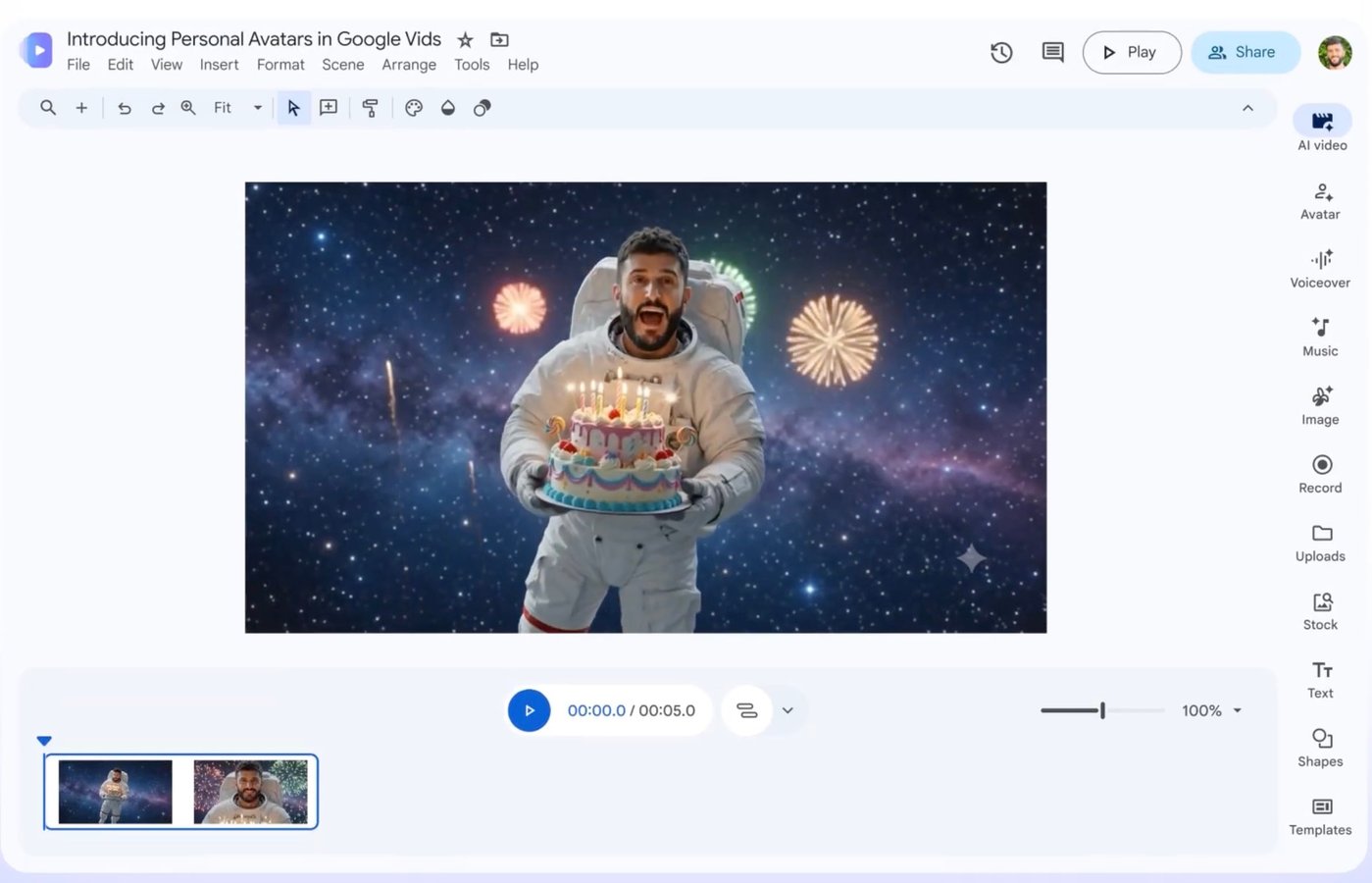

SAN FRANCISCO – The first time you use Google Vids’ new personal avatar feature, you submit a selfie and record ten seconds of your voice. The next time your employer needs a training video, company announcement, or onboarding module, the software generates one starring a digital version of you, without you needing to show up on camera. Google rolled out this avatar capability Thursday alongside an integration of its Gemini Omni multimodal AI model, a pair of updates that move Vids out of the niche of polished slide decks and into the wider market for avatar-based enterprise video.
The practical target is clear. HeyGen, Synthesia, Captions, and D-ID have built subscription businesses around exactly this use case, letting companies produce video content at scale without scheduling production crews or requiring executives to memorize scripts. Google is now offering a version of the same thing inside a productivity bundle that most large organizations already pay for, which changes the economics of enterprise video procurement in ways those competitors will need to answer.
The Gemini Omni integration is, in some ways, the more technically interesting addition. TechCrunch’s review of the rollout notes that Omni handles the gap that avatar-generation tools have traditionally left open: the editing loop. Rather than requiring users to restart a video if they want to adjust the background, change the lighting on phone-recorded footage, or layer in effects, Omni enables step-by-step modifications within a single session. The model takes written prompts combined with reference images and synthesizes the desired video, then accepts incremental requests on top of that output.
For the standalone avatar-video vendors, the structural problem is a familiar one. They sell subscriptions that start at $50 a month for individuals and can exceed $500 a month at enterprise tier. Google Workspace costs large organizations $12 to $22 per user per month, and most already have it. The precedent for what bundling does to adjacent software categories is not encouraging for the companies currently in HeyGen’s position. Enterprise chat startups discovered this when Microsoft Teams and Slack absorbed their market; independent video-conferencing vendors discovered it when Google Meet became a Workspace default.
The rollout lands in the middle of a complicated regulatory week for Google. The European Union issued binding DMA obligations Thursday requiring Google to share search data with rivals and open Android to competing AI services, with fines of up to 10 percent of global turnover for non-compliance. Adding new AI features to bundled products is precisely the kind of conduct that DMA oversight scrutinizes. Separately, a class action accusing Google of using copyrighted books to train Gemini without authorization is pending in federal court. Vids runs on Gemini Omni, and the training data question applies.
Google says it has embedded SynthID watermarking in the avatar feature, an invisible digital fingerprint in AI-generated video content that in principle allows verification of whether footage was created by a human or generated by an AI. The company restricts personal avatar access to users aged 18 or older in what it describes as “specified regions,” though it has not publicly named those regions in the product documentation available at launch. Corporate deployments will test the age restriction quickly: IT administrators, not individual employees, often control account provisioning in enterprise environments, meaning the safeguard depends on administrators to enforce it.
The timing is worth noting. OpenAI’s Sora has been restricted or unavailable through much of 2026. The absence of Sora from the active market allowed Runway, Captions, and HeyGen to consolidate institutional clients this year. Google’s entry does not eliminate those relationships, but it changes what the sales pitch needs to justify: why pay for a separate avatar-video subscription when the IT department is already paying for Google Workspace?
What Thursday’s announcement does not address is the data story. Google has not stated what happens to the selfie and voice clip that generate a personal avatar, whether that biometric data is retained, for how long, and under what access controls. For enterprise clients in regulated industries, where biometric data governance is a compliance question, the absence of that disclosure is not a minor gap. The “specified regions” restriction for personal avatars similarly lacks detail; companies operating across multiple jurisdictions will need clarity before deploying the feature at scale.
Whether this accelerates the consolidation of the avatar-video market into Google’s orbit or simply gives Vids a modest upgrade depends on factors that Thursday’s announcement does not resolve. Enterprise video is still diffuse enough that category incumbents have time to differentiate. The sales conversation changed Thursday, and it runs in one direction.