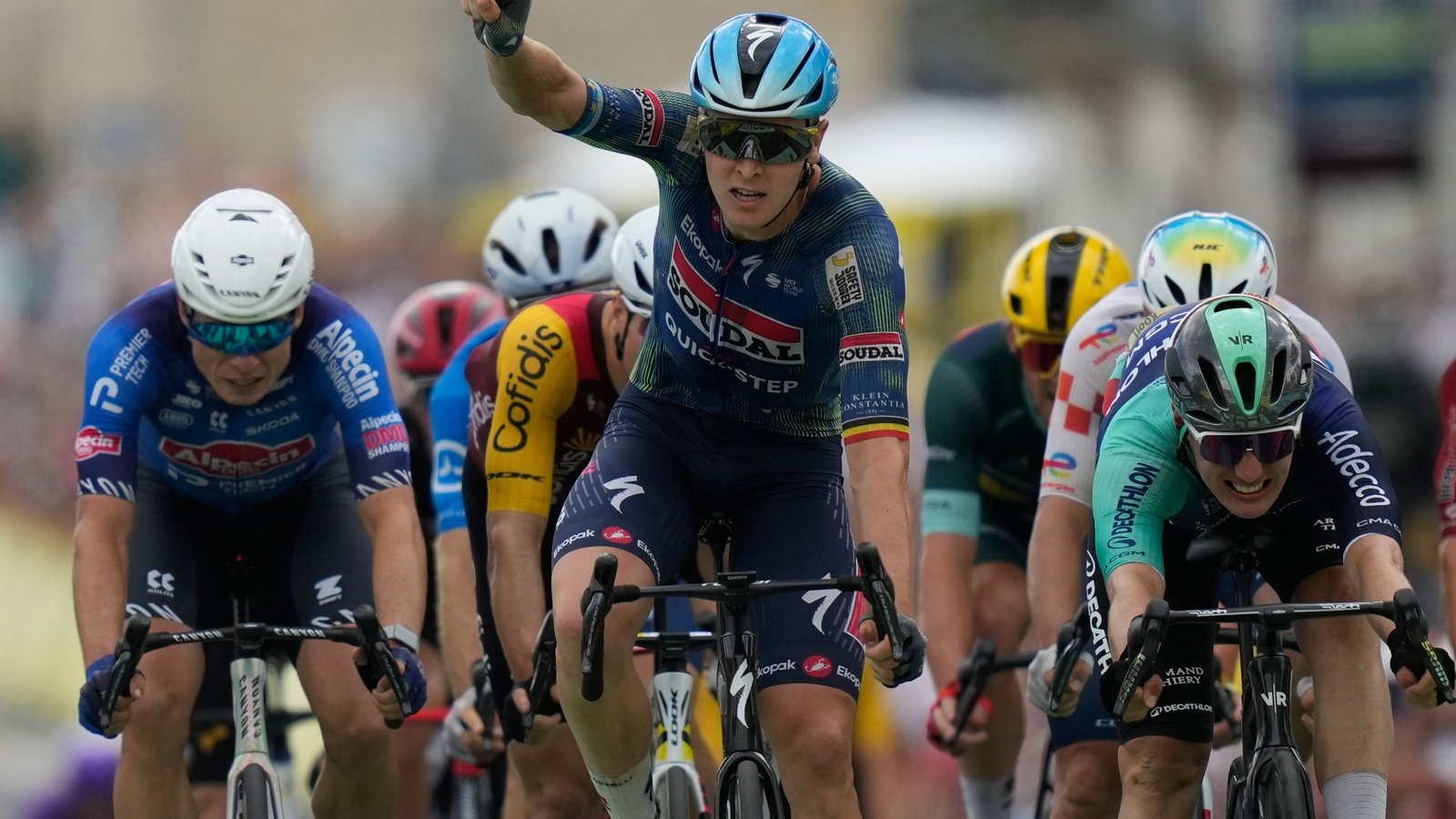

CHALON-SUR-SAÔNE – Fernando Gaviria found his moment and then lost it in an instant. The Colombian sprinter, one of the fastest men in the peloton when the finish is clear, clipped a wheel inside the final two hundred metres on Thursday, pitching sideways into the tarmac as the sprint unravelled around him. Four other riders could not avoid what he had left in the road. By the time the chaos settled on the banks of the Saône river, Tim Merlier was already raising his arms.
The Belgian, riding for Soudal Quick-Step, claimed his third stage victory of the 2026 Tour de France and the sixth of his career at the race. He took his first of this year in a Bordeaux sprint on Stage 7, his positioning already drawing attention from team directors down the road, and has sharpened his finishing instincts in every stage since. The win on Thursday arrived not through calculated position-holding but through patience: staying calm as the sprint lane changed shape around him. Olav Kooij of Team Visma-Lease a Bike finished second, Jasper Philipsen third.
Stage 12 began in Magny-Cours, the former Formula One circuit that held eighteen consecutive grands prix before losing its calendar slot, sitting a hundred and seventy-nine kilometres south of Thursday’s finish. The gradient profile offered sprinters a clean runway, no summit finishes or decisive climbs to fracture the field before the Saône riverbank. The stage read as a formality for the fast men, the question of who would control the final kilometre settling into a familiar contest between Soudal Quick-Step’s sprint train and Visma-Lease a Bike’s lead-out operation.
Tadej Pogacar arrived in Chalon-sur-Saône still in yellow, his lead over Jonas Vingegaard standing at three minutes and thirty-six seconds after twelve days of racing. Remco Evenepoel remained third at four minutes and six seconds. The general classification produced no movement on Thursday, and none was expected on a stage designed for sprinters’ legs rather than climbers’ lungs. The race’s decisive week lies just ahead.
The incident unravelled inside the final five hundred metres. Gaviria made contact with a wheel ahead of him and went down hard, leaving blood visible on his knee and arm when attended to at the finish line. Soeren Waerenskjold, the Norwegian who had won Wednesday’s Stage 11, was also caught in the pile-up. ABC News reported that four other riders were unable to avoid the collision. Race officials confirmed no life-threatening injuries, but Gaviria’s continued participation in the Tour remains uncertain heading into Friday’s stage.
Merlier described the sprint as a test of nerve rather than pace. “Winning for them is special. I managed to find the opening, I had to stay calm and wait,” he said. The words compress what sprinters spend careers trying to learn. There were riders with a clearer route to the line at that moment. They were on the tarmac instead. Soudal Quick-Step, the Belgian outfit that has dominated professional cycling’s sprint races for more than a decade, has now taken four stages of this year’s race.
The green jersey competition, the Tour’s secondary drama, continues to evolve. Merlier’s win Thursday adds to his points tally in a classification that rewards consistency across three weeks rather than a single day of exceptional climbing. Jasper Philipsen, one of the race’s premier sprinters, now faces the challenge of the upcoming Alpine stages while managing a points standing that Merlier is actively pressuring. The final ten days will be demanding for those racing on two fronts.
The sprint stages have given Soudal Quick-Step a counterweight to the summit-finish losses, the days where Pogacar’s solo attacks on Bastille Day widened his general classification lead. That dynamic between what the sprinters gain and what the climbers decide has defined the first two weeks of the 2026 Tour de France, a balance that is about to shift.
Stage 13 arrives Friday, still in transitional terrain before the Alps take over the race entirely. After that, the climbers inherit the schedule and the sprint tables go quiet until Paris. Pogacar’s three-minute-and-thirty-six-second lead looks durable entering the mountains, but Vingegaard has not yet launched the kind of attack that defined his previous Tour campaigns, and the Alpine stages ahead give him enough time and terrain. What the mountains produce is the question that defines the final week.
Whether Gaviria can restart Friday is the question that follows the peloton through the night. His team, Caja Rural-Seguros RGA, had not confirmed his race status when coverage closed. A crash at racing speed, with riders unable to shed momentum in time, produces damage that often shows itself the morning after rather than at the finish line. For now, Merlier has his three wins. The Tour de France does not pause to take stock.