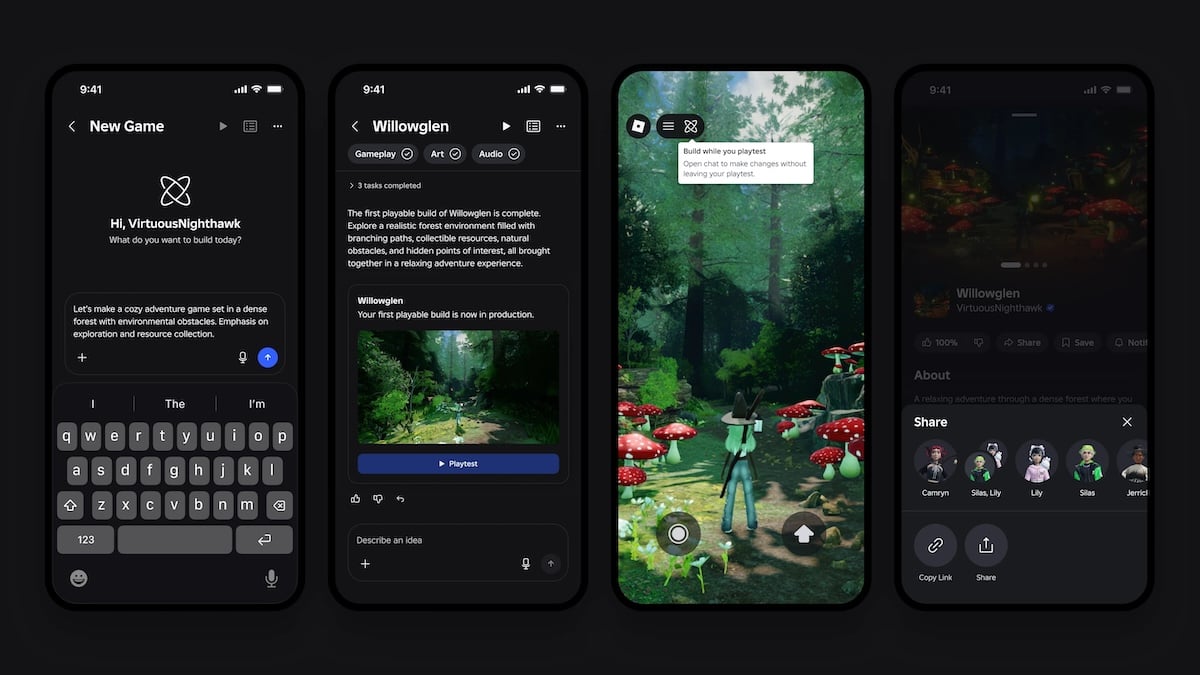

SAN FRANCISCO – A nine-year-old in Auckland types a few sentences into a text box: the characters she wants, the kind of world she imagines, the way the game should work. Within moments, something playable comes back. That is the premise of Build, Roblox’s new AI-powered game creation tool, which the company announced this week alongside a public alpha launch date of July 28 for New Zealand users. It requires no coding, no 3D modeling experience, and no knowledge of how game engines actually function. Describe the game you want, and Build assembles it.
The feature is embedded in the Roblox mobile app and open to users aged nine and older, according to TechCrunch. There is a catch built into the publishing side: users younger than 16 can share their creations with friends, but only those 16 or older can publish games to Roblox’s global platform, where millions of players would discover and play them. The restriction reflects a tension at the core of Roblox’s design. The company wants to lower the barrier to creation as far as it can go, while maintaining oversight over what reaches its youngest users.
Behind the text prompt interface, Build draws on a mix of open-source models and Roblox’s own proprietary AI systems. The platform has been developing scene-generation models and 3D asset foundation models alongside its consumer-facing tools. Together, they handle the full stack of what makes a game a game: the physical environment, how characters behave, the rules of the mechanics, and the sound design. One prompt can yield something that would have taken a developer days to rough out, at least at the structural level.
The service will launch with a free basic tier and at least one paid option. Roblox has not said what the paid plans will cost. That pricing gap matters because Roblox’s creator economy is built on the premise that anyone can make things on the platform, not just professionals but teenagers, hobbyists, and people who put a game together on a Saturday afternoon and never return. If the AI tools that produce good games turn out to live behind a paywall, the democratization story gets more complicated than Roblox’s announcement implies.
Roblox’s roadmap for Build extends beyond creation itself. The company says it is developing AI playtesting agents and analytics tools, expected to arrive in the coming months. The vision is a closed loop: a creator describes a game, Build generates it, AI agents play-test it against edge cases and failure states, and the analytics system reports back what human players actually do. That loop would make Roblox’s creator pipeline faster and could reshape how frequently new content arrives on the platform.
Roblox is not alone in this space. Google, Microsoft, and Tencent are all developing AI-powered game creation tools aimed at similar demographics. Roblox’s moat, if it has one, is the platform itself, with 88 million daily active users who already treat Roblox as both a gaming destination and a creative space. Whether that advantage holds as competitors scale their own offerings is not something the New Zealand alpha will answer. As Epic Games moved to advance Unreal Engine 6 with its own suite of creation tools, the question of which platform captures the next generation of game makers has grown sharper. Google, meanwhile, has been expanding its AI creative suite across other product lines, including AI-generated video avatars in Google Workspace.
Inside the industry, that skepticism runs wide. At GDC 2026, 52 percent of game professionals surveyed said generative AI was negatively affecting the games industry, a majority view rather than a fringe one. The concern is partly about quality and partly about what floods of AI-generated content do to the discovery dynamics of platforms that depend on players finding things worth playing. Roblox has a direct answer ready: “Our discovery systems are designed to highlight games with long-term retention, which doesn’t include AI slop,” the company said ahead of the launch. The framing positions Roblox’s algorithm as the quality filter its AI creation tools cannot guarantee on their own.
What Build cannot resolve in alpha is the thing that will matter most: whether the games it generates actually hold players. Roblox’s discovery system can deprioritize low-retention content but cannot retroactively make those games better. The New Zealand test will produce early data, but the real stress test comes if and when Build rolls out globally, to an audience with expectations shaped by the best human-built games on the platform. Roblox has lowered the barrier to creation. Whether what comes through that lower barrier is worth playing is the question its AI systems cannot answer yet.