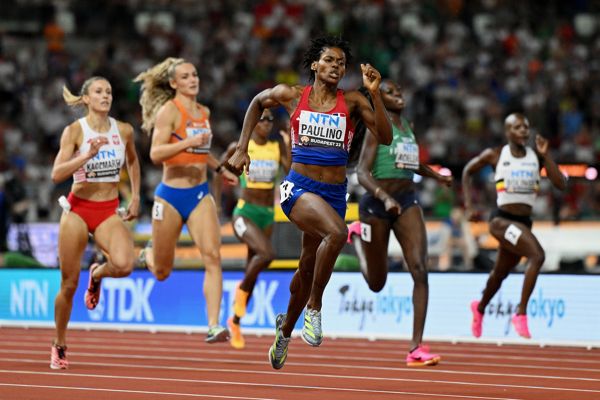
BUDAPEST — With 200 metres remaining, Marileidy Paulino was last. That detail will make the replay more interesting than the race itself felt to anyone following the splits.
The reigning Olympic and world champion reached the halfway mark of Sunday’s 400 metres having allowed the field to move ahead—not through tactical error, but with complete confidence that she would catch them. She did. By the time Paulino entered the straight, the question was no longer whether she would win the women’s 400 metres at the inaugural World Athletics Ultimate Championship, but whether anyone could remain within sight of her.
Henriette Jæger of Norway finished second in 49.28 seconds. Paulino stopped the clock at 49.07 and kept walking.
That performance punctuated a three-day championship that World Athletics created around the premise that the sport’s best athletes deserve a showcase matching their ability—and a $10 million prize pool to match. The inaugural edition, held at Budapest’s Gyula Zsivótzky National Athletics Centre, delivered an opening weekend filled with performances that strengthened the case for the new format.
Kenny Bednarek made that argument loudest. The Reading, Pennsylvania native had entered Saturday’s 100m having never won an individual global title — two Olympic 200m silvers in consecutive Games, a career defined by strong finishes that fell just short. He ran 9.85 to win the 100m, crossing first ahead of Oblique Seville of Jamaica, then returned Sunday to win the 200m. He is the first American man in decades to hold both sprint titles at the same global championship. “It just proves that I’m capable of doing it,” he said.
The 100m was the proof that the 200m confirmed. At major championships, Bednarek had generally been treated as the 200m specialist who happened to enter the shorter event. That framing does not survive Saturday’s result. He beat a final that included former world champion Christian Coleman at 9.94, and he now holds both sprint titles with the season still unfinished.
Melissa Jefferson-Wooden had established the American sprint template earlier in the weekend, and not by a comfortable margin. Her 10.62 in the women’s 100m — the world lead for 2026, run into a -0.2m/s headwind — is joint seventh in the all-time lists, according to World Athletics. Julien Alfred of Saint Lucia, the reigning Olympic champion, took second in 10.74. Sha’Carri Richardson ran 10.76 for third. The margin between Jefferson-Wooden and the Olympic champion was not the headline. The 10.62 was.
The men’s 400m was the one event where the American sprint programme yielded across disciplines. Collen Kebinatshipi of Botswana ran 43.39, leading Rai Benjamin of the United States at 44.15 and Jereem Richards of Trinidad and Tobago at 44.23. Kebinatshipi’s time ranks among the fastest 400m performances of the 2026 outdoor season globally.
The championship opened Friday with the mixed 4x100m relay — the format’s structural novelty, bundling individual stars into team competition on the same programme. The United States ran 39.64, Jamaica took second in 39.72, Great Britain third in 40.26. The relay worked as a curtain-raiser. What Saturday and Sunday produced stood on its own.
Track and field has spent years building arguments for why casual audiences should pay attention outside of Olympic cycles. The World Athletics Ultimate Championship is the most direct version of that argument: reduce the field, concentrate the talent, put the sport’s largest prize pool in one stadium. The inaugural edition gave the format evidence. Whether Bednarek’s sprint double becomes the story the competition references for years — whether Paulino’s come-from-behind 400m becomes the image in the highlight reel — is still being decided. One weekend is enough to start with.